The Bullroarer Atlas

NA-S1952-016 - secondary catalog

Tanaina / Dena'ina

United States - Alaska - Mackenzie-Yukon edge - North America

Sacred / spirit

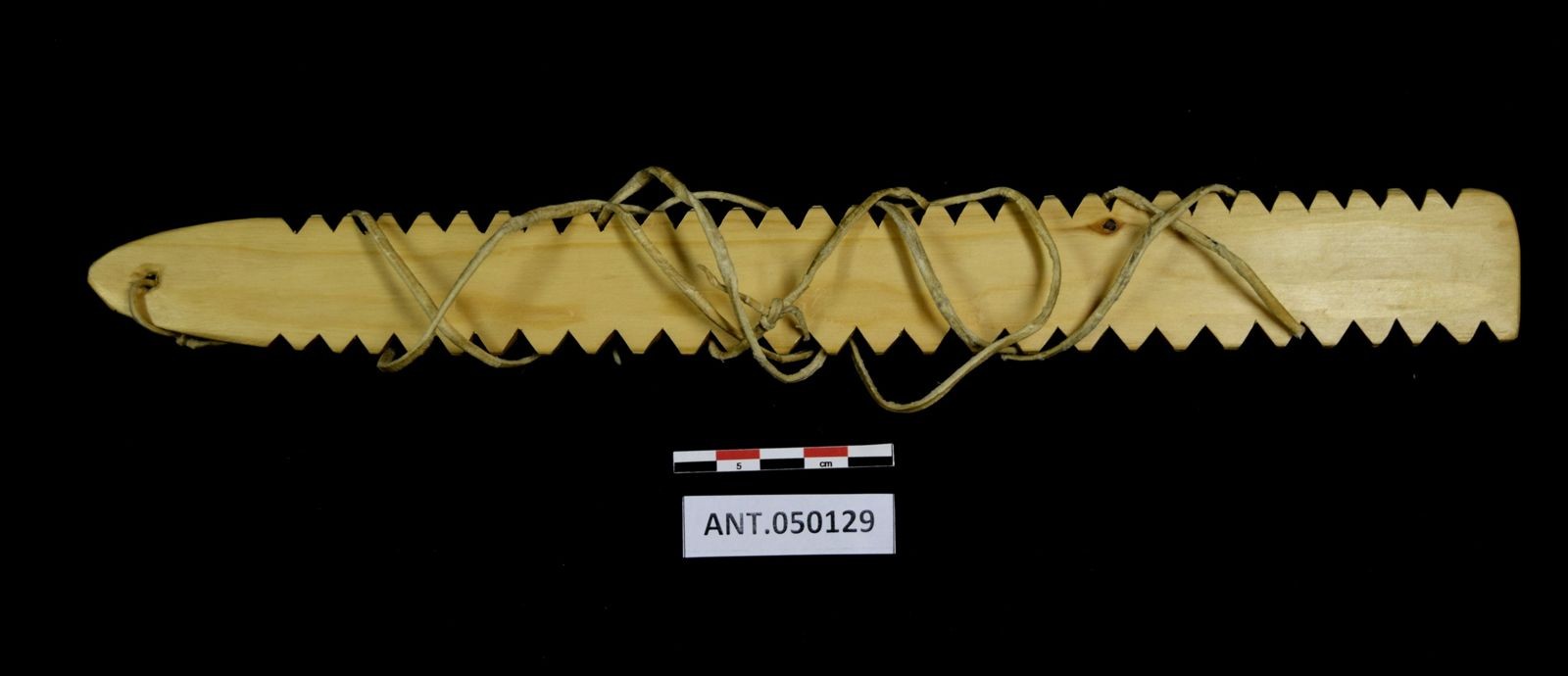
A broad, oar-like wooden blade paired with a slender separate handle stick, the two joined by a length of cord - a Nuu-chah-nulth bullroarer in...
Representative image. A broad, oar-like wooden blade paired with a slender separate handle stick, the two joined by a length of cord - a Nuu-chah-nulth bullroarer in Berlin's Ethnologisches Museum, shown for the general Northwest Coast form since no photograph survives of the Tanaina/Dena'ina instrument once listed here with shamanic curative properties. Ethnologisches Museum (IV A 1488) CC BY-NC-SA Image source

Source term: bullroarer

Among the Tanaina (Dena'ina) of the Cook Inlet country in south-central Alaska, the bullroarer once served the shamans as a curing instrument. By the time Theodore Seder surveyed North American parallels to Old World instruments in 1952, this use was already in the past tense, recorded as a former practice and set beside the still-living shamanic gear of the Tanaina, such as the "devil stick" used to drive out the evil producers of physical ailments and spells. Seder's note is the whole of the record here; no description of the object itself survives with it.

In North America, the bull-roarer has curative properties among the shamans of the Diegueno, Mono, Navaho, Tonto Apache, Yokuts, Pomo, and Papago; formerly this was also true of the Tanaina.

Seder 1952, "Old World Overtones in the New World," University Museum Bulletin (Penn Museum)
Object
Formerly listed with shamanic curative properties
Map confidence
low_medium - regional_anchor: Former-use statement; broad Cook Inlet/Dena'ina regional anchor only
Source location
51-54

View source Open this point on the interactive map