Atlas Essay —
Mantiki
Central Australia · the Western Desert · the Kimberley coast of Western Australia
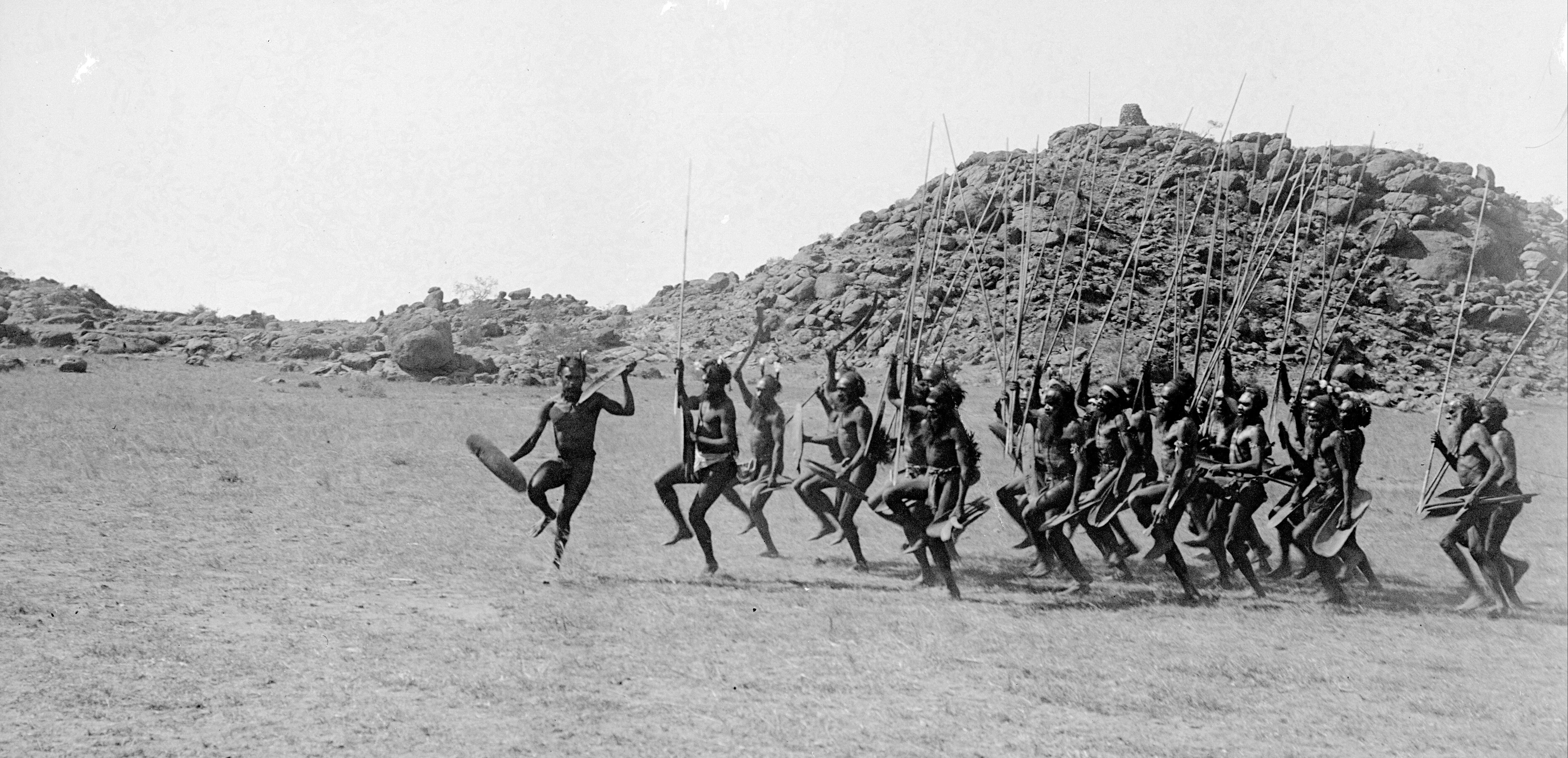
West of Alice Springs, in Central Australia, a young man whose beard has come in is handed a small bullroarer. Its Luritja name is mantiki. He swings it when he wants the girl promised to him. Some thirteen hundred kilometres to the north-west, at Beagle Bay on the Kimberley coast of Western Australia, the Nyulnyul called the small sacred board mandaki, and their word for a love spell is the same word swung.
One name for the small bullroarer, mantiki, mandagi, mandargi, mandaki, runs from Central Australia across the desert to the Kimberley coast, and along most of its length the board it names is swung for a woman.
In brief
- Carl Strehlow, at Hermannsburg in 1908, gives Luritja mantiki for the small bullroarer a young man swings for his promised bride.
- Hermann Klaatsch, at Beagle Bay in 1906, heard mandeken or mandaka for the small sacred boards, “the father of the large one”. Strehlow’s editor linked the two words in print in 1908.
- Géza Róheim in 1945 gives Luritja mandagi and Nyulnyul mandeken side by side; a missionary dictionary of 1953 adds Walmajarri mandargi from the Great Sandy Desert between them.
- Nyulnyul mandakidkid is a love spell made by swinging the small board, and the Nyulnyul boards often carry an engraved woman.

The beard and the board
Hermannsburg is a Lutheran mission on the Finke River, west of Alice Springs in the Northern Territory of Australia. Its missionary, Carl Strehlow, worked there among Aranda speakers and their Luritja-speaking neighbours from the desert to the west, and in 1908 he described the boy’s road to manhood among the Luritja. One stage of it is marked by the beard:
“When the young man’s beard grows, he is given a small bullroarer (mantiki), which he swings when he wishes to marry his promised girl.”
C. Strehlow, Die Aranda- und Loritja-Stämme in Zentral-Australien II (1908), p. 82; translated from German.
The same board runs through the rest of Strehlow’s Luritja volumes. A conception spirit throws a small bullroarer at a woman, and the mantiki enters her and takes the form of a child. A song begins Mantakina wonka, “the small bullroarer whirrs”. Novices are charged that they must never lose their mantiki, and never show them to children or women. Messengers sent to call up a war party carry one under the arm.
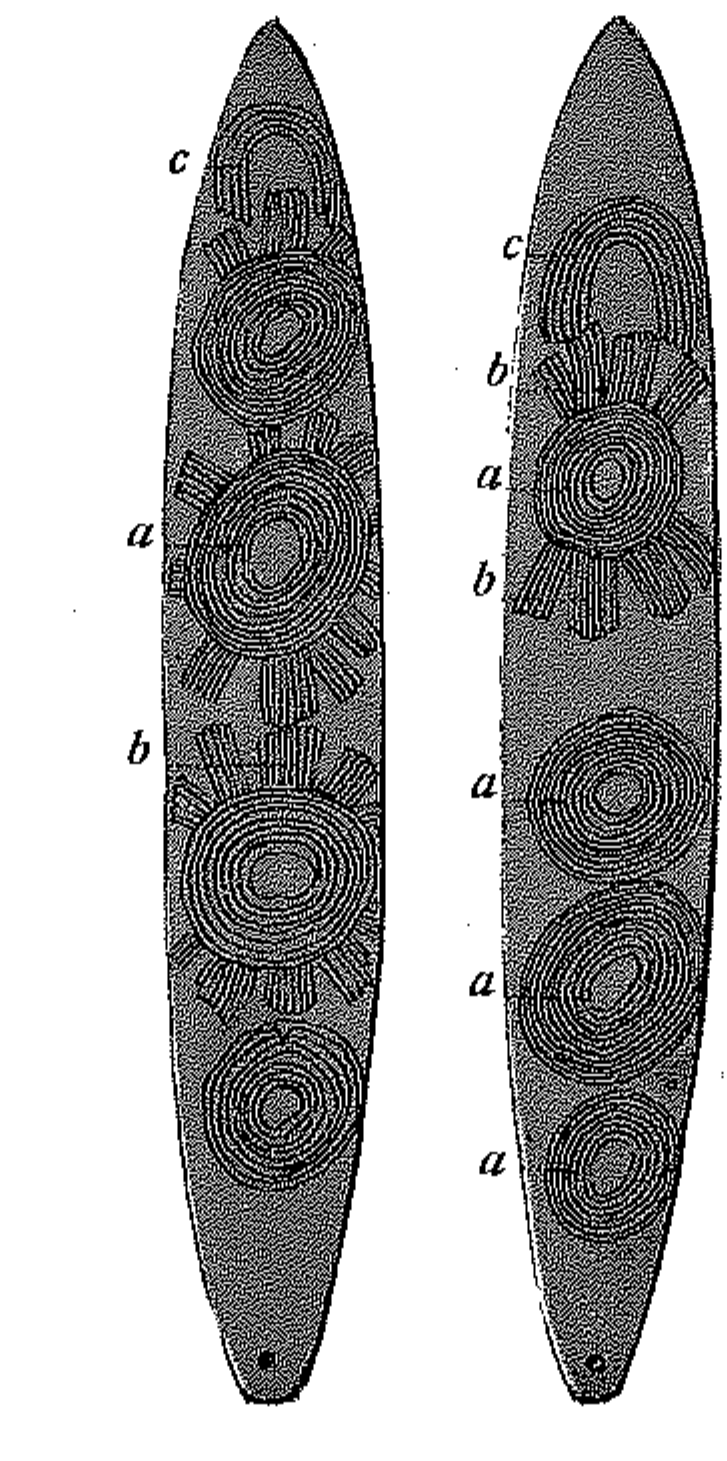
In Aranda the same small board is namatuna. Strehlow says so directly: mantiki is the Aranda namatuna. The board on Plate III is one of these. Its engraving is the totem’s story: the pods of the tnaueria fruit, the camps where the tnaueria women sat, and one of those women, seated.
Géza Róheim, who worked with Aranda and Luritja men in 1929, heard how the small board gets its power. Knatata, a man of the honey-ant totem at Hermannsburg, told him what the novices are told when it is put in their hands: “For the woman’s road don’t take it. When you whirl it, you keep to the thick scrub only.” Róheim adds that the namatuna used for love magic receives its power from blood drawn at subincision. Among the Aranda generally, he was told, the small love-bullroarer had first belonged to the women of the Dreaming, and only later passed to men.
Mandaki at Beagle Bay
Beagle Bay lies on the Dampier Peninsula, north of Broome, on the Kimberley coast of Western Australia. The German anatomist Hermann Klaatsch stayed among the Nyulnyul there in his Australian travels of 1904 to 1907, and the men showed him their sacred boards. He wrote down two words:
“The small churingas are called ‘Mandeken’ or ‘Mandaka’, the large ones ‘Mirnbor’ or ‘Minbor’.”
H. Klaatsch, Zeitschrift für Ethnologie 39 (1907), p. 648; translated from German.
A man named Merimba told him how the two were related. Mandeken ibaldien Mirnbor: “the small sacred wood is the father of the large one.”

A year later, Strehlow’s editor in Frankfurt, Moritz von Leonhardi, read Klaatsch’s list beside the Luritja material from Hermannsburg. Under the word mantiki he added a note: it is “linguistically certainly related” to mandeken or mandaka, the name Klaatsch had recorded at Beagle Bay for the small bullroarer. The two ends of the name were joined in print in 1908.
The Pallottine missionaries Hermann Nekes and Ernest Worms, who spent decades at Beagle Bay, filled in the Nyulnyul side. Their dictionary, as William McGregor gives it in his grammar of Nyulnyul, defines mandaki as a small tjuringa, “often with engraved female figure”, and mandakidkid as a “love spell with swinging of small tjuringa”. The engraved woman on the board, and the swinging for a woman, are both here, on the coast.
Later the Nyulnyul tied the mandaki to a newer ceremony. In the 1920s a cult of the Dreaming being Djanba reached Dampier Land, the peninsula around Beagle Bay, carried up through the desert from Aranda country in Central Australia. Klaatsch had already heard the word there some fifteen years before.
Across the desert
Between Hermannsburg and Beagle Bay lie the Western Desert and the Great Sandy Desert. Nekes and Worms set the name’s other forms out themselves, with the Walmajarri of the Great Sandy Desert in the middle: mandargi and mandargin, “small tjuringa”. Next to it they put mandurgal, a magic string, in Mangala and Walmajarri in the desert and Yawuru on the coast at Broome, and they proposed that the root meant “hidden, covered, secret”.
Róheim, writing in 1945, laid out the same span from his own fieldwork and reading:
“The bull-roarer is called mandelprindi by the Murngin, mandeken by the Niol-Niol, and mandagi in the group of Luritja speaking tribes with which I worked.”
G. Róheim, The Eternal Ones of the Dream (1945), p. iv.
The Murngin live in Arnhem Land, on the far north coast of Australia.
In the body of the book he names the small whirled love-magic board twice over: Aranda namatuna, Luritja mandagi. Among the Pitjantjatjara to the south, boys learn after subincision that the bullroarer is made by men, “not only for the purpose of frightening the women but also … for the purposes of love magic.”
From Wiluna, on the western edge of the desert in Western Australia, comes a small pierced charm with a standing woman engraved on it. Someone has written on it in capitals: “MANTITJA LOVE CHARM WILUNA”.
The board that calls a woman
From Hermannsburg to the Kimberley coast, the name and the office travel together. At one end a Luritja youth with a new beard swings his mantiki for his promised girl, and at Hermannsburg Knatata warns Aranda novices away from the woman’s road. At the other a Nyulnyul man works a mandakidkid with a small board on which a woman has been cut. Between them the Walmajarri say mandargi, and a love charm from Wiluna is labelled mantitja.
Mantiki. Mandagi. Mandargi. Mantitja. Mandaka. Mandeken. Mandaki.
Key sources
- Carl Strehlow, Die Aranda- und Loritja-Stämme in Zentral-Australien, ed. M. von Leonhardi, II (1908) pp. 60, 80–82 and fig. 1; III.2 p. 47; IV.1 pp. 54, 60; IV.2 p. 12.
- Hermann Klaatsch, “Schlussbericht über meine Reise nach Australien in den Jahren 1904–1907,” Zeitschrift für Ethnologie 39 (1907): 635–690, pp. 648, 652.
- Géza Róheim, The Eternal Ones of the Dream (1945), pp. iv, 11–14, 83–84, 175, 234.
- Hermann Nekes and Ernest A. Worms, Australian Languages (1953), p. 684, as given in William B. McGregor, A Grammar of Nyulnyul (2011), pp. 24–25, 793–794.
- Woolley & Wallis, sale of 21 February 2018, lot 672: a love charm inscribed “Mantitja love charm Wiluna”, 11.6 cm.