No. CROVETTO1968-001
Mbyá-Guaraní waimí kerambú bamboo bullroarer, Misiones
Argentina · Misiones · South America · Southern Cone
Play / practical
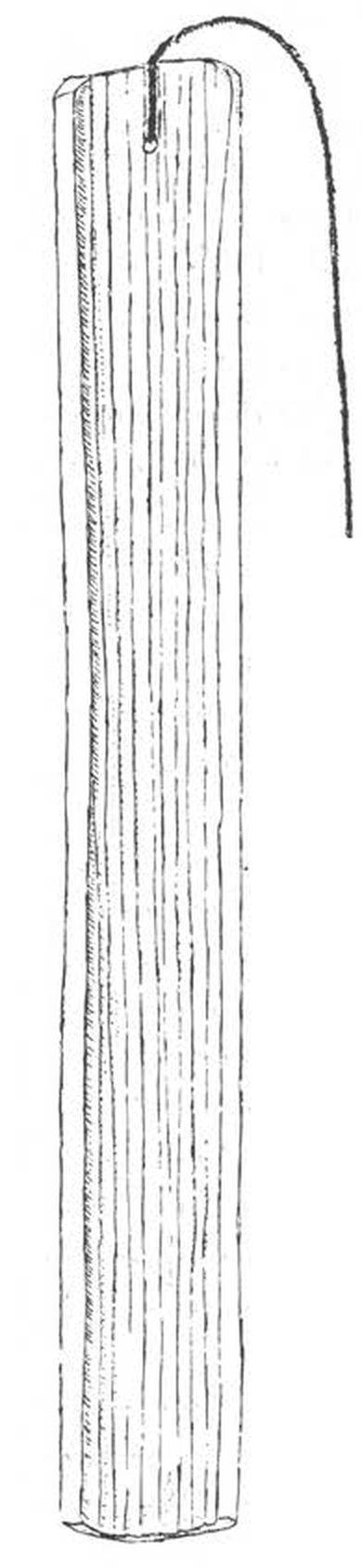
waimí kerambú
Source term: palo zumbador; first of two toys called waimí kerambú
waimí kerambú = 'vieja roncadora' (old snoring woman); applied to both the corded blade and a twist disc.
The Mbyá of the Misiones forest cut this roarer from a bamboo internode and named it waimí kerambú — 'the old snoring woman.' A slat of takuára some twenty centimetres long, pierced at one end and whirled on two metres of cord, it gave a deep, loud hum; Martínez-Crovetto, recording Mbyá games in the 1960s, is emphatic that men and boys made it solely to amuse the smallest children. The same name covered a second humming toy, a twist-spun disc cut from a gourd.
"Waimí kerambú" quiere decir "vieja roncadora" y los dos elementos que hemos descripto, conocidos bajo este nombre, se utilizan como juguetes y no como instrumentos musicales.
'Waimí kerambú' means 'old snoring woman', and the two objects described under this name are used as toys, not as musical instruments.
Martínez-Crovetto, 'Juegos y deportes de los indios guaraníes de Misiones,' Etnobiológica 6 (1968), p. 18.
Particulars
- Object
- Bamboo (takuára/takuarusú) lamina about 20 by 3 cm, perforated at one end and spun from a cord about 2 m long.
- Function
- Made by men and boys solely to amuse younger children; explicitly a toy, not a musical instrument.
Source
Raúl Martínez-Crovetto, 'Juegos y deportes de los indios guaraníes de Misiones (República Argentina),' Etnobiológica 6 (1968), p. 18 and fig. 3A