No. NAMER-014
Ingalik (Deg Hit'an)
United States (Alaska) · Deg Hit'an (Ingalik) territory, lower Yukon and Innoko rivers, Anvik-Shageluk-Holy Cross region, interior Alaska · North America · Subarctic
Play / practical
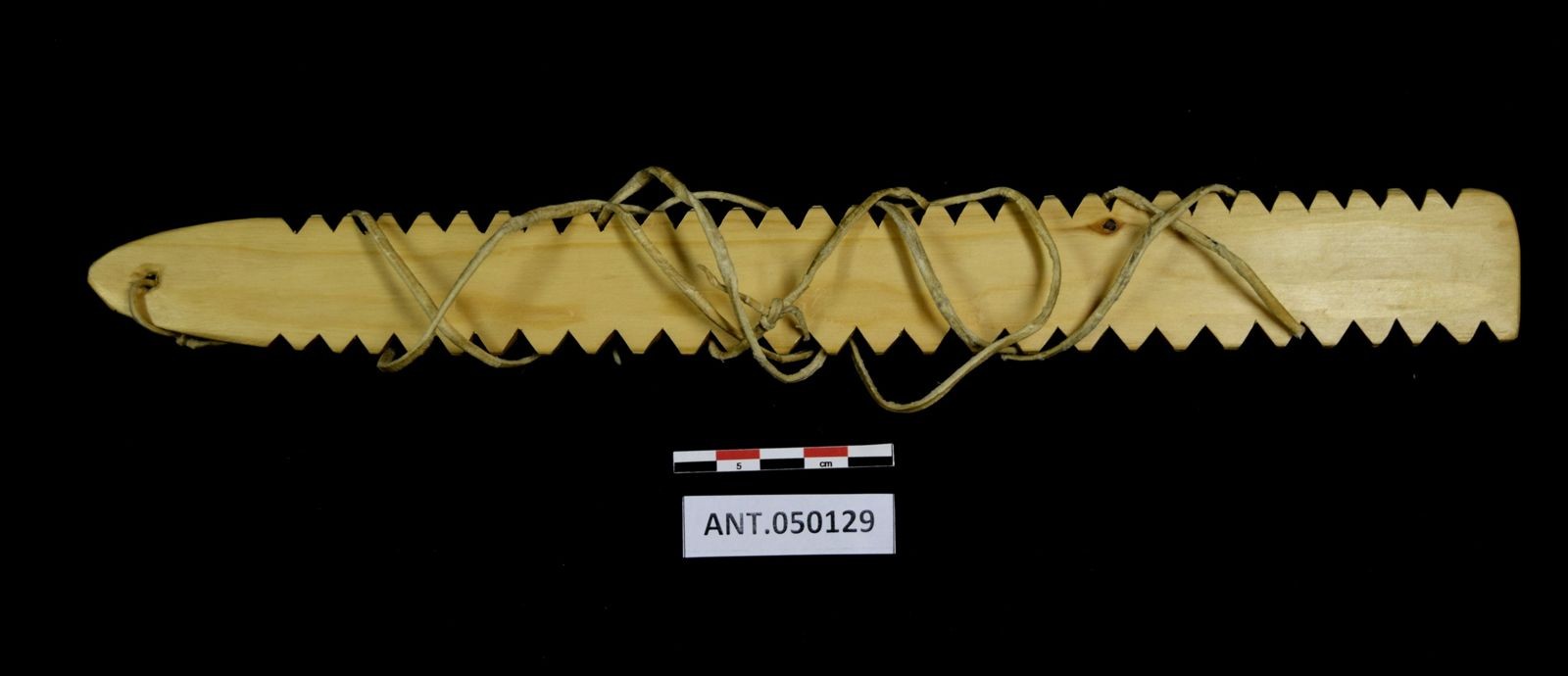
Source term: bull roarer
Among the Deg Hit'an (Ingalik) of the lower Yukon, the bull roarer was a boys' toy. Cornelius Osgood, working out of Anvik in the mid-1930s, described it as a narrow strip of spruce about a foot long with serrated edges, pierced at one end so a six-foot rawhide line could be tied through it; a boy would whip it around his head to raise a loud burr. One such roarer, made at Anvik by Billy Williams, survives in the Yale Peabody Museum. In this corner of subarctic Alaska the roaring slat belonged to the boys.
Made of spruce wood with a rawhide line attached at one end. Used only as a toy by small boys. Made by Billy Williams at Anvik, Alaska.
Yale Peabody Museum, Division of Anthropology, catalog record YPM ANT 050129, "Bull Roarer" (Deg Hit'an, Northern Athapaskan).
Particulars
- Object
- A narrow strip of spruce about a foot long with serrated edges, pierced at one end where a roughly six-foot babiche (rawhide) line is fastened, whipped around the head to produce a loud burr.
- Function
- A boys' noisemaking toy: a serrated spruce slat whirled on a long rawhide cord.
Source
Cornelius Osgood, Ingalik Material Culture, Yale University Publications in Anthropology No. 22 (New Haven: Yale University Press, 1940), describing a boys' spruce bull roarer on a babiche line; an associated specimen survives as Yale Peabody Museum of Natural History, Division of Anthropology, catalog YPM ANT 050129 (Deg Hit'an, Northern Athapaskan; bull roarer made by Billy Williams at Anvik, Alaska). Osgood wording also quoted in F. Riede, S. Lew-Levy, N. N. Johannsen, N. Lavi & M. Andersen, "Toys as Teachers: A Cross-Cultural Analysis of Object Use and Enskillment in Hunter-Gatherer Societies," Journal of Archaeological Method and Theory 30 (2023)