No. GIFFORD1936-001
Lightning zigzag and Skatakaamcha's heart
United States · Northeastern Yavapai country, Cleator–Turkey Creek, Bradshaw Mountains, central Arizona · North America · Southwest
Sacred / spirit
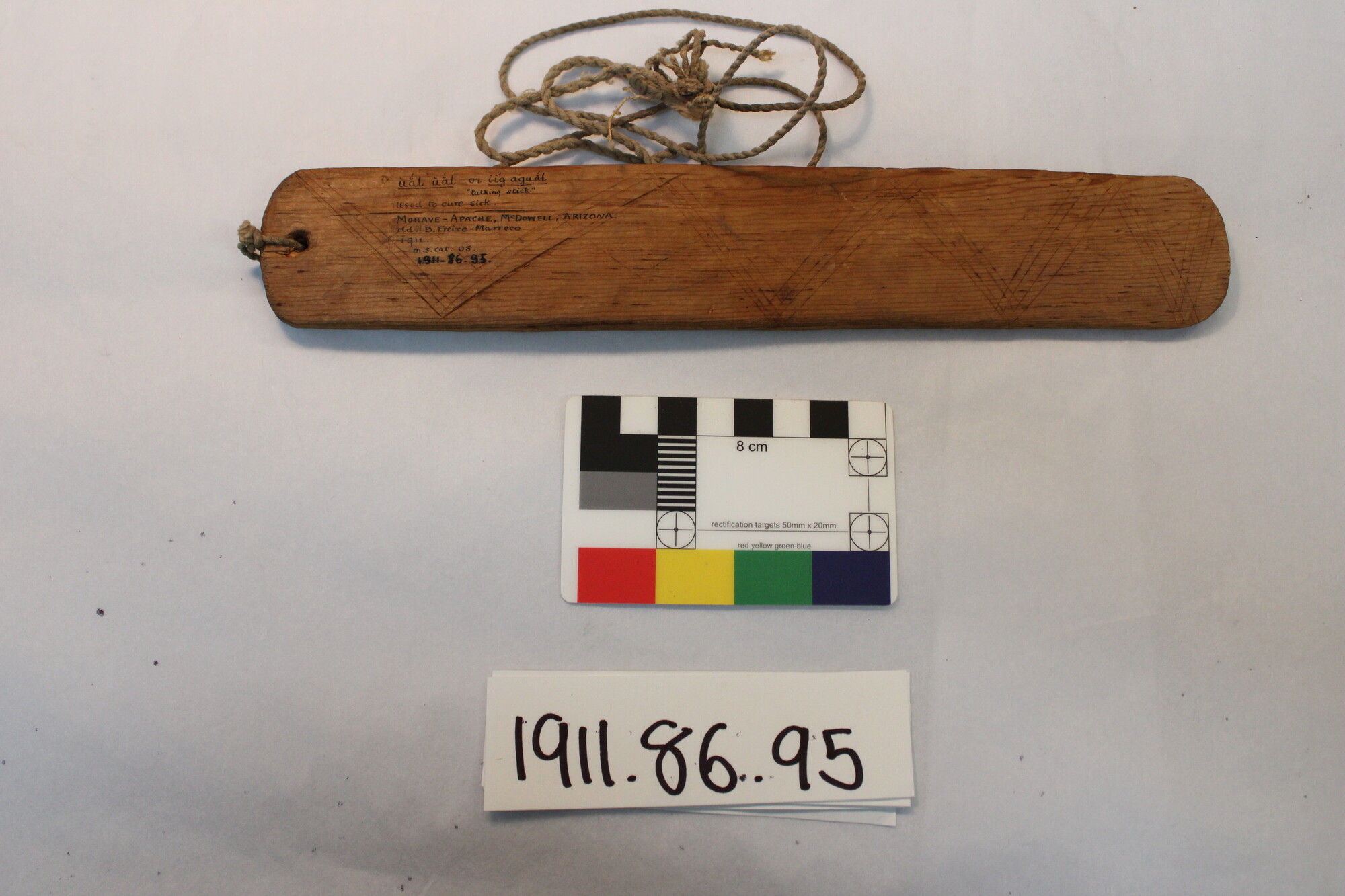
i'ikwauwa
Source term: bullroarer
It was cut from a pine that lightning had struck, and painted to say so. Amuukyat, an aged, blind Northeastern Yavapai shaman whom Gifford interviewed in the Cleator and Turkey country of central Arizona in 1932, had an i'ikwauwa nine inches long and an inch and a quarter wide, one end square and one rounded, a forty-inch buckskin cord through the square end. Its whole surface was painted with white earth, a red zigzag ran down one face for lightning, and on the other an X stood for the heart of the god Skatakaamcha. Northeastern Yavapai shamans swung the bullroarer secretly at night before sucking a patient in the morning, calling Skatakaamcha or an akaka' to help. Summoned to a sick person, Amuukyat whirled it to send his power ahead, then followed with it and swung it outside the house; if cloud, lightning and thunder rose in the east, the patient would recover. By 1932 he had put it aside.
Also swung bullroarer in public demonstrations. On one such occasion cord broke. Shaman declared bullroarer had gone to sky, but it fell near man in audience who later gave it to nonplussed shaman.
Gifford, Northeastern and Western Yavapai (1936), p. 309.
Particulars
- Object
- Bullroarer (i'ikwauwa) of lightning-struck pine, 9 inches long and 1.25 inches at its widest, one end square and one rounded, on a 40-inch buckskin cord through the square end; surface painted with white earth, a red zigzag down one face for lightning, and an X on the other for the god Skatakaamcha's heart.
- Function
- A shaman's curing instrument: swung secretly at night before a morning sucking cure to summon Skatakaamcha or an akaka', whirled to send the shaman's power ahead to the patient, and sounded again outside the sick person's house.
Source
E. W. Gifford, 'Northeastern and Western Yavapai,' University of California Publications in American Archaeology and Ethnology 34(4) (1936), pp. 289 and 309