Atlas Essay —
Mero-Mero
Western Australia · southern Papua New Guinea · eastern Peru
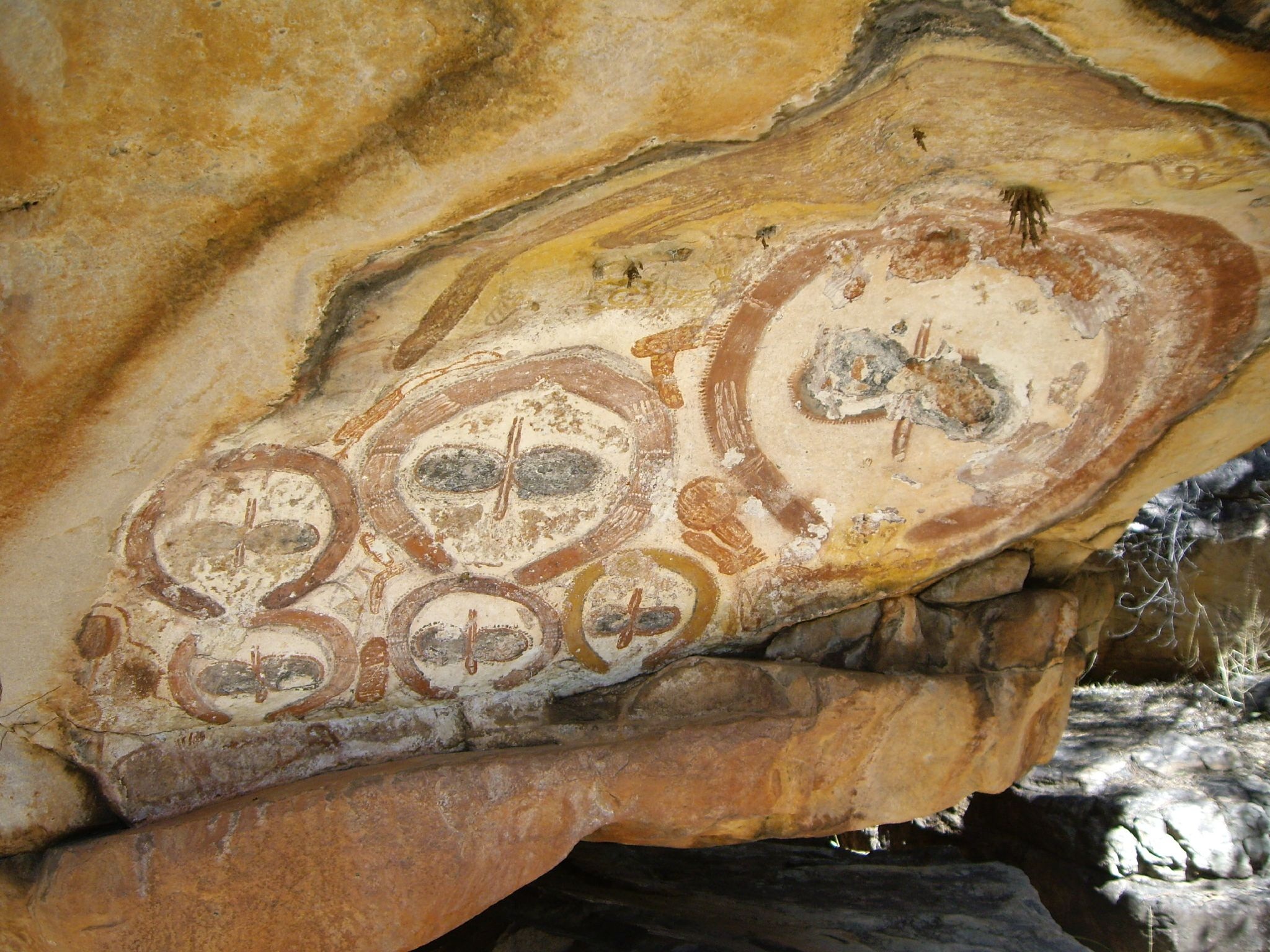
In Western Australia, a bullroarer could be called Meroo, Mirudi, Meerudi, Mirroodee or mero-mero. The spelling changes with each person who wrote it down, from the Murchison district north toward the Kimberley, but the sound stays. North of Australia, the Nen of southern Papua New Guinea call one kind of bullroarer mérmér. On the far side of the Pacific, in the forests of eastern Peru, an Asháninca toy that sings as it turns is called meromero.
A family of bullroarer names runs through Western Australia. A similar name, mérmér, belongs to a bullroarer in southern Papua New Guinea, and the same four syllables, meromero, name a turning wooden toy in eastern Peru.
In brief
- Sources from 1886 onward give Meroo, Mirudi, Meerudi, Mirroodee and mero-mero for bullroarers in Western Australia, Australia, from the Murchison district north to the Kimberley.
- The Nen of southern Papua New Guinea name one bullroarer mérmér, distinct from their general meyang. Its vowel sits close to “i”, so the word sounds roughly like “mirmir”.
- Among the Asháninca of eastern Peru, meromero is a wooden toy that sounds like a small spotted cat as it turns. Adults also used it to warn small children that a jaguar was coming.
- Sacred instruments in Papua New Guinea and Brazil share concrete features. In 1997, Nekeni listeners in Papua New Guinea recognized recordings from Brazil, and some sang along.

Meroo in Western Australia
Begin on the western side of Australia, enlarged on the map above. North of Perth, the Murchison River and its tributaries cross dry country to the Indian Ocean. Farther north, past the Pilbara, lies the Kimberley. Across that stretch the name appears in an exhibition list, an account of a Kimberley initiation, two museum blades and Daisy Bates’s vocabulary questionnaires.
The earliest written witness is a single line. In 1886, Charles George Nicolay’s Notes on the Aborigines of Western Australia gave the entry:
“Signal meros. Mero mero.”
Nicolay, Notes on the Aborigines of Western Australia (1886), p. 16. Original page.
The objects listed around it come from Geraldton, Northampton and the Murchison. This entry has no place of its own and says nothing about how the object was sounded. Even so, the doubled form was already in a Western Australian collection by 1886, a year before Hardman presented his paper.
E. T. Hardman describes the instrument itself, in the Kimberley. At the initiation of boys, a thin flat stick was whirled rapidly and gave out a heavy booming sound. He calls it mero-mero. The roar hid the boys’ cries, and women were kept away from its source. Hardman presented his account to the Royal Irish Academy in January 1887. He had not seen the ceremony; it had been described to him.
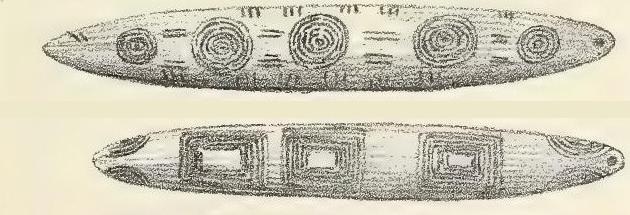
Two carved blades in the Musée du quai Branly in Paris, France, carry the name Meroo. They are recorded only as Western Australian, with no narrower community. At 22.7 and 24.5 centimetres, they fit in the hand.
Bates’s papers tie the word to particular speakers. Wajida, identified with the Waianwonga, gave Mirudi. Bilbil’s information from Ngabbaroo, at Lake Mibbeean in the Peak Hill district, gives Meerudi. Kondebomur of Meega, on the Sanford River in the Murchison, gave Mirroodee.
| Name | Place or attribution | Source |
|---|---|---|
| Mero mero | Western Australia; precise community unspecified | Nicolay 1886, p. 16 |
| mero-mero | Kimberley, north-western Australia | Hardman, p. 73 |
| Meroo | Western Australia; precise community unspecified | Quai Branly, 71.1887.17.23–24 |
| Mirudi | Wajida, Waianwonga | Bates, folio 54/199 |
| Meerudi | Bilbil, Ngabbaroo/Lake Mibbeean, Peak Hill district | Bates, folio 55/25 |
| Mirroodee | Kondebomur, Meega, Sanford River | Bates, folio 54/71 |
The same vocabularies separate the roarer from a longer sacred board, Yinma or Yeenma. At the Sanford River, Kondebomur’s Mirroodee could signal that an emu had been killed. The entries record more than variant spellings. They name different kinds of board and the occasions for each. The larger board has its own essay, The Yeenma Isogloss.
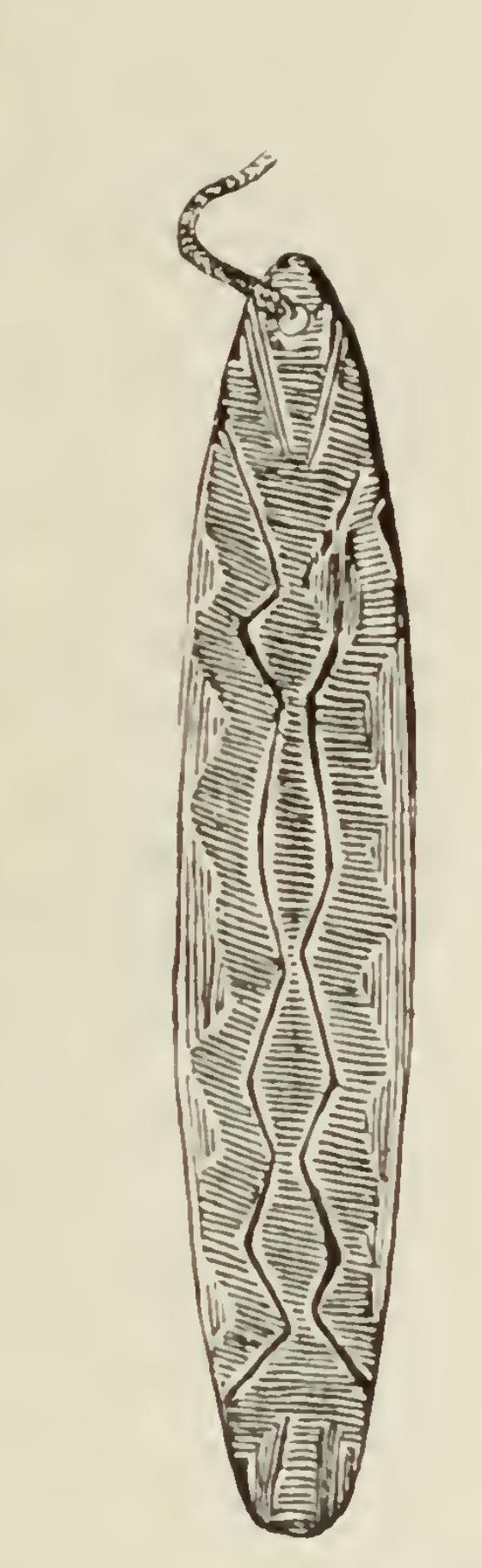
No single linguist standardized these spellings. Different people wrote them down, years apart. Read together, Mirudi, Meerudi and Mirroodee are nearly the same word, and Meroo and the doubled mero-mero are very close to them. Before the map leaves Australia, it already shows a family of names.
Mérmér in Papua New Guinea
Move north-east on the map, to the Morehead region of southern Papua New Guinea. Nen is spoken around Bimadbn, also written Bimadeben, inland from the south coast. Nicholas Evans’s dictionary records a rich vocabulary of bullroarers, their owners and the plants used to make them.
The general instrument is meyang, also called är bolo, “old man.” Particular types belong to particular clans or peoples. Agalsge belongs to the Seregu clan, giñgiñ meyang to the Kiembturer people, and basolsge is made from the basol plant. Among them Evans lists mérmér, a bullroarer of a different kind from meyang.
The spelling misleads an English reader. In Nen, é is a short vowel, high and central, closer to “i” than to the English “e”, and the r is trilled. Mérmér sounds roughly like “mirmir.” It shares the doubled m–r frame of mero-mero, but not every Australian vowel or syllable. The dictionary marks it as a separate instrument without recording its size or pitch.
Torres Strait separates northern Australia from southern New Guinea; the Western Australian names lie thousands of kilometres farther south-west. Australia and New Guinea were once a single landmass, Sahul, and later history brought sea contact through Torres Strait. Their bullroarer traditions share much more than the shape of a word: hidden voices, ancestral beings, first owners, and the passage of boys into adult knowledge. The Atlas follows those threads in Two Voices and The Mother of All.
Within that shared world, mérmér offers a resemblance to the north of the Western Australian names. It keeps its own vowel and its own place among Nen instruments.
Meromero in Peru
The next point lies on the other side of the Pacific, in eastern Peru. Among the Asháninca, called Kampa in older sources, Günter Tessmann recorded a bullroarer called mēromēro. Adults used it to frighten small children with the warning that a jaguar was coming, and it was also a toy. This is a far longer reach from Western Australia. A shared name is weak evidence of a shared history on its own, because four syllables can match by chance. What makes meromero striking is everything the dictionaries record alongside it.
An Asháninca dictionary by Lee Kindberg brings the object vividly to life. It lists nomeromero and defines it as:
“My toy which, when it turns, sounds like a small spotted cat.”
Kindberg, Diccionario asháninca (1980), p. 115; translated from Spanish: “mi juguete que al girar suena como tigrillo.” Original page.
Words for possessions like this are cited with a first-person n- or no-, so the noun itself is meromero. A second entry, on page 38, calls it a wooden whistling toy. Together the two entries record the turning object, its material and the cat-like call a listener was meant to hear.
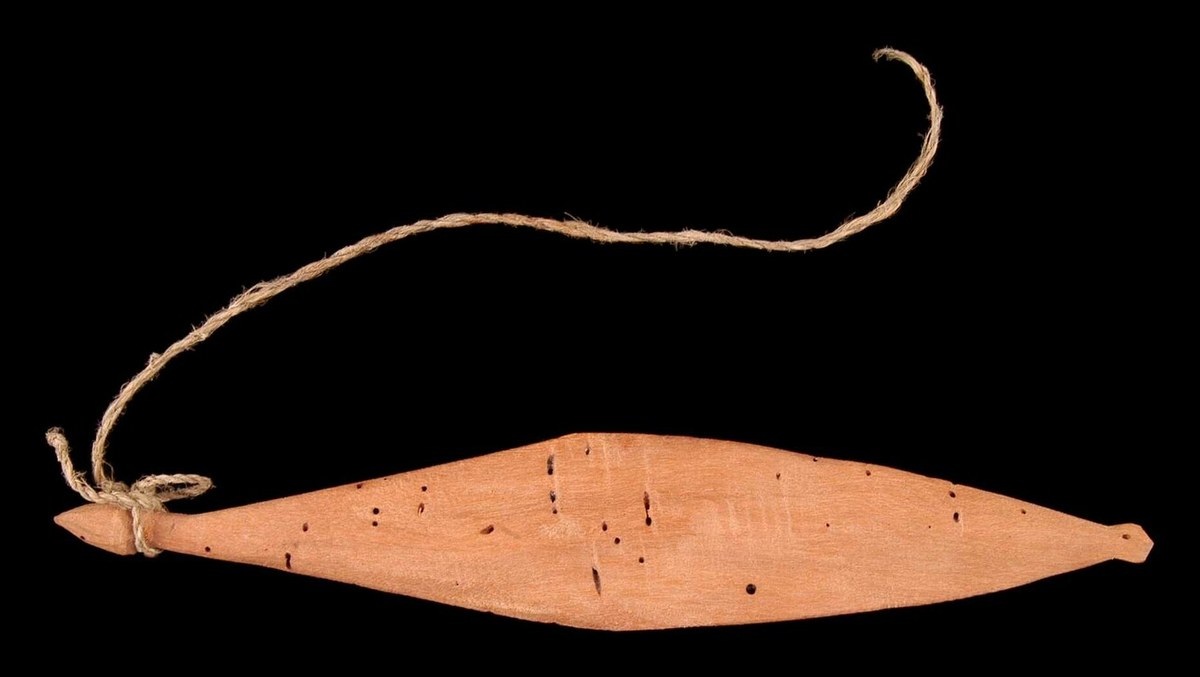
A neighbouring people in Peru make a jaguar call with a similar board, under another name. Betty Snell’s Matsigenka dictionary describes koroshi, a small rhomb-shaped board, about twelve centimetres long, with a cord through its upper point. Turned fast, it sounds like a jaguar: jirón jirón jirón. Mothers warn children not to make it call the cat.
In Asháninca meromero, the four syllables of Hardman’s Kimberley word name a turning wooden sound-maker on the far side of the Pacific. In the Kimberley the roar hid the cries of initiated boys. In Peru the toy calls a small cat and warns small children. The name and the turning wooden board match, but their uses differ.
Across the Pacific
The name is not the only resemblance between the two sides of the Pacific. Terence Hays compared the sacred-flute cults of the Papua New Guinea Highlands with South American myths of women’s former rule, in Deborah Gewertz’s Myths of Matriarchy Reconsidered (1988). Thomas Gregor and Donald Tuzin’s Gender in Amazonia and Melanesia (2001) brought together a wider comparison: ancestral voices, secret instruments, the initiation of boys, and stories that women once owned the cult.
Robert Reigle tested the comparison by ear. In 1997 he played recordings of the Enauené-Naué of Brazil to Nekeni listeners around Serieng, in Papua New Guinea. Visitors from four villages heard resemblances, and some sang along. Nekeni men also barred women from seeing photographs of the Brazilian instruments, applying their own rule to another people’s sacred objects. Reigle compared the long split-tube voice modifiers of the two peoples, bamboo in New Guinea and reed in Brazil, each used to turn a human voice into a spirit’s. He also compared gourd instruments and ceremonial houses, and noticed another name resemblance: Nekeni tereri and Brazilian Arara tereret, both bamboo voice modifiers. The resemblances lie in sound and construction. Reigle also notes differences: Enauené-Naué women may see their instruments, unlike the women at Serieng. Reigle (2015), pp. 102–103 · archived.
People did cross that ocean. A 2020 genetic study found Indigenous American ancestry in eastern Polynesia and dated the early mixing to around 1200 CE. The closest match among its sampled American groups was in present-day Colombia. In 2024, fifteen ancient genomes from Rapa Nui (Easter Island, Chile) carried about one-tenth Indigenous American ancestry. The mixing was dated to 1250–1430 CE, and the strongest affinity was with Central Andean highland populations. Polynesians and Indigenous South Americans met and had children together before Europeans arrived in the Pacific. The genomes show that meeting, but they do not identify a particular landing in Peru or show which words travelled. Ioannidis et al. (2020); Moreno-Mayar et al. (2024).
The boards and their names
The names stay where they were written down. On the Sanford River in Western Australia, Kondebomur’s Mirroodee could signal that an emu had been killed. In the Kimberley, Hardman’s mero-mero boomed over boys at their initiation. Two Meroo blades, 22.7 and 24.5 centimetres long, are kept in Paris. At Bimadbn in Papua New Guinea, mérmér stands beside meyang, the “old man”, among boards owned by clans and named for plants. In eastern Peru, an Asháninca meromero turns, and a small spotted cat seems to call from the forest.
Meroo. Mirudi. Meerudi. Mirroodee. Mero-mero. Mérmér. Meromero.
Key sources
- C. G. Nicolay, Notes on the Aborigines of Western Australia (1886), p. 16. Original entry.
- E. T. Hardman, “Notes on some Habits and Customs of the Natives of the Kimberley District, Western Australia,” Proceedings of the Royal Irish Academy, third series 1, pp. 70–75, especially p. 73; paper read 10 January 1887. Original volume.
- Daisy Bates, vocabulary questionnaires: Wajida, Waianwonga, folio 54/199; Bilbil, Ngabbaroo/Lake Mibbeean, folio 55/25; Kondebomur, Meega/Sanford River, folios 54/68, 54/71. Wajida · archived; Bilbil · archived; Kondebomur · archived.
- Musée du quai Branly–Jacques Chirac, Western Australian blades, 71.1887.17.23–24. Collection.
- Nicholas Evans, Nen dictionary, Dictionaria 8 (2019), mérmér LX000790/SN002597 and orthographic introduction. Dictionary · archived; underlying data · archived.
- Günter Tessmann, Die Indianer Nordost-Perus (1930), p. 92 and pp. 99–100. Lee Kindberg, Diccionario asháninca (1980), pp. 5–6, 38, 115. Kindberg edition · archived.
- Betty A. Snell, Diccionario matsigenka–castellano (2011), pp. 233–234, koroshi.
- Deborah B. Gewertz, ed., Myths of Matriarchy Reconsidered (1988), especially Terence E. Hays, “Myths of Matriarchy and the Sacred Flute Complex of the Papua New Guinea Highlands,” pp. 98–120. Thomas A. Gregor and Donald Tuzin, eds., Gender in Amazonia and Melanesia (2001), chapters 1 and 13. Publisher text.
- Robert F. Reigle, “Mono- versus poly-genesis of music cosmologies in Amazonia and New Guinea,” Música em Contexto 9(1) (2015): 89–115, especially pp. 102–103. Article · archived.
- Alexander G. Ioannidis et al., “Native American gene flow into Polynesia predating Easter Island settlement,” Nature 583 (2020): 572–577. Article. J. Víctor Moreno-Mayar et al., “Ancient Rapanui genomes reveal resilience and pre-European contact with the Americas,” Nature 633 (2024): 389–397. Article.