No. LOEB1929-031
Havasupai rain bullroarer
United States · Grand Canyon · Havasupai · North America · Southwest
Weather / fertility magic
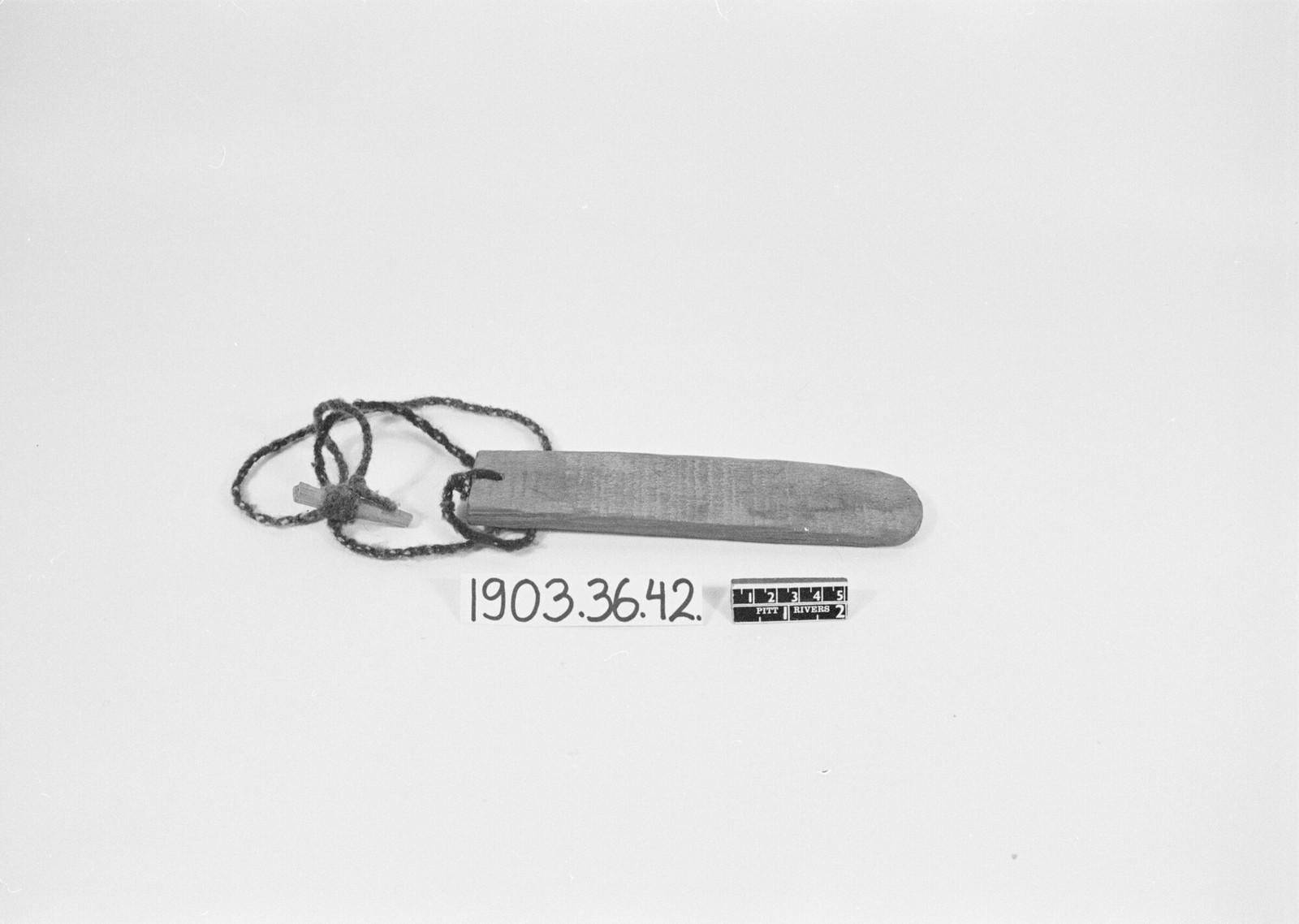
Source term: bullroarer
Among the Havasupai of the Grand Canyon, the bullroarer was associated with rain. The canyon people lived at the edge of the great secret-society country, and here, Edwin Loeb argued after Leslie Spier, the roarer kept its pull on the weather while shedding the sacred charge it carried among the cult-holding peoples beyond.
Thus the Havasupai, San Carlos Apache, and Papago associate the bullroarer with rain, while the Arapaho and the Klamath have an analogous use, to produce wind. Among the Gros Ventre and Paiute it is only a toy.
Loeb 1929, Tribal Initiations and Secret Societies, UCPAAE 25(3):284 (citing Spier, Havasupai Ethnography, AMNH Anthr. Pap. 29:290, 1928)
Particulars
- Function
- Loeb cites Spier that Havasupai associate the bullroarer with rain.
Sources
- Edwin M. Loeb, 'Tribal Initiations and Secret Societies,' University of California Publications in American Archaeology and Ethnology 25(3) (1929), p. 284 View · archived
- Leslie Spier, Havasupai Ethnography, Anthropological Papers of the American Museum of Natural History 29(3) (1928), p. 290, cited in Loeb (1929), p. 284