No. MUS2026-004
Tzi-ditindi, cut from lightning-struck pine
United States · Arizona · North America · Southwest
Weather / fertility magic
Source term: bull-roarer
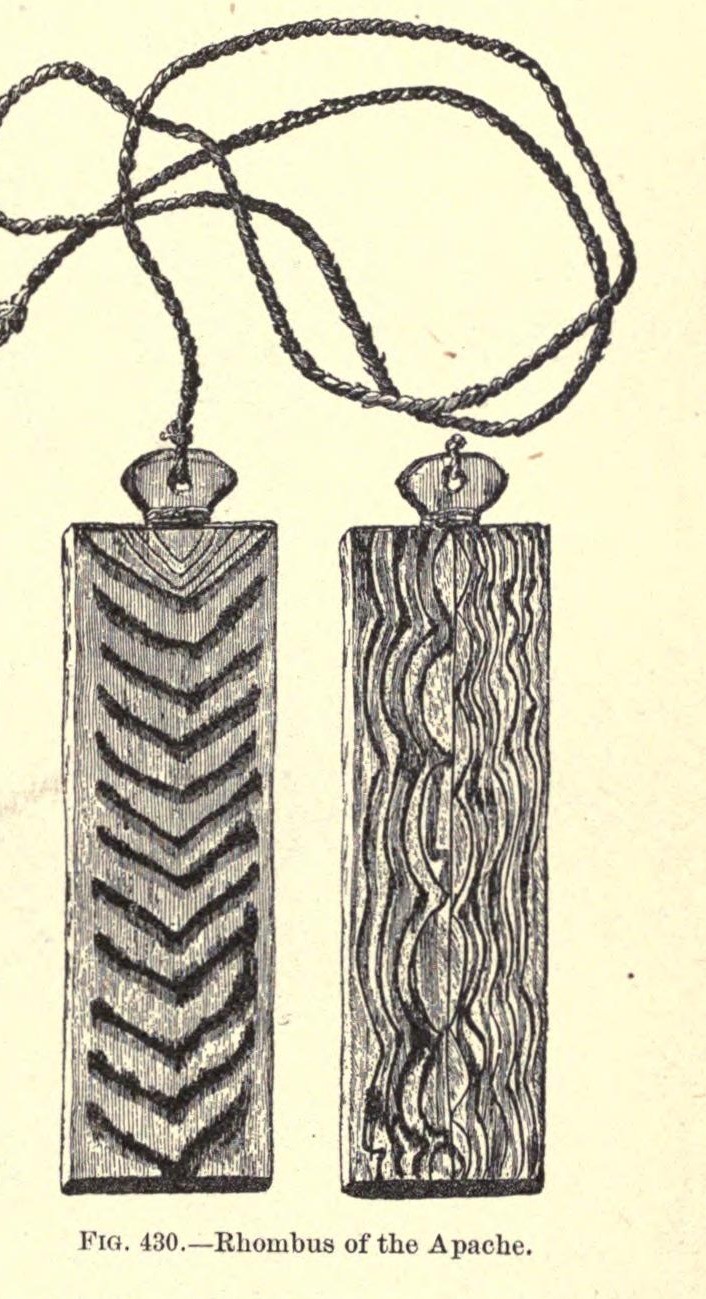
Apache medicine-men made their bull-roarer of pine or fir taken from a tree struck by lightning on the mountaintops, and called it tzi-ditindi, the "sounding wood." John Bourke, who studied the Apache during the campaigns of the 1880s, recorded that the lines incised on its faces were read as the entrails and the multicolored hair of the wind god, the hair standing for the lightning. Twirled rapidly about the head, it imitated the sound of a rain-laden gust, and by that sound the medicine-men compelled the wind and rain to come to the aid of the crops. This Chiricahua Apache example is held by the Smithsonian's National Museum of the American Indian, which withholds its image as a culturally sensitive object.
The Apache explained that the lines on the front side of the rhombus were the entrails and those on the rear side the hair of their wind god. The hair is of several colors, and represents the lightning.
John G. Bourke, "The Medicine-Men of the Apache," Ninth Annual Report of the Bureau of Ethnology (1892), on the tzi-ditindi
Particulars
- Object
- Bull-roarer of the Chiricahua Apache, in the collection of the Smithsonian's National Museum of the American Indian (NMAI).
- Function
- Twirled to compel wind and rain to the aid of the crops; in the drought of 1884, Apache medicine-men near San Carlos carried it in procession.
Sources
- Smithsonian National Museum of the American Indian, object 23/9328 View
- John G. Bourke, "The Medicine-Men of the Apache," Ninth Annual Report of the Bureau of Ethnology (1892), tzi-ditindi passage