No. MUS2026-003
Dakelh weather bull-roarer
Canada · British Columbia · North America · Subarctic
Weather / fertility magic
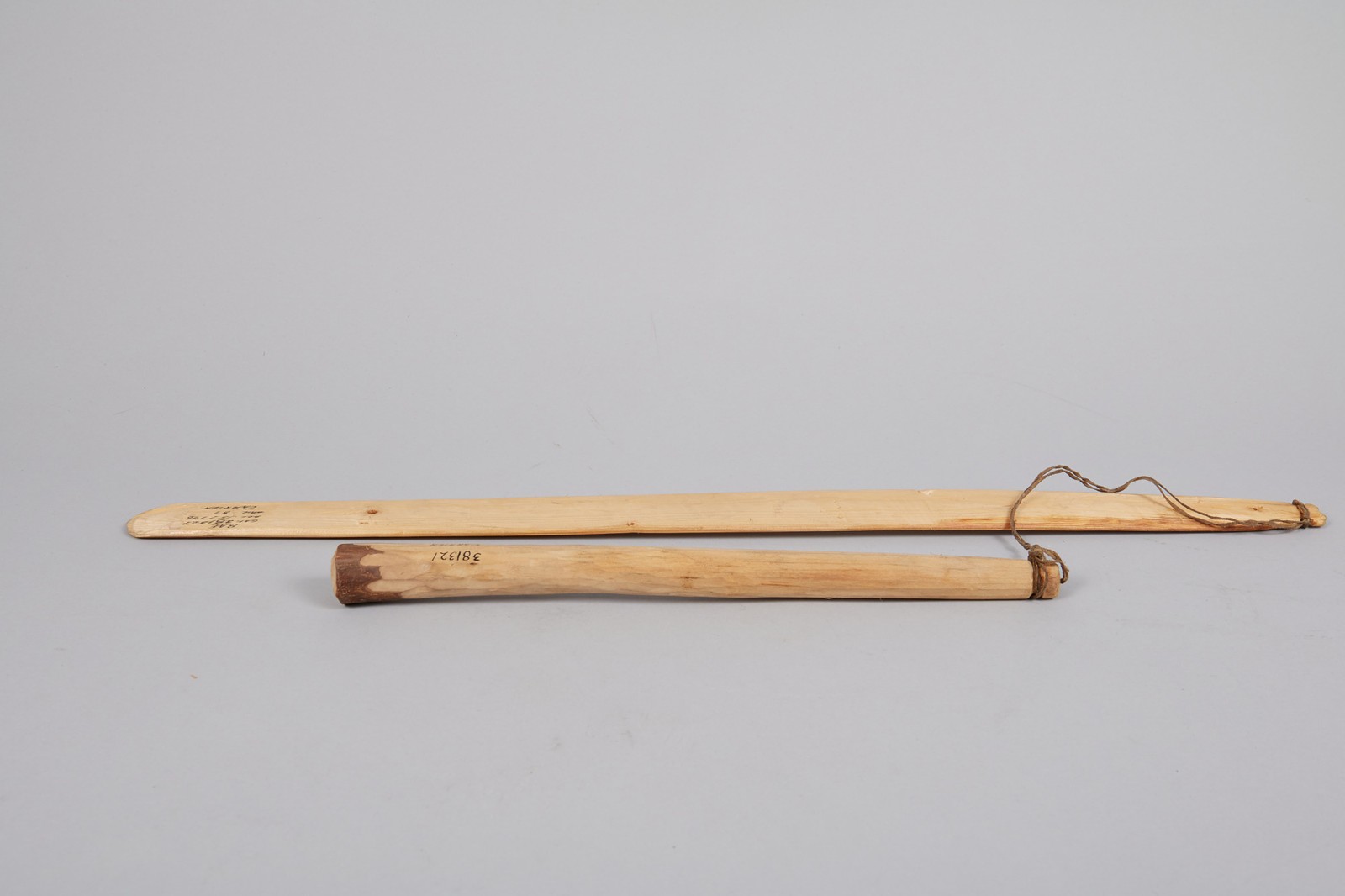
Source term: bull-roarer
Among the Dakelh the blade was swung to move the weather, and sometimes to bring rain. Children held it, but they swung it only when their elders told them to. What it would not do is call the Chinook, the warm wind off the Pacific that takes a Plateau winter apart. The Kittitas, the Wenatchi and the Kutenai, away to the south, all claim that power for the instrument; the Dakelh, at the northern edge of the Plateau, deny it, and theirs brings rain instead. This one was collected by the anthropologist Julian Steward during his 1940 fieldwork at Stuart Lake, among the Carrier, or Dakelh, the Athabaskan people of British Columbia's central interior.
Particulars
- Object
- A bull-roarer of the Carrier (Dakelh), held by the Smithsonian's National Museum of Natural History.
- Function
- A child's toy that is also a weather instrument: it works on the weather and sometimes brings rain, and children sound it at the request of their elders. The warm-wind call claimed to the south is denied here.
Source
Smithsonian National Museum of Natural History, USNM E381321-0 (accession 157796; collected by Julian H. Steward, 1940); Verne F. Ray, 'Culture Element Distributions: XXII, Plateau,' Anthropological Records 8:2 (1942), pp. 102-103 and 184, elements 4094-4103