No. RIDINGTON1976-001
Giant Spider's whirled lure (Dunne-za)
Canada · Peace and Prophet River drainages, northeastern British Columbia · North America · Subarctic
Sacred / spirit
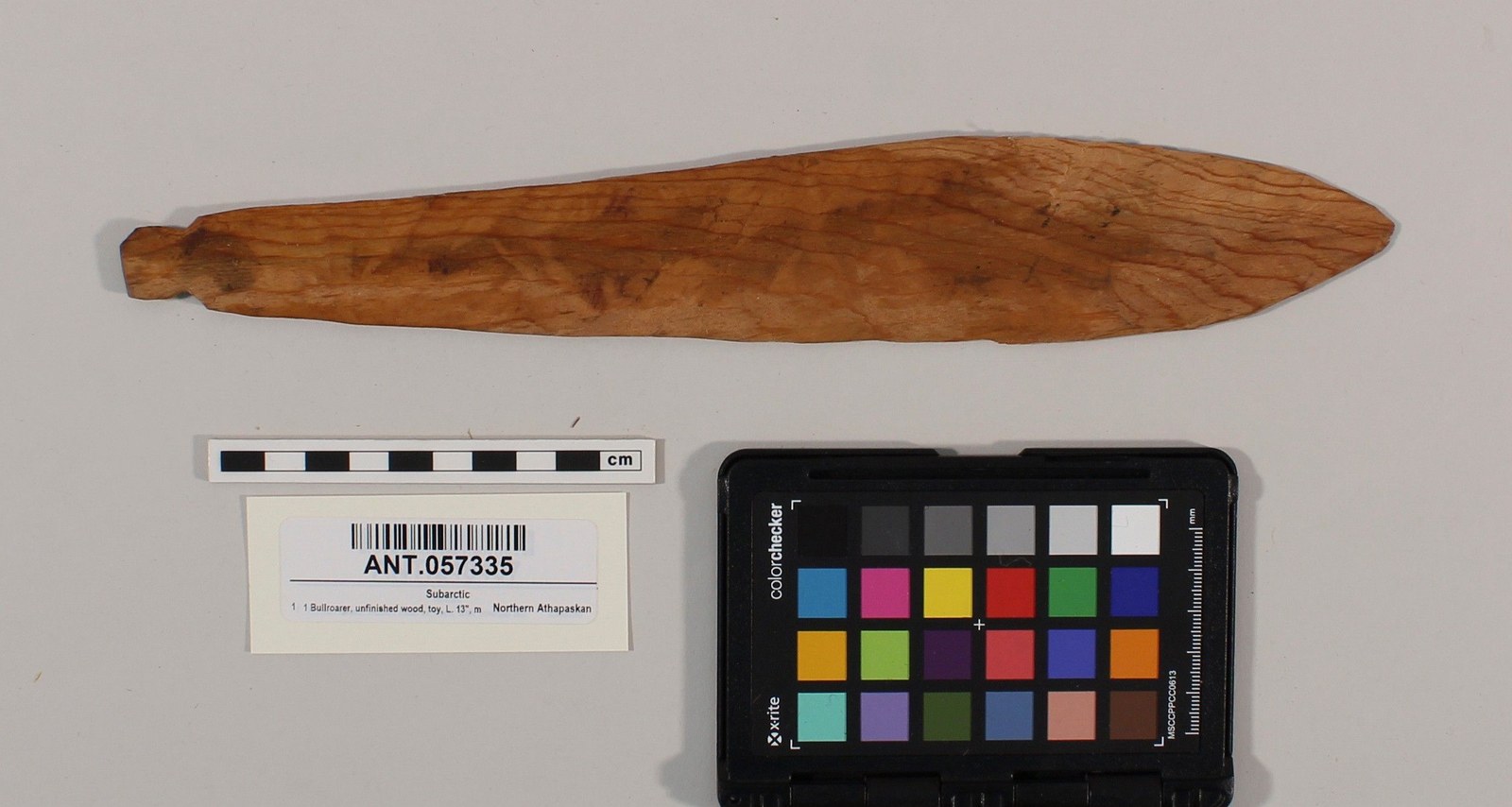
Source term: bullroarer
In Dunne-za story, the Giant Spider lured people to a mountain top by whirling a roarer around his head. Drawn by the sound of his stretched thread, they approached; he killed them and sucked out their body fluids. Among the Dunne-za, a person whose power came from Giant Spider could not hear any sound made by a stretched string or hide: it could wake the monster within him and make him wechuge, a cannibal. When Ridington put country music on the car radio while driving the Dreamer Charlie Yahey, a young man reached over and switched it off. Once in a cafe a jukebox began playing guitar music and Yahey grew 'too strong'; he was hustled into the bush, where another person sang a medicine song to overcome the monster emerging inside him.
Particulars
- Object
- Swung on a line around the head, its voice that of a stretched spider thread.
- Function
- In story, swung by the cannibal Giant Spider on a mountain top to draw people within reach, whereupon he killed them and drank their body fluids. Among living people the corollary is a prohibition: anyone whose power comes from Giant Spider must not hear the sound of a stretched string or a stretched hide, or he becomes wechuge.
Sources
- Robin Ridington, 'Wechuge and Windigo: A Comparison of Cannibal Belief among Boreal Forest Athapaskans and Algonkians', Anthropologica n.s. 18(2) (1976): 107–129, pp. 115–116 View · archived
- Robin Ridington, Little Bit Know Something: Stories in a Language of Anthropology (Vancouver: Douglas & McIntyre; Iowa City: University of Iowa Press, 1990), pp. 167–170 View