Atlas Essay —
Names That Travel
Nigeria · northern Australia · Upper Xingu, Brazil
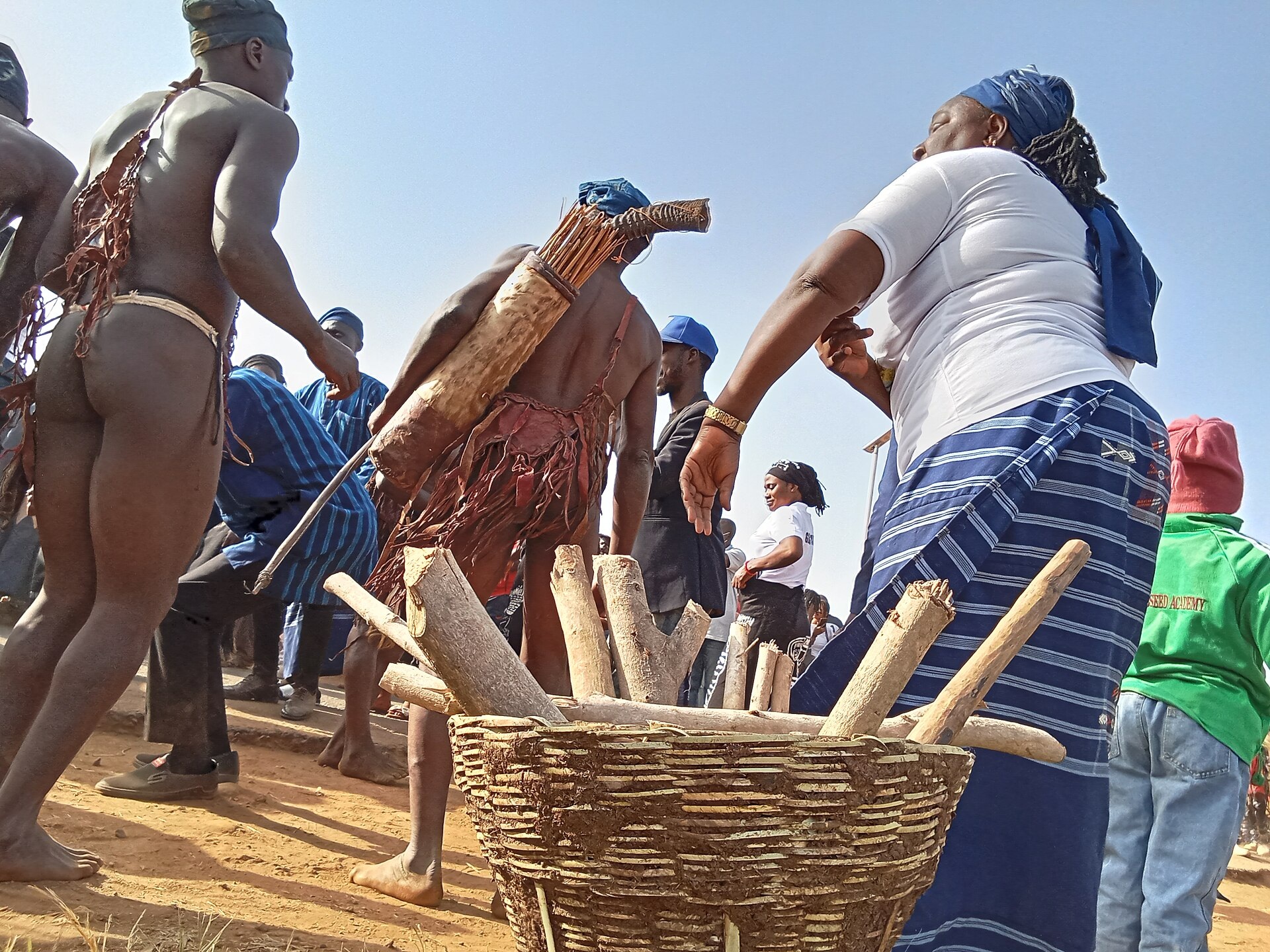
In April 1936, at Kuta in Nigeria, the anthropologist Siegfried Nadel began calling a Gwari bullroarer by the name he had learned among the Nupe: vugu-vugu. The Gwari men he was talking with liked it. Their own word for the instrument was almost the name of the rite it belonged to, and the borrowed word kept the two apart. Within a few days most of them were using it.
Bullroarer names pass between neighboring languages. At Kuta in Nigeria one changed hands within days; across Arnhem Land in Australia and the Upper Xingu in Brazil, related names run from language to language among neighbors.
In brief
- At Kuta in Nigeria in 1936, the Gwari men speaking with Nadel took up his Nupe word vugu-vugu within a few days, because it distinguished their instrument, Bwagi, from the Abwagi rite.
- In Arnhem Land and the country south of it, in Australia's Northern Territory, maralbindi and its relatives name the bullroarer in eight languages on both sides of the old divide between the Yolngu languages and their non-Pama-Nyungan neighbors.
- In the Upper Xingu of Brazil, the Mehinaku say matápu and the neighboring Nahukua matávu. For the Wauja, matapu is a fish-shaped board and the fish spirit it calls from the lake to the pequi feast.

A borrowed word at Kuta
Nadel came to Kuta from the Nupe of Nigeria, among whom vugu-vugu was the bullroarer's name. The Gwari of Kuta called the instrument Bwagi or Bwari, and the whole rite it served was Abwagi. With the board and the ceremony sounding so alike, every question slid from one to the other. Nadel used the word he already had.
The day was full of music. On 16 April he watched a Kakayu masquerade: drummers, singers, and a dancer in a costume of straw. People from the Abwagi compound came out to join their neighbors. In a pause Nadel asked about the bullroarer and learned that it belonged to the Abwagi performances, the annual rite and the funerals. There was more talk, and an offer of beer, and then the Madoci, head of the Abwagi cult, brought one out. He kept it half hidden under his sleeve, played it, and carried it away again.
The new name came out of that exchange. The Gwari men had their own words for their own things, and they took Nadel's because it let them say something they wanted to say: this is the instrument, not the rite. His diary records how quickly it happened:
“Actually, after a few days, most of them have adopted the new name when speaking of bull-roarer”
Nadel, diary entry for 16 April 1936, printed p. 127 · archived.
Few borrowings are caught this close. We know who offered the word, which language it came from, why the people at Kuta wanted it, and how fast they began to use it in the talk that went on around their visitor.
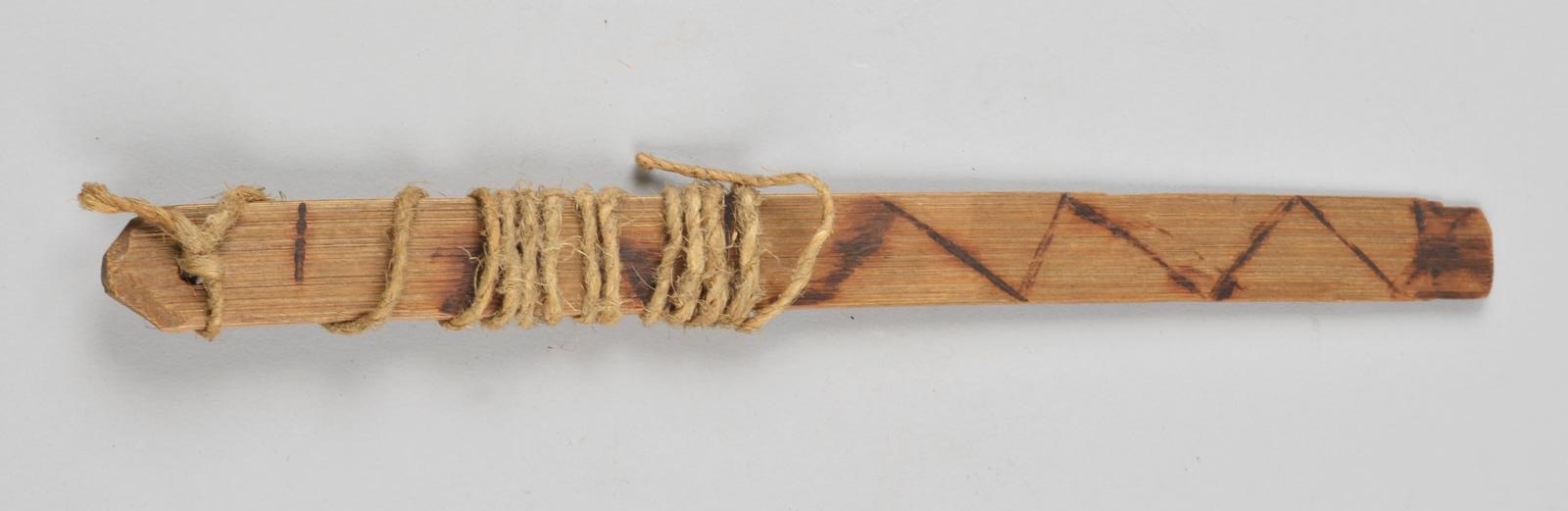
Say vugu-vugu aloud and the word itself whirs, a doubled rush of air like the board on its cord. That may be part of why it passed so easily from one man to the people around him. A name that already sounds like the thing it names is easy to take up while the thing is there to be heard.
Kuta gives a single exchange, measured in days. Arnhem Land and the Upper Xingu give something wider: a family of names heard in language after language, across country where neighbors have long talked, traded and sung together.
Maralbindi across Arnhem Land
In 1956 Arthur Capell set six hundred words from forty languages of northern Australia side by side. Under the heading Bullroarer, one shape keeps coming back: maralbindi, ralbindi, bindi, maralgbindiri. These are the words of central and eastern Arnhem Land and the country south of it toward Katherine, in Australia's Northern Territory: rivers and coastal plains where many languages lie close together.
Begin on the coast. At the mouth of the Blyth River, Burarra speakers called the board maralbindi. Farther east, Djinang speakers said the same, and so did Ritharrngu speakers inland. Gupapuyngu speakers gave Capell ralbindi; Rembarrnga speakers, the short bindi. Away to the south, Jawoyn and Yangman speakers both said maralgbindiri.
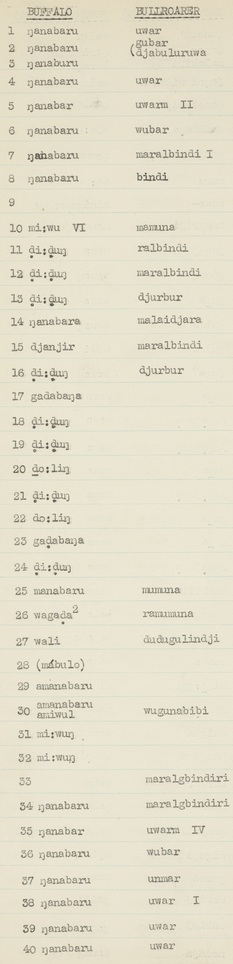
These are separate languages, not spellings of one. Djinang, Ritharrngu and Gupapuyngu are Yolngu languages, members of the great Pama-Nyungan family that covers most of the continent. Burarra, Rembarrnga, Jawoyn and Yangman stand outside it. The name runs straight across one of the deepest divisions in Australian speech, and it stays within one connected stretch of country.
| Language | Bullroarer name |
|---|---|
| Burarra | maralbindi |
| Rembarrnga | bindi |
| Gupapuyngu | ralbindi |
| Ritharrngu | maralbindi |
| Djinang | maralbindi |
| Jawoyn | maralgbindiri |
| Yangman | maralgbindiri |
| Ngandi | maralpiṇḍiʔ |
Ngandi, another language outside the Pama-Nyungan family, makes the eighth. Jeffrey Heath's 1978 dictionary of Ngandi, compiled quite apart from Capell's list, gives maralpiṇḍiʔ for the bullroarer, and gives the same word for a species of tree. Heath leaves the tree unnamed. In a single entry the sounding board and a living tree of the same country share one name.
The forms share a recognizable middle. Burarra, Djinang and Ritharrngu have maralbindi; Gupapuyngu’s ralbindi lacks its opening syllable, and Rembarrnga’s bindi matches its close. Jawoyn and Yangman have a longer form, with a g inside and a final -ri. Ngandi’s form ends on a catch in the throat. Set side by side, the names hold much of the same shape.
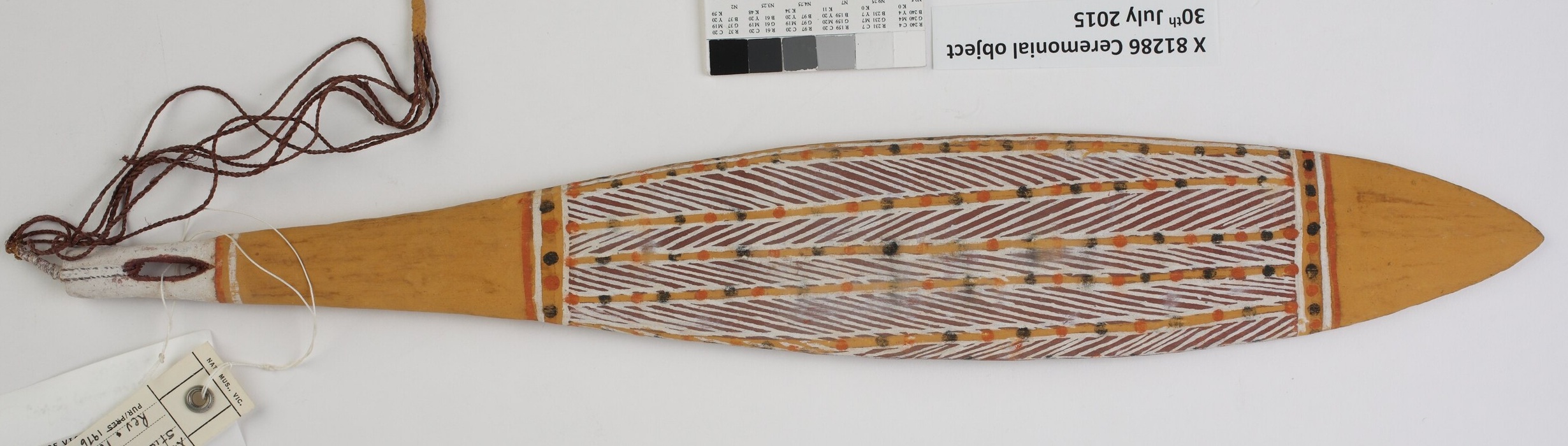
A song carries the name into ceremony. Mathaman Marika, Rirratjingu artist and songman of Yirrkala on the north-eastern Arnhem coast of Australia, knew a Kunapipi chant that begins Mamuna maralpindi: “This is the Snake, the bullroarer of the Snake.” In that line the board belongs to a great being, and the name sounds among singers and dancers.
Read from the coast inland, Capell's column offers the same small pleasure in language after language: a new tongue, a different history, and the same familiar shape. Heath and Marika let it be heard beyond the word list, as a board and a tree in one dictionary entry, and as a bullroarer and a Snake in one line of song.
The fish people of the Upper Xingu
In the Upper Xingu, in the state of Mato Grosso in Brazil, the shared name is matapu. Karl von den Steinen heard it on his expedition of 1887–88, and his 1894 book sets Mehinaku matapu beside Nahukua matavu. The Mehinaku speak an Arawakan language and the Nahukua a Cariban one.
Von den Steinen saw the likeness himself. Describing their instruments, he wrote that the two peoples had the same word for the bullroarer. There he spells the Nahukua form matähu; in his vocabulary it is matavu. His vocabularies also follow a rule a modern reader can easily miss: a word printed without an accent is stressed on its next-to-last syllable. The names are matápu and matávu.
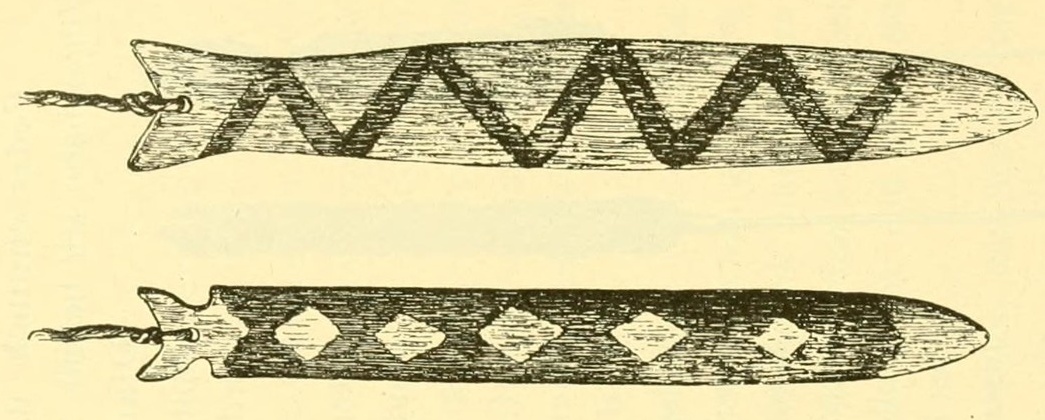
The name comes with an object anyone could recognize. Von den Steinen drew a long Mehinaku board beside two Nahukua boards shaped as fish, with heads, bodies and forked tails, and patterns running the length of the wood. The word belongs to things that are carved, painted, carried and heard.
Among the Wauja, another Arawakan-speaking people of the Upper Xingu, matapu is also a fish spirit. At the pequi festival, Acácio Piedade writes, two men go out to Lake Piulaga in Brazil and whirl the boards beside the water. They walk slowly back to the village, stopping again to whirl as they come, inviting the fish apapaatai, the powerful beings with whom Wauja ritual life is lived, to the feast. While the rite lasts, men may not fish. The fish people arrive as guests.
The fruit matters too. The pequi orchards give the abundance around which the ceremonies are sponsored. In Thomas Gregor's account of the Mehinaku, Matapu comes with the pequi season: the orchard owners appoint makers to carve and paint the boards, which are kept in the men's house, and then the instruments sound together in the village. One name covers the board, the spirit and a ceremony of the year.
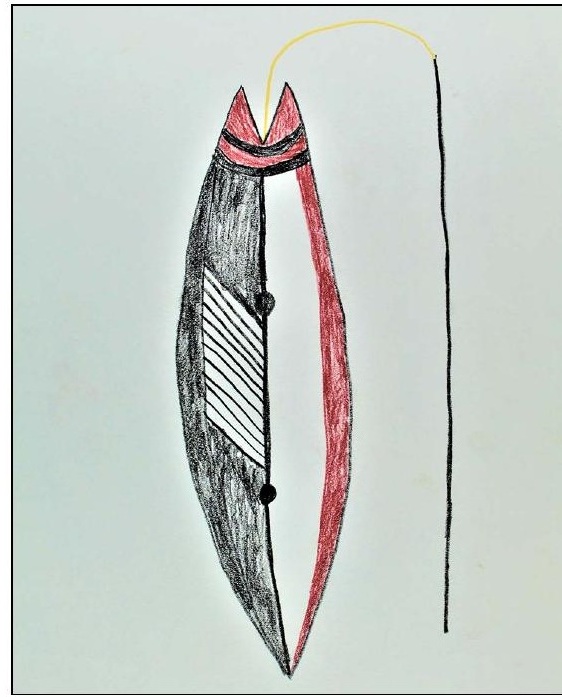
Here the name is shared together with a whole way of doing things: a carved fish, a season of plenty, a feast with guests from the lake. The Mehinaku and Wauja speak Arawakan languages and the Nahukua a Cariban one, and matapu runs across that boundary within a single neighborhood of villages, an ordinary name for an extraordinary visitor.
Names among neighbors
At Kuta, a borrowed word let people set an instrument apart from its rite. In Arnhem Land, one family of names runs through eight languages on both sides of the great divide in Australian speech. In the Upper Xingu, one name goes with a carved fish, a spirit and a harvest feast. In each place, speakers and a sounding board are together, and the name passes among them.
A bullroarer is easy to carry: a shaped board, a cord, sometimes a pole. Its name is lighter still. It can be said while someone shows the instrument, asks for one, makes one, sings of it, or tells a visitor what is roaring out of sight. Nadel happened to write down a few days at Kuta when exactly that happened. In Arnhem Land and the Upper Xingu the word lists give the wider view: neighbor after neighbor calling the same sound by a name their neighbors also knew.
Key sources
- S. F. Nadel, diary entry for 16 April 1936, in Roger Blench, ed., S. F. Nadel: The Field Diaries of an Anthropologist in Nigeria 1935–36 · archived (2006), printed pp. 126–127: demonstration at Kuta and short-term adoption of vugu-vugu.
- Arthur Capell, A Vocabulary of 600 Words in Forty North Australian Languages (1956), State Library of New South Wales A 6929: p. 18, bullroarer column · archived, read against the numbered language key · archived. Modern language names are used in the table above.
- Jeffrey Heath, Ngandi Grammar, Texts, and Dictionary · archived (1978), printed p. 156: (ma-)maralpiṇḍiʔ, bullroarer and tree species.
- James A. Davidson, “Mathaman: warrior, artist, songman” · archived, National Gallery of Victoria: Arafura Lagoon (1963) and the Kunapipi chant containing Mamuna maralpindi.
- Karl von den Steinen, Unter den Naturvölkern Zentral-Brasiliens (1894), pp. 327–328, instruments and shared name; pp. 524–525 and 527–528, pronunciation conventions and Nahukua/Mehinaku entries.
- Acácio Tadeu de Camargo Piedade, O canto do kawoká: música, cosmologia e filosofia entre os Wauja do Alto Xingu · archived (doctoral thesis, 2004), printed pp. 92–96, especially p. 93: pequi festival, invitation of fish spirits and fishing prohibition.
- Thomas Gregor, Anxious Pleasures: The Sexual Lives of an Amazonian People (1985), Matapu accounts in the sections on spirits and pequi rituals: Mehinaku terminology, seasonal appearance, orchard sponsors and makers.
- Aristoteles Barcelos Neto, “A flauta-jaguar e outros aerofones wauja” (2021), fig. 9: Ajoukuma Wauja's drawing of matapu-kumã.

