No. NA-S1952-013
Navajo shamanic curing bullroarer
United States · Southwest · North America
Sacred / spirit
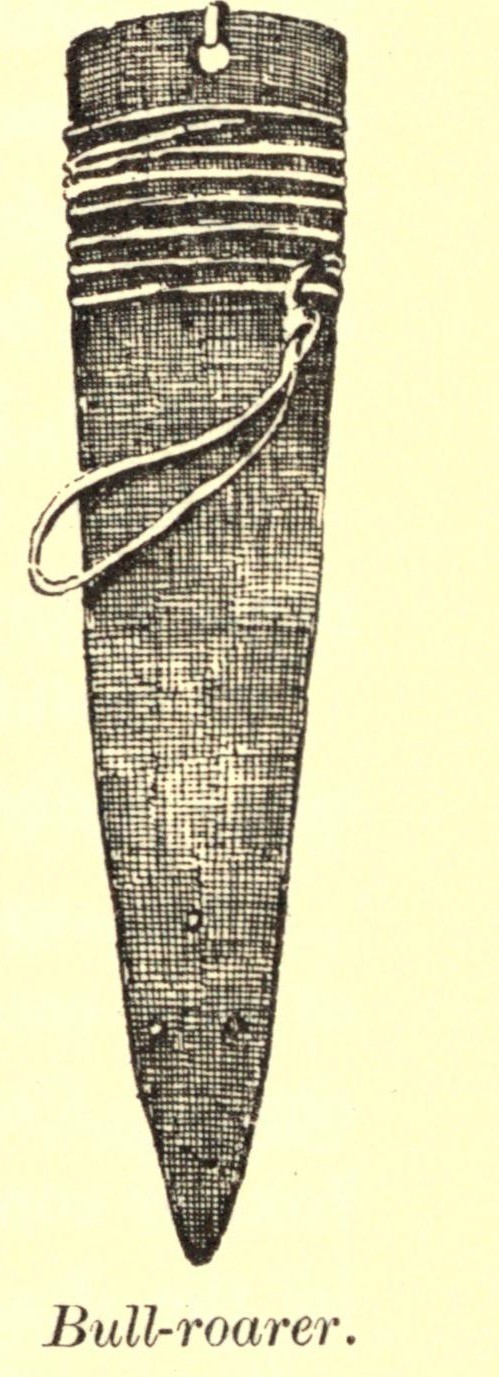
Source term: bullroarer and related buzz
The Mountain Chant is a dance brought back from the houses of the gods. Its origin myth tells how Dsilyí Neyáni, a young Navajo captured by the Ute, was freed by Talking God and led home through the dwellings of the Holy People, who taught him its sandpaintings, sacrificial sticks and plumed-arrow dance: 'it was not until Dsilyi' Neyáni recounted his revelations that it became the great dance it now is among the Navajo.' The rite is held only in winter, 'when the thunder is silent and the rattlesnakes are hibernating.' In the last night's dances a bearer leads the processions whirling the tsin-di'ni, the groaning stick — a black blade sparkling with specular iron ore, turquoise inlaid for eyes and mouth, cut only from a pine struck by lightning — filling the dark corral with 'a sound like that of a rain storm.' And in the curing chants an assistant soaks its buckskin thong in the medicine bowl, circles the hogan whirling the roarer violently while all within keep silence, then presses it, wrapped, to the patient's limbs.
The Navajo chanters say that the sacred groaning stick may only be made of the wood of a pine tree which has been struck by lightning.
Matthews 1887, "The Mountain Chant: A Navajo Ceremony," Fifth Annual Report of the Bureau of Ethnology, para. 135 (p. 436)
Particulars
- Function
- Whirled at the head of the last-night dance processions of the Mountain Chant, making a mimic rain storm; in curing chants an assistant circles the hogan whirling it, then presses the wrapped roarer to the patient's limbs; northwestern Navajo informants also counted it among a shaman's paraphernalia and whirled it to chase devils
Source
Washington Matthews, 'The Mountain Chant: A Navajo Ceremony,' 5th Annual Report of the Bureau of Ethnology (1887), pp. 435-439; Franciscan Fathers, An Ethnologic Dictionary of the Navaho Language (1910), pp. 414-415