Atlas Essay —
Orò Crosses the Water
The Yoruba night-god in the Niger Delta
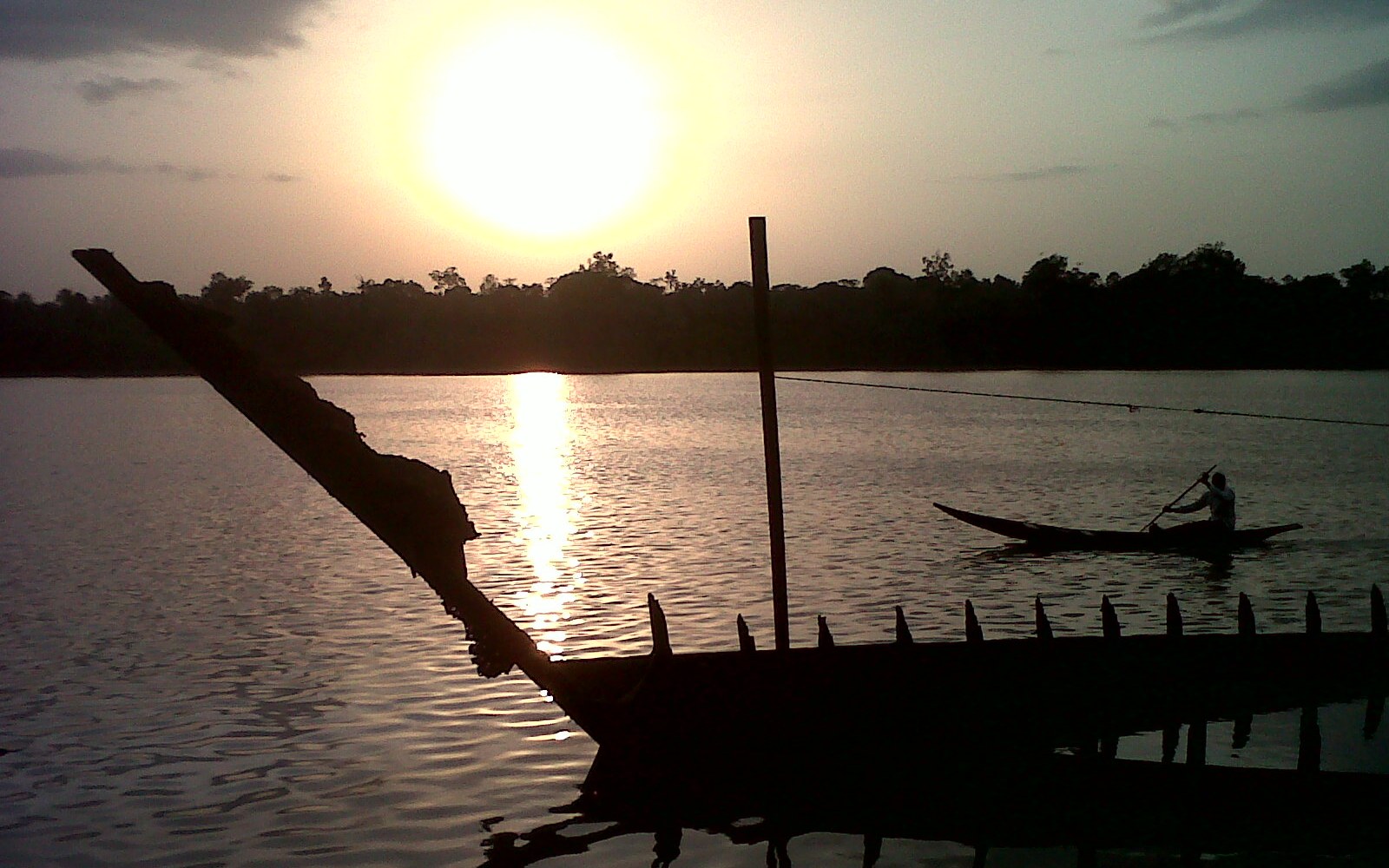
Every April the Kolokuma of the Niger Delta keep the festival of Okpótú, the lake that belongs to all of them. Swimmers cross the river. The young women circumcised the year before come out with headties knotted on their arms and fancy umbrellas over their heads. And someone whirls a flat board on a cord until it roars. The Kolokuma call it the oróro. A few hundred kilometres to the west, in the Yoruba towns of the forest, the same roar is a god, and his name is Orò.
The Yoruba night-god Orò crossed into the Niger Delta in pieces. Its name reached Kolokuma as oróro; its law, that no woman may see it, reached Brass as Noin-nama; and the Bini of Benin took the word too, as oɽo. Between Orò’s country and the Delta stand the Apoi, a Kolokuma lineage that settled among Orò’s own people and learned to speak their language.
In brief
- The Kolokuma, an Ijo clan of Bayelsa State in the central Niger Delta, call the bullroarer oróro and whirl it at the April festival of Okpótú, their oldest god. No other Ijo language has the word, and the Ijo word for a god, óru, does not make it.
- Among the Yoruba of south-western Nigeria, Orò is the voice of the bullroarer at night. At its sound every woman shuts herself indoors on pain of death. The name means something in Yoruba: “custom,” “fierceness,” “torment.”
- At Brass, on the Delta’s seaward edge, Adebiyi Tepowa watched the roarer cult called Noin-nama in 1906 and wrote that it “is equivalent to the Yoruba term Oro.” Its roar speaks a Yoruba sentence, and no woman may see it, although Ijo masquerades otherwise let women watch.
- The Apoi descend from Opoi, a son of the Kolokuma ancestor. They live among the Yoruba Ilaje and Ikale, speak Yoruba, and keep Ijo for their rites. The war that once divided them from the Ilaje ended with the sacrifice of a woman who, some say, had touched Orò.
- In Benin City the word for the “bull-roaring” of the Ovia society is oɽo, and the standard Bini dictionary of 1937 marks it “cf. Yor. oro.”

The roar over the lake
The Kolokuma are a clan of the Ijo, or Ịzọn as they call themselves, the people of the creeks and mangroves that make up the Niger Delta in southern Nigeria. Their towns stand on the Nun River, one of the two great mouths of the Niger, and their traditions bring them there from Agadagbabou, an old site in the swamp forest of Wilberforce Island “from where most Kolokuma towns migrated to their present settlements.” Agadagbabou has a lake, and the lake is a god. Kay Williamson and Roger Blench’s dictionary of Kolokuma has it:
Okpótú n. A. name of a lake at Agadagbabou, which belongs to the whole of Kólokümá; B. festival associated with the lake, celebrated in April, involving swimming across the river and use of a bull-roarer; young women circumcized the previous year dress up with a short wrapper like a shirt, tie headties on their arms, and carry fancy umbrellas; okpotu fọ́ụn whirl a bull-roarer to make a sound.
Williamson and Blench, Dictionary of Kolokuma Ịzọn (2011), p. 168
Four pages on, the roarer has a name of its own: “oróro n. bull-roarer; oróro fọụn play bull-roarer” (p. 172). The instrument is called after the god at the festival, “whirl an Okpótú,” and called oróro everywhere else.
Okpótú is the oldest god the Kolokuma remember. The Delta’s historians conclude that “the worship of Okpotu, indeed, preceded the ascendancy of Kolokuma Egbesu,” the war god the clan carried with it to the Nun (Okorobia, in Alagoa et al. 2009, pp. 461–462). The lake festival with its roar is the rite of the homeland.
Nothing in the entry shuts anyone indoors. The festival is the young women’s day as much as the swimmers’: they parade in borrowed finery under their umbrellas, and the hairstyle called ofukú is “associated particularly with priestesses and with the Okpotu festival” (p. 161). This is a roarer at home among women. Hold on to that, because in the Yoruba country it is not.
Orò, the voice in the night
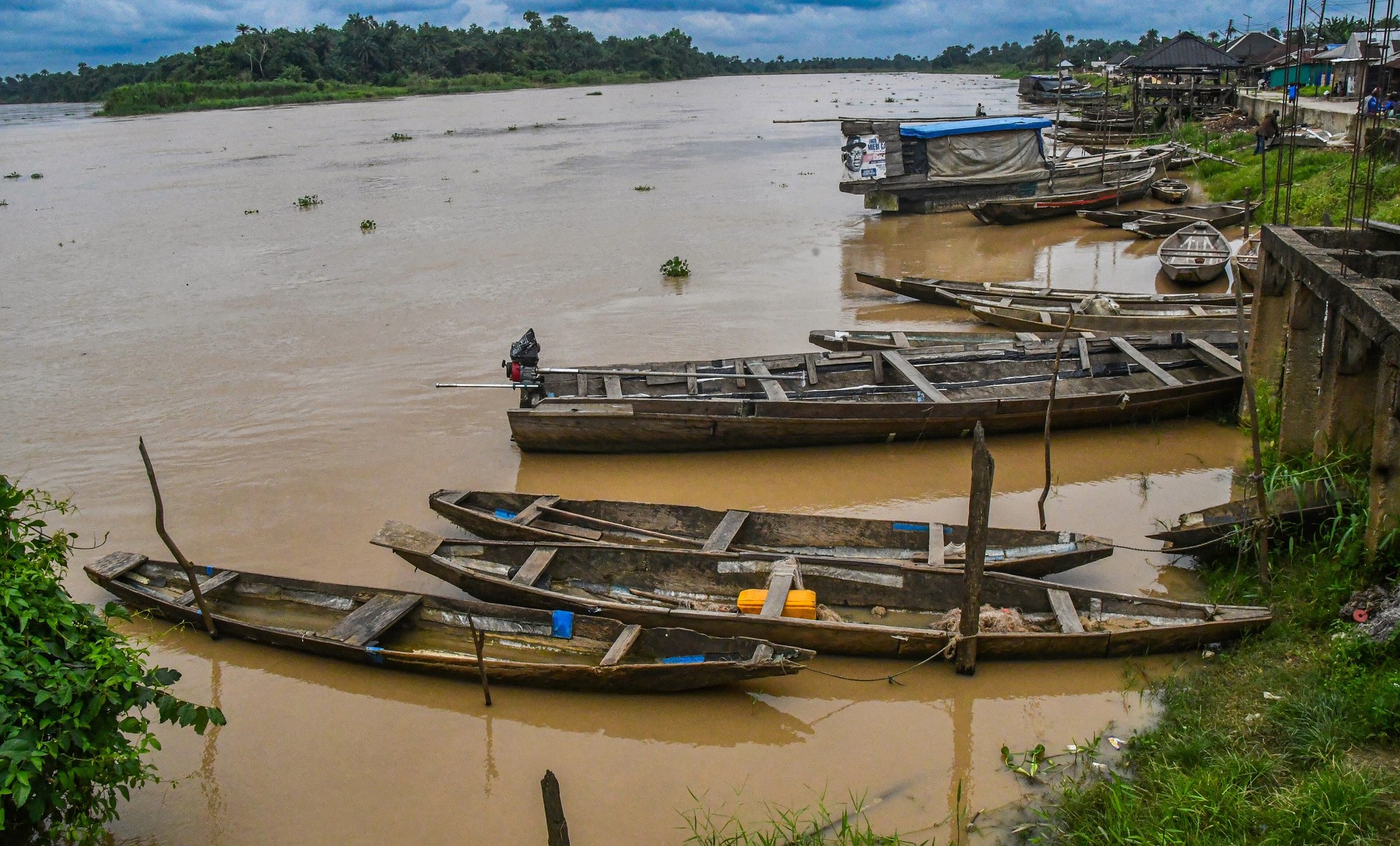
In the Yoruba country of south-western Nigeria the bullroarer is not played at festivals. It is a god, and when he walks the town the women hide. The missionary Thomas Bowen, who worked among the Yoruba in the 1850s, put him among the powers of the state: “Egungun, bones, and Oro, torment, are the executive or vindictive power of civil government deified. The latter is most usual among the Egbas, who term the punishment of criminals ‘giving them to Oro.’ On Oro day all women are obliged to remain closely shut up in their houses” (Bowen 1858, p. xvii). The fullest early account is A. B. Ellis’s, from 1894:
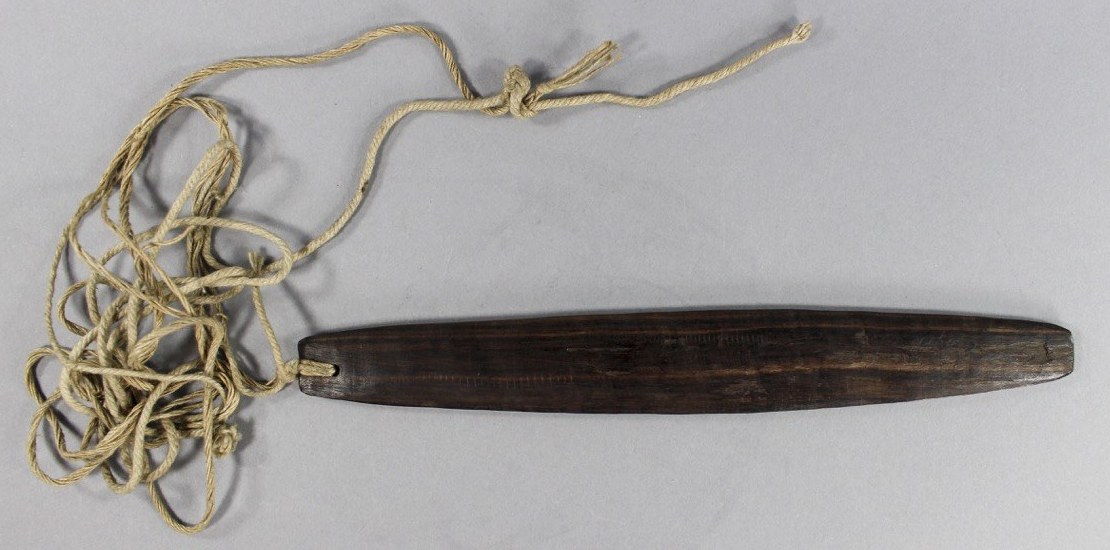
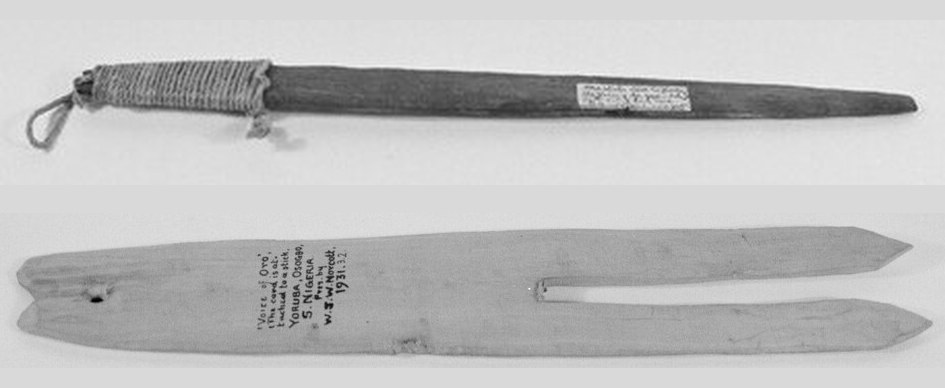
Oro is supposed to haunt the forest in the neighbourhood of towns, and he makes his approach known by a strange, whirring, roaring noise. As soon as this is heard, all women must shut themselves up in their houses, and refrain from looking out on pain of death. The voice of Oro is produced by whirling round and round a thin strip of wood, some 2½ inches broad, 12 inches long, and tapering at both ends, which is fastened to a stick by a long string. … No women may see the “bull-roarer” and live, and all women are obliged, under pain of death, to say that they believe Oro to be a powerful Orisha, and to act up to that belief.
In Ondo there is an annual festival to Oro, called Oro Doko. It lasts for three lunar months, and every ninth day women are obliged to remain within their houses from daybreak till noon, while the men parade the streets, whirling the bull-roarer, dancing, singing, and beating drums.
A. B. Ellis, The Yoruba-Speaking Peoples of the Slave Coast (1894), pp. 109–111
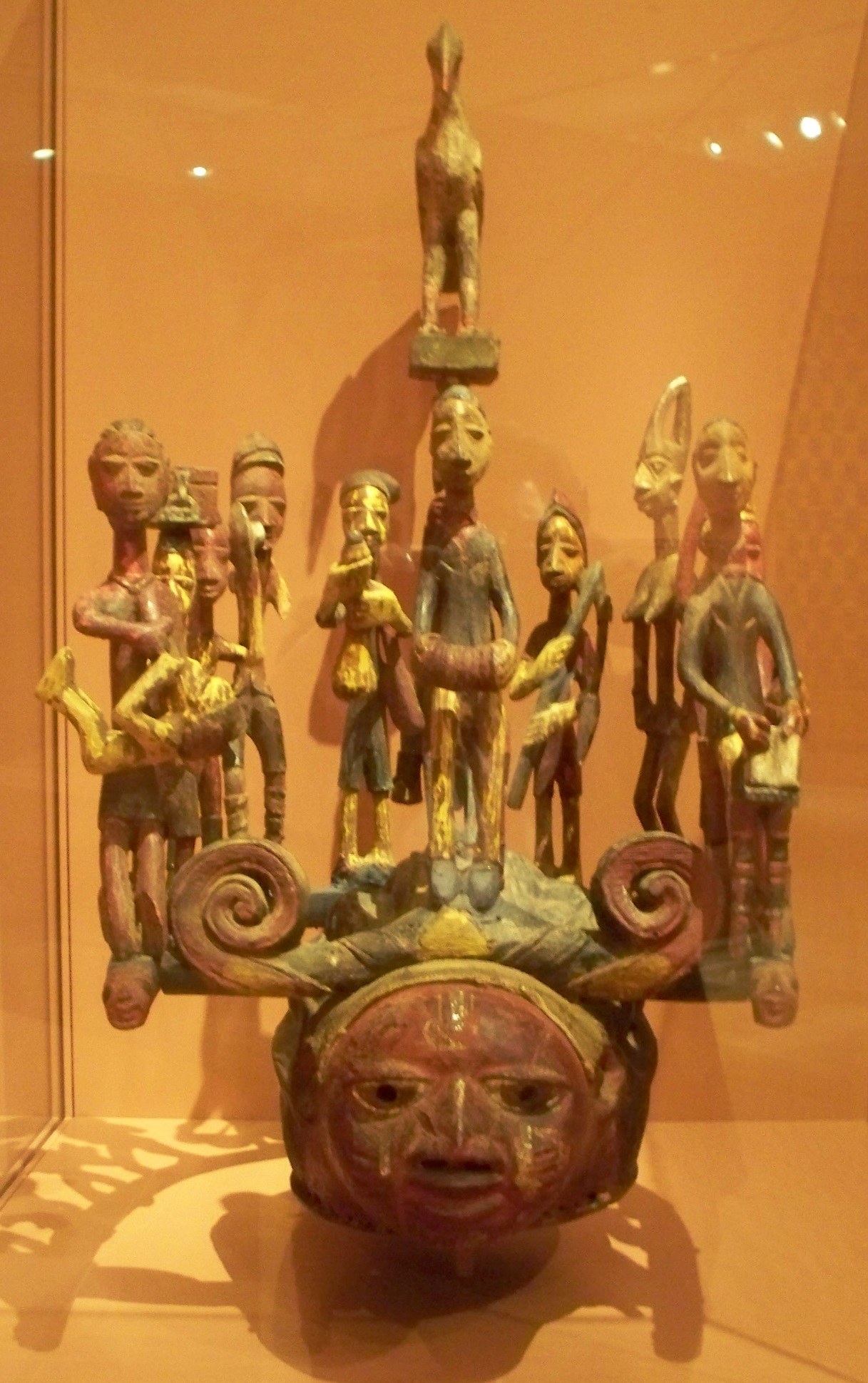
Orò had a body too. On his day, Ellis goes on, “Oro himself, in a long robe hung with shells, and a wooden mask painted white, with the lips smeared with blood, parades the town with a numerous following.”
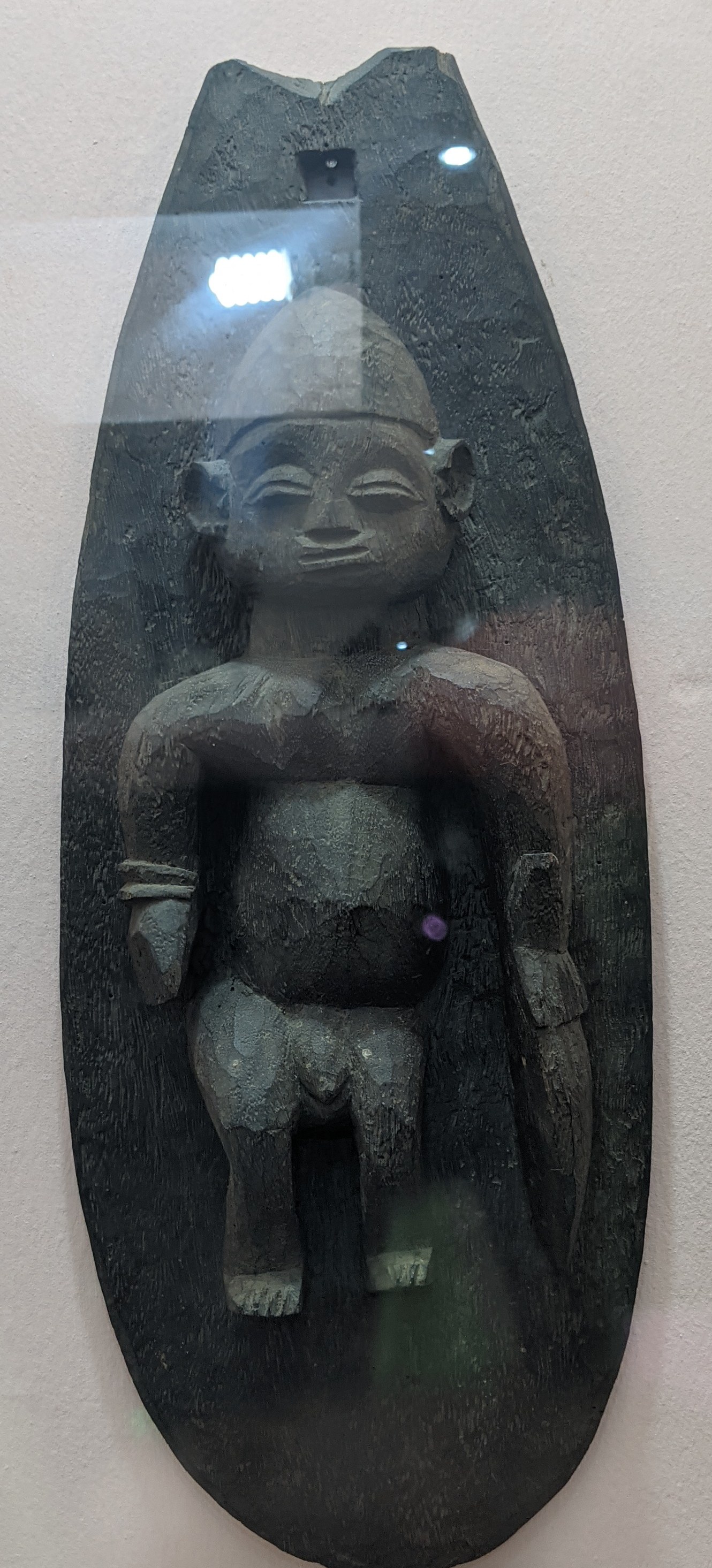
The name belongs to the Yoruba language. Samuel Crowther, the first Yoruba lexicographer, entered it in the 1852 edition of his vocabulary as “Oro, custom, fashion, habit; fierceness, sauciness, provocation,” and beside it stands a second oro, “poison, torture, torment” (Crowther 1852, p. 223). Orò is the Rite, or the Fierce One, and either way the word is at home. The god is at home too. His cult runs from Oyo in the north to Lagos on the lagoon, from the Egba in the west to Ondo in the east, and it crossed the Atlantic with the slave ships to Cuba.
A Yoruba word in an Ijo mouth
On the Ijo side, oróro stands alone. Kolokuma is one dialect of one Ijo language, and the roarer word appears nowhere else in the family. The Nembe of Brass call their roarer ánoin. The dictionaries of Ibani, Kirike and Mein list no roarer word at all, and Roger Blench’s comparative wordlist of the Ijoid languages has no entry for one. Kolokuma itself has an older oróro, a different word: “gutter; stream; natural channel.” The Nembe have that one too, as oro, and it is plainly native. The bullroarer oróro has no relatives.
The Ijo do have an old word that sounds close. Óru is “deity; god; divinity; ‘juju’” in Kolokuma, oru in Nembe, órú in Ibani and Kalabari, and Williamson and Blench reconstruct it for the ancestor of every Ijo language. But óru does not make oróro. Its last vowel is u, not o. Every word Kolokuma builds from it is a compound, óru-egele, órusẹị, oru-otú “ancestors, the god-people,” and none of them doubles a syllable. Williamson, who glossed the óru family entry by entry, gave oróro no place in it.
What oróro does resemble is the Yoruba words that cluster around Orò, and Ijo has taken words of exactly that shape from Yoruba before. The Kolokuma dictionary marks some loans openly: “okuún n. ocean [< Yoruba òkun ocean].” Others it leaves unmarked. “ororó n. ẹgúsi or groundnut oil” carries no bracket, yet it is the Yoruba òróró, “oil; unction,” three syllables carried whole into Ijo. The roarer is a Yoruba trisyllable of the same build, sitting in Kolokuma beside its Yoruba neighbour in the dictionary, and like the oil it came from the west.
The night-beast at Brass
The other half of Orò turned up seventy kilometres south of Kolokuma, at Brass, the old trading town on the Delta’s seaward edge where the Nembe Ijo dealt with European ships. In 1906 Adebiyi Tepowa, whose name suggests he was Yoruba himself, wrote from the Custom House at Sapele and sent the Journal of the African Society a history of Brass and its people. Among its jujus he described one he had watched himself:
Noin-nama.—This is a juju worshipped by the Beletiama people, but used generally by the Brass people for swearing purposes. The writer has witnessed the play of this juju in Beletiama, and is inclined to believe, that there is no difference between it and that of Lagos, Abeokuta and Ijebu.
Adebiyi Tepowa, “A Short History of Brass and Its People” (1907), p. 71
“Noin-nama is equivalent to the Yoruba term Oro.”Adebiyi Tepowa, Journal of the African Society 7 (1907), p. 71
Then he told the story. A king had an only son, Aiye, a hunter, and Aiye had a dog called Iya that would not leave him. One day Aiye shot an animal, and the dog ran it down with its master behind, and both went into a ditch they could not climb out of and died there. When the town found them, five days later, the bodies were burnt, and no one knew how to tell the king. An old farmer among the elders made a thing:
a piece of wood about 9 inches to 12 inches long and about ½-inch broad with a hole at one end to which a strong string was tied, the other end of the string being tied to a stick of about two or three yards long. This vibrated on being swung in the air, and, producing a dreadful sound, was, in the opinion of the inventor, the most effective means of conveying the news to the king—the import of the sound so produced being, in effect the following in Yoruba “Aiye jona pelu Iya” which translated into English means “Aiye and Iya are both burnt to death by fire.”
Thus up to this day no woman may see the play of Noin-nama even in Beletiama (Brass) where less importance is attached to it than in Yorubaland.
Tepowa (1907), pp. 71–72
Everything in that account points west. Tepowa measures the Brass rite against Lagos, Abeokuta and Ijebu and finds no difference. The rig he describes, a short blade on a cord tied to a long stick, is the Yoruba rig. The sentence the roarer speaks in an Ijo town is in Yoruba. The king’s wives run indoors at the first sound, and the women of Brass have stayed indoors ever since. And Tepowa notes that Brass cares less for the rite than Yorubaland does, which is how a borrowed institution looks at the far end of its road.

Only the name stayed Ijo. The Nembe dictionary of M. H. I. Kaliai, edited by Blench, supplies the parts: noin, “night”; nama, “animal; meat or flesh”; noindeaḹụ, “roving night spirits”; and the instrument itself, ánoin, “wooden plaque bullroarer,” built on the same word for night. Noin-nama is the Night-Beast. That is Orò exactly, the thing that walks the town after dark and devours those given to it, put into Ijo words.
The Ijo let their women watch
The ban at Brass is the imported piece, and the Ijo’s own customs show it. When Kay Williamson set down the cultural traits that separate the Ijo from every neighbour around them, she listed a female Creatrix, a marriage system in which most children belong to the mother’s family, and this:
Masquerades (owu) which are said to imitate the dances of water-spirits observed by solitary fishermen, etc. The carved head-piece is worn flat on the head instead of covering the face; and there is no prohibition on women observing the dances although they are not supposed to know about the dressing and preparation.
Kay Williamson, “Cultural traits distinguishing Njọ speakers,” in Williamson and Blench, Proto-Ijoid Reconstructions, p. 41
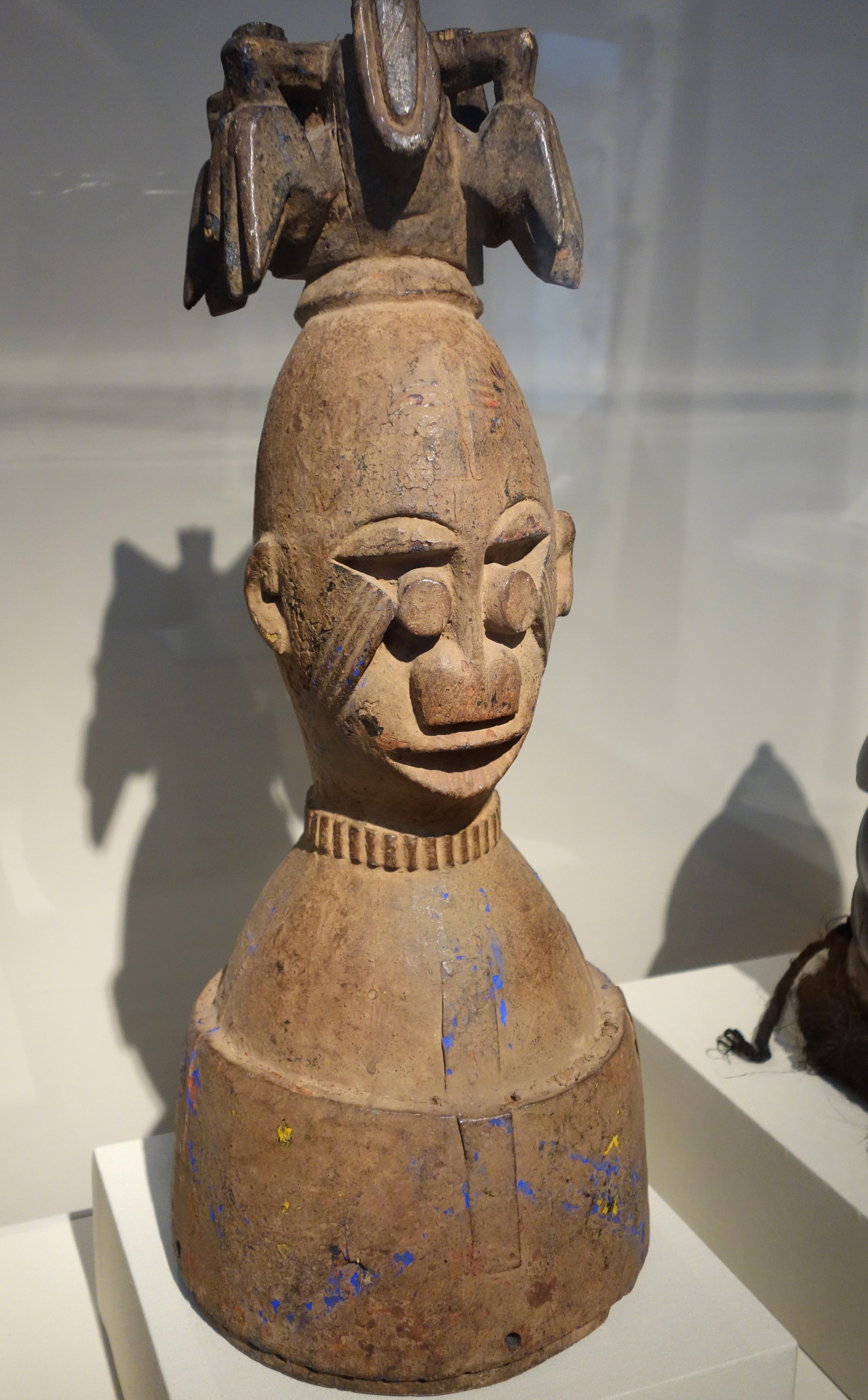
That is the Ijo norm, and Kolokuma keeps it: the roar over Okpótú’s lake sounds on the young women’s day, and the ofukú hairstyle belongs both to priestesses and to the festival. Brass breaks it. A rite that sends every woman of the town indoors, on pain of death in its homeland, is not what Ijo masquerade grew into. It is what Orò is. So the two Ijo communities each hold one half of a single foreign thing, and the half each lacks is the half the other has. Kolokuma has Orò’s name on an Ijo festival. Brass has Orò’s law under an Ijo name.
Kolokuma’s lineage among Orò’s people
A name and a law do not cross a language border by themselves. They need people who stand on both sides of it, and the Delta’s own histories name them. The Apoi are an Ijo people who live today among the Ilaje and Ikale, the Yoruba of the Ondo coast, in the creeks and lagoons where the Yoruba country meets the western Delta. E. J. Alagoa and his colleagues describe them so in their history of the Ijo:
The Apoi and Arogbo in Ondo State live among the Ilaje and Ikale sub-groups of Yoruba. The Apoi have accordingly adopted Yoruba as their common language, but still use Ijo (which they no longer understand) in their religious ritual, funeral songs and masquerade plays.
Alagoa, Kowei, Owei and Dunu, in The Ịzọn of the Niger Delta (2009), p. 400
And they come from Kolokuma. “According to the Kolokuma account, Opoi, one of the seven sons of Kala-Okun (ancestor of Kolokuma, and founder of the Opoidani lineage of the Kolokuma), ‘left with his grand father Ijo (Kalasuo) to Apoi creek and founded the Apoi clan in western Ijo’” (p. 403). The Kolokuma still name Opoidani in their ranked roll of lineages, and still say it is gone: “Opoidani is also no longer in existence, having migrated to Apoi” (p. 461). Opoi’s first settlement lies on Apoi creek, in the central Delta not far from the Kolokuma towns; from there a second migration carried his people west to the Ondo lagoons. The two Apoi still share their founder, Kalasuo, and their war god, Oborowe, whose western shrine stands at Igbobini. On the way west, the traditions agree, the Apoi stopped for “a long time” at Okomu, on the edge of Benin, before they settled near the present town of Kiribo (pp. 403–405).
“but still use Ijo (which they no longer understand) in their religious ritual, funeral songs and masquerade plays.”Alagoa et al., The Ịzọn of the Niger Delta (2009), p. 400
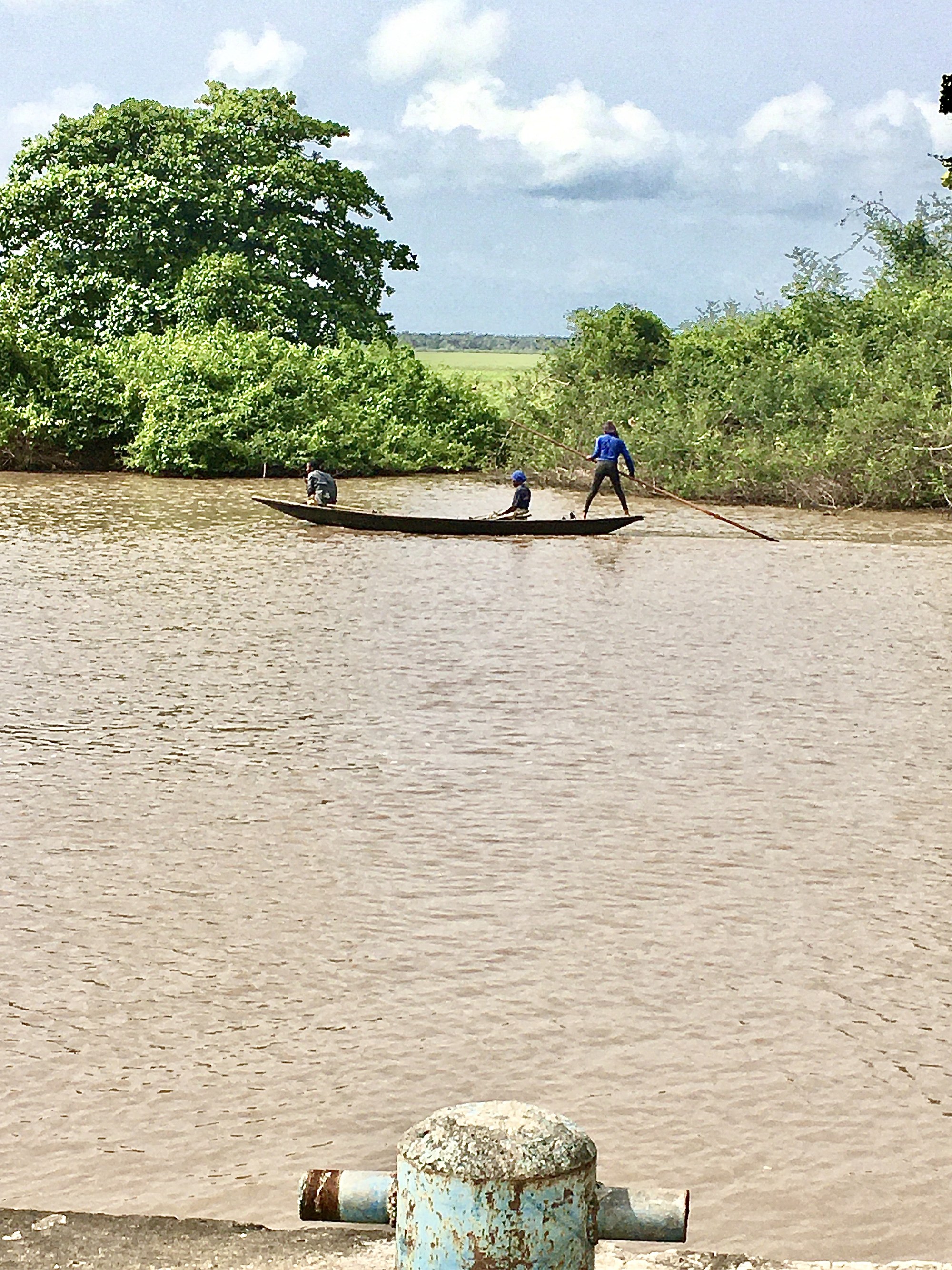
In the west the Apoi were bound into the Yoruba world by every tie a people can have. They paddled for their neighbours, who “relied on the Apoi for water transport and gave their daughters in marriage to Apoi men”; they dealt with “the Oba of Ado and Oba of Ondo,” the Yoruba kingdom whose Orò festival ran three months; they towed timber and gin to Epe and Lagos (p. 405).
They lived under Orò’s law. The goddess Ayelala, whose first chief priests were an Ilaje man and an Apoi man and whose offerings are still divided equally between the priests of the two peoples, was once a woman. An Apoi man had seduced an Ilaje chief’s wife and fled to the Oborowe shrine at Igbobini, and when the Apoi would not give him up a long war followed. It ended when both sides agreed that a substitute should die in his place, and the woman chosen was Ayelala (pp. 234–235, 244, 246). Why her? “Some traditions claim that Ayelala had come into physical contact with the male-only Orò cult, which is forbidden to women, and as a consequence was automatically condemned to become an object of sacrifice” (Raheem and Famiyesin 2017, p. 235). The peace between the Yoruba and the Ijo of the Ondo coast was sealed with the blood of a woman who had broken Orò’s law. The Apoi say they came from the central Delta, from the old “Brass Division” (p. 233): the colonial district named after the town of Brass.
Here, then, is the bridge the crossing needed: an Ijo lineage born at Kolokuma, Yoruba in speech, Ijo in ritual, married into Ilaje families, trading to Ondo and Lagos, and held to Orò’s law. The road between Orò’s towns and the Kolokuma creeks runs through their nine towns. A word learned on the lagoons would travel home along the kin line to the Apoi of the central Delta, a short paddle from Okpótú’s lake.
The Itsekiri, the other Yoruba speakers inside the Delta, were not that road. Their kingdom on the Benin River claims an origin at a Yoruba town in Ijebu Waterside, but the Itsekiri, as P. C. Lloyd found them, “know nothing of such Yoruba deities as Olorun, Obalufon, or Shango,” and their own masks are “copied (and acknowledged to be so) from the Ijaw,” danced “between rows of women” (Lloyd, in Bradbury 1957, pp. 179, 200). The Itsekiri took the Ijo way with masks. Orò came by the Apoi.
Benin took the word too
Orò reached Benin City as well, and there the evidence is a dictionary. Hermann Melzian, who compiled the standard dictionary of Bini, the Edo language of the old kingdom of Benin, heard oɽo used for a whole class of things done in secret, and he marked where the word came from:
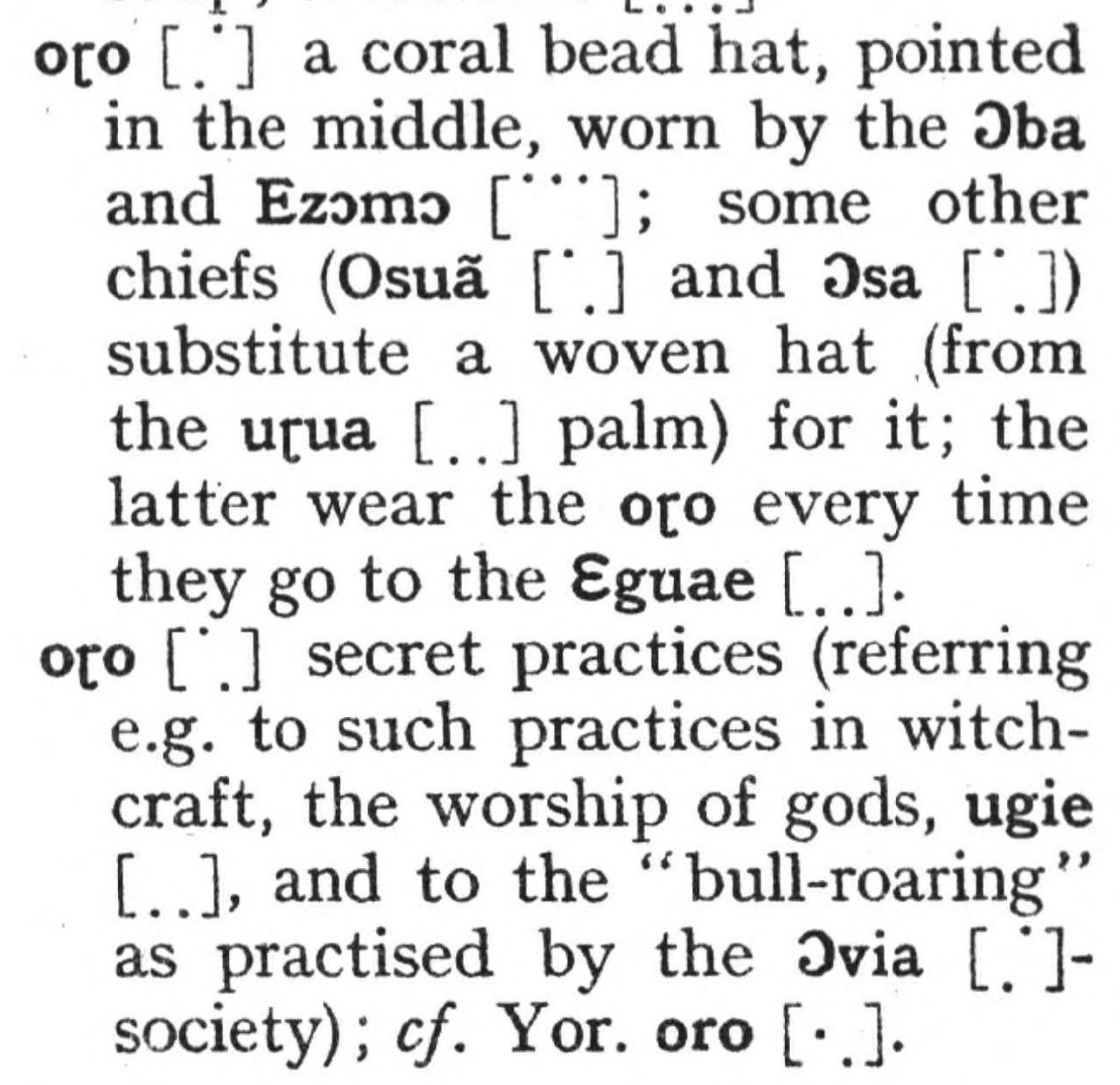
oɽo secret practices (referring e.g. to such practices in witchcraft, the worship of gods, ugie [festival], and to the “bull-roaring” as practised by the ɔvia-society); cf. Yor. oro.
Hermann Melzian, A Concise Dictionary of the Bini Language of Southern Nigeria (1937), p. 147
Ovia is a god of the forest villages west of Benin City, and his society kept a long initiation in its groves: members spend “three or four months’ initiation away from home” (p. 170). R. E. Bradbury found that “except on two occasions all women are barred from the Ovia groves” (Bradbury 1957, p. 57). The roar was the god speaking. Melzian again, under ɛmila, “cow”:
ɛmil-ovia practice of twirling the bull roarer at the Ovia-society, in order to warn passers-by that secret things are going on; the bull roaring was believed to be the voice of the god himself.
Melzian (1937), p. 54
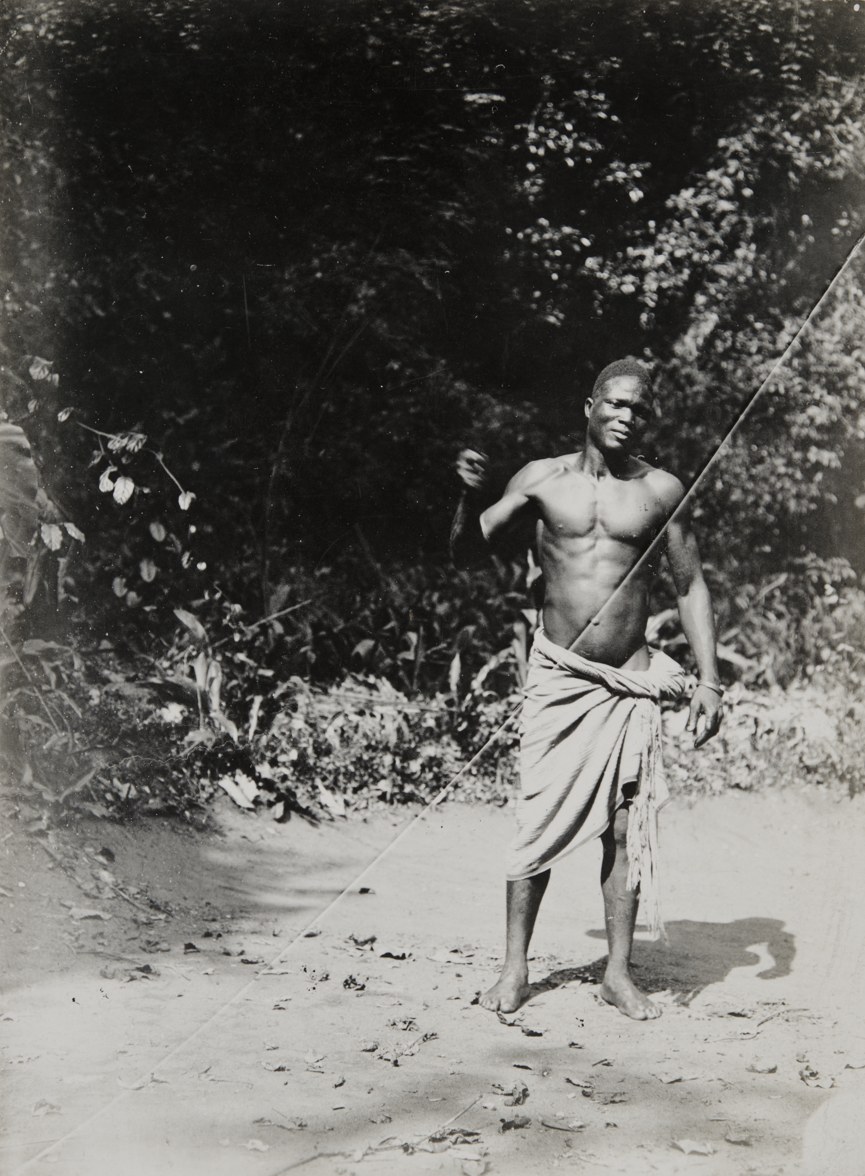
The Bini themselves called it Orò. R. E. Dennett, writing in 1910, gave its local titles: “The Oro of the Bini is known as Oloawon Ovato, Oloawon Ovia, and Usaokwhaiyi,” and he was sure that “the bull roarer is certainly used at Ovia’s yearly festival in Benin territory” (Dennett 1910, p. 39). At the end of Ovia’s three months, he adds, “Oloawon (or Oro) comes down for seven days, and Ovia is then said to be dead until next year. During these seven days women are not allowed outside their houses” (p. 40). P. Amaury Talbot, the colonial ethnographer of southern Nigeria, heard the same in the capital: “The sound of the Oro bull-roarer, called by Bini Elimidu, is sometimes heard when it is desired to confine women to their houses … as, for instance, when the Obba of Benin is about to eat new yams” (Talbot 1926, vol. 3, p. 764).
So Benin, Yoruba’s great eastern neighbour, took Orò as a word for secret rites and as the title of the god whose roar sends the women in, and grafted it onto its own forest god. Orò went east from the Yoruba country by more than one road, and wherever it arrived it was taken apart.
A god travels in pieces
A cult does not move as a package. Orò left the Yoruba towns whole: a voice in the night, a secret society, a law that killed women who looked, a name that meant the Rite and the Fierce One. It reached the Delta in parts, each set down where kinship and trade carried it. The Apoi were the line along which a Yoruba word could go home and settle on an Ijo instrument, the way Yoruba òróró settled on Kolokuma oil. At home it met the oldest god of the clan and a festival where women walk under umbrellas, and the law did not take. Brass took the law and gave it an Ijo name, the Night-Beast, as people do when a thing’s own name is too dangerous to speak. Benin took the word, and Melzian, who knew both languages, wrote the crossing into the entry: cf. Yor. oro.
Put the pieces back together and they make Orò again. The Delta keeps him the way a delta keeps anything carried down to it: broken up and sorted, but every grain traceable to its source. In April at Agadagbabou, when the board whirls over the lake, the Kolokuma are calling the night-god of the Yoruba by his name.
Key sources
Williamson, K. and Blench, R. 2011. Dictionary of Kolokuma Ịzọn. Electronic edition — s.v. Agadagbábòu (p. 3); Kólokùmá (p. 118); ofukú (p. 161); Okpótú (p. 168); oróro¹ “stream,” oróro² “bull-roarer,” óru, oru-otú (p. 172); okuún, ororó. Williamson, K. and Blench, R. Proto-Ijoid Reconstructions, v. 3.1 — “deity” (p. 11); appendix on Ijo cultural traits (p. 41). Blench, R. Comparative Ijoid Wordlist — DEITY.
Kaliai, M. H. I. 1964. Nembe-English Dictionary. Ed. R. Blench, 2008 — s.vv. ánoin, noin, noindeaḹụ, nama, noinnama, oro, oru.
Tepowa, A. 1907. “A Short History of Brass and Its People.” Journal of the African Society 7 (25): 32–88 — Noin-nama, pp. 71–72. Talbot, P. A. 1926. The Peoples of Southern Nigeria, vol. 3. Oxford — the Bini Elimidu (p. 764); the Lower Ijaw Noin-nama (p. 765). Leonard, A. G. 1906. The Lower Niger and Its Tribes. London — p. 291.
Bowen, T. J. 1858. Grammar and Dictionary of the Yoruba Language. Washington: Smithsonian — introduction, p. xvii. Crowther, S. 1852. A Vocabulary of the Yoruba Language. London — p. 223. Church Missionary Society. 1913. A Dictionary of the Yoruba Language. Lagos — p. 200, s.vv. Orò, Oró, Òróró. Ellis, A. B. 1894. The Yoruba-Speaking Peoples of the Slave Coast of West Africa. London — pp. 109–111.
Alagoa, E. J., Tamuno, T. N. and Clark, J. P., eds. 2009. The Ịzọn of the Niger Delta. Port Harcourt: Onyoma — Alagoa, Kowei, Owei and Dunu on the Apoi and Arogbo (pp. 400–409); Okorobia on the Kolokuma lineages and Okpótú (pp. 461–462). Raheem, O. and Famiyesin, M. 2017. “Controlling the Boundaries of Morality: The History and Powers of Ayelala Deity.” Yoruba Studies Review: 231–247 — pp. 233–236, 244, 246.
Melzian, H. 1937. A Concise Dictionary of the Bini Language of Southern Nigeria. London: Kegan Paul — ɛmila, ɛmil-ovia (p. 54); oɽo (p. 147); ɔvia (p. 170). Bradbury, R. E. 1957. The Benin Kingdom and the Edo-Speaking Peoples of South-Western Nigeria, with P. C. Lloyd, The Itsekiri. London: International African Institute — Ovia (pp. 56–57); Itsekiri (pp. 179, 200). Dennett, R. E. 1910. Nigerian Studies. London: Macmillan — pp. 39–40.
Marcuzzi, M. 2010. “The Bullroarer Cult in Cuba.” Latin American Music Review 31 (2): 151–181.
As far as we know, the pairing of the Kolokuma oróro with the Yoruba Orò is original to this page.