Atlas Essay —
Ask for the Bullroarer
Arnhem Land, the Roper River and the Gulf of Carpentaria, northern Australia · 1938–41
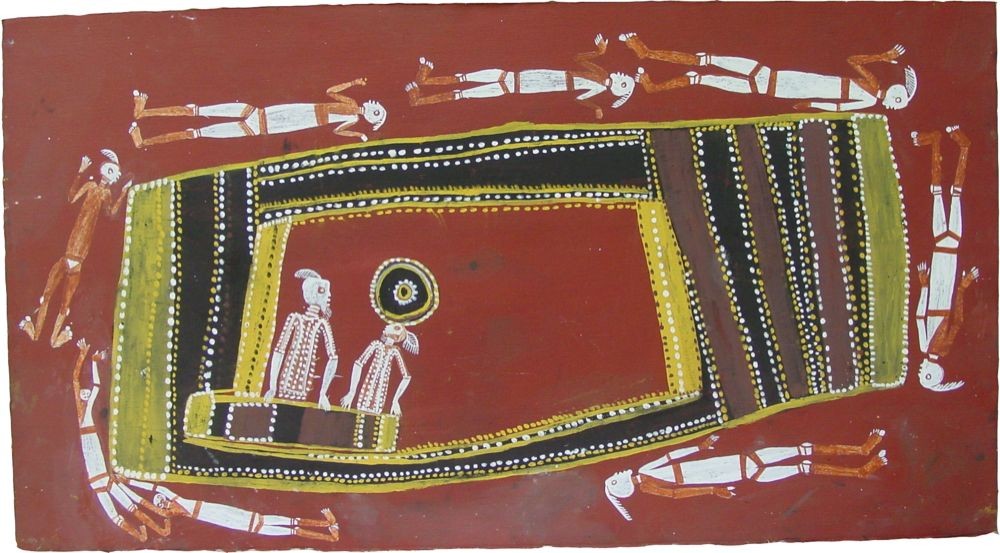
Between 1938 and 1941 the linguist Arthur Capell went from language to language across Arnhem Land, in the far north of Australia, with a list of six hundred English words. At each stop he asked for “buffalo,” “bullroarer,” “burn” and the rest, and typed the answers in columns. Under bullroarer the men did not give him a word for a slat on a string. On Goulburn Island they said uwar. On the Gulf of Carpentaria they said mumuna. On the Phelp River they said wugunabibi. In the middle of the country they said maralbindi. Every one of those names a Mother, her rite, or her Snake.
In 1938–41 Arthur Capell asked Arnhem Land men for the word “bullroarer,” and most of them gave him the public name of a Mother, her rite or her Snake: mumuna, wubar, gunabibi, maralbindi. Set on the map, the Ubar names hold the north-west coast and the Kunapipi names run from the Roper River to the Arafura Sea.
In brief
- Twenty-six of Capell’s forty languages answered under bullroarer. Twenty-one of the answers name a rite, its Mother or its Snake: ten the Ubar, eleven the Kunapipi.
- The secret voice has two names. Ronald Berndt calls mumuna “the ‘outside’ secular word used for both the bullroarer and the Snake,” and the Gunwinggu roarer mumana, “the Mother’s name, a non-secret word.” A stranger asking for the roarer was given that one.
- On the Roper River in 1911–12 the roarer was already kunapippi, the voice of Mumanna. Berndt traces the Kunapipi of north-east Arnhem Land to the Roper, and Capell’s Kunapipi names reach from the Roper to the Arafura coast, in four language families.
- On the north-west coast the Mother’s voice is a hollow log, the ubar gong, with the snake Yirawadbad inside it. Every west-coast answer in Capell’s column is the Ubar’s name, and in 1970 Capell himself glossed Mawng wuwar “Ubar ceremony.”
- The first Kunapipi was danced at Oenpelli early in 1950. From then on the Gunwinggu Kunapipi roarers were maralbindi and mumana.
- Lloyd Warner and A. P. Elkin set the bullroarer of the Kunapipi, the Ubar’s hollow log and the Yabuduruwa gong in one place in the rite.

Six hundred words
Capell was a Sydney linguist with a fellowship from the Australian National Research Council and a plan to set down every language of the north. After the north-west in 1938–39, a second grant carried him “over the remainder of Arnhem Land” (Oceania 12, 1942, p. 364). The survey ran from Port Essington on the Cobourg Peninsula to the Gulf of Carpentaria and south to the Roper River. In 1956 he typed the vocabularies into one ledger, A Vocabulary of 600 Words in Forty North Australian Languages: forty numbered lines, one per language, and a page for each handful of English words. Page 18 holds buffalo, bullroarer, burn and burrawang. The buffalo column is the dull one: ŋanabaru nearly everywhere, the same introduced animal under the same borrowed name. The bullroarer column is the one that talks.
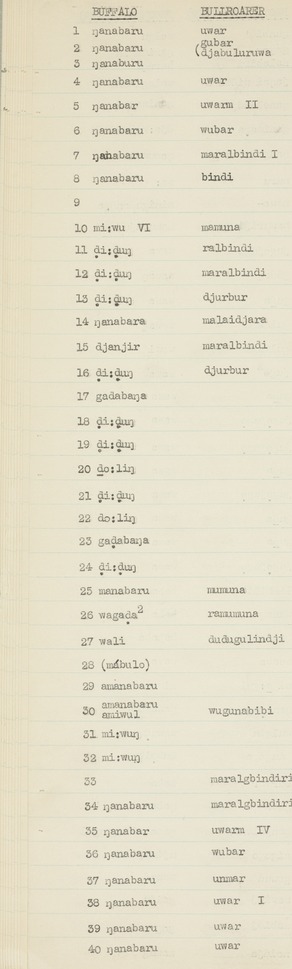
Here is what the forty lines say, sorted by what the answers name. The map above sets each one on its country.
| The answer names | Capell’s lines | Forms |
|---|---|---|
| The Ubar, the hollow-log rite of the north-west coast | Iwaidja, Kunwinjku, Amurdak, Mengerrdji, Gunavidji, Urningangk, Gurrgoni, Mawng, Kunbarlang, Marrku (10) | uwar, uwarm, wubar, gubar |
| The Kunapipi Mother, Mumuna | Nunggubuyu, Mara, Yanyuwa (3) | mamuna, mumuna, ramumuna |
| The Kunapipi itself | Wandarang (1) | wugunabibi |
| The Kunapipi roarer’s song-name | Burarra, Rembarrnga, Gupapuyngu, Ritharrngu, Djinang, Jawoyn, Yangman (7) | maralbindi, bindi, ralbindi, maralgbindiri |
| Another word | Wangurri, Yan-nhangu, Djinba, Alawa, Dalabon (5) | djurbur, malaidjara, dudugulindji, unmar |
| No answer | Gaagudju, Anindilyakwa, eight north-east Yolngu clans, Mangarrayi, Ngandi, Buan, Ngalakan (14) | — |
Twenty-one of the twenty-six answers are proper names. A Kunwinjku man gave two, gubar and djabuluruwa, and the second is the name of yet another rite, the Yabuduruwa. Capell asked for a thing and was answered, nearly every time, with a someone.
The name that may be said
In northern Australia the sacred voice is kept from women and children, and so are some of its names. But not all of them. The voice has an inner name that men keep among themselves, and an outer one that anybody may say aloud. The outer name is the Mother’s. Ronald Berndt, who worked through the Kunapipi from the Roper River to Yirrkala in the 1940s, set it down twice. Here is the Roper, where the Snake swallowed the two Wawalag sisters:
… the noise made by Julunggul, after telling the dua Snakes she had swallowed the Wauwalak, was (as mentioned) part of the sound of the ritual bullroarer (termed also julunggul or julunggir, and mumuna; this latter is the ‘outside’ secular word used for both the bullroarer and the Snake, called ‘Lightning Snake’. It is also one name of the Kunapipi or Kadjari Mother …
Ronald M. Berndt, Kunapipi (1951), p. 25
And here is Oenpelli, in western Arnhem Land, where he and Catherine Berndt watched the Gunwinggu Kunapipi:
‘The Mother is calling them, they will be swallowed by the Snake.’ Simultaneously, bullroarers are swung — maralbindi, either male or female. The female ones are ordinarily used, the mumana (or ngalmamuna, the Mother’s name, a non-secret word) or ‘Mother one’ …
Ronald M. Berndt and Catherine H. Berndt, Man, Land and Myth in North Australia (1970), p. 139
The Ubar, on the north-west coast, keeps the same two registers. Its gong has an inside name kept for the initiated; ubar is the name the whole country uses. Its elders put the rule in one line to the linguist Murray Garde: “Women and children will hear the Ubarr … but they must not see it.” The voice is public. The name of the voice is public. What is hidden is the thing that makes it.
“mumuna; this latter is the ‘outside’ secular word used for both the bullroarer and the Snake”
Ronald M. Berndt, Kunapipi, 1951So a stranger with a notebook, asking for “bullroarer,” got the name a man was allowed to give. That name belongs to the Mother, to her rite, or to her Snake. The voice in the trees is the Mother herself, and in the stories the men tell about their own cult the voice was hers first. In Arnhem Land the rule leaves a paper trail, because the outside name is the one that gets written down.
Mumuna on the Roper
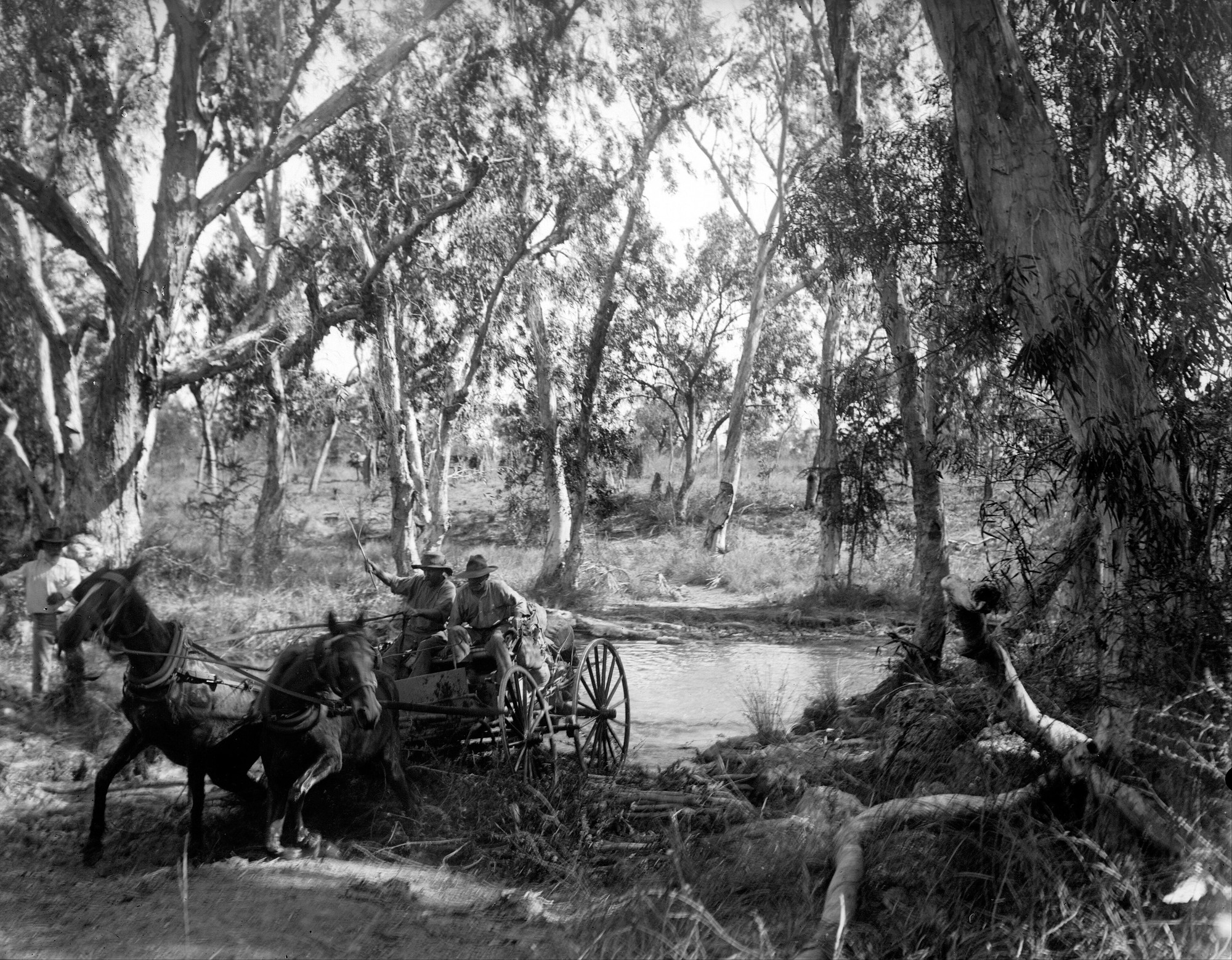
The Roper River runs east out of the Northern Territory into the Gulf of Carpentaria, along the southern edge of Arnhem Land. In 1911 Baldwin Spencer travelled its country by buggy and found the Kunapipi’s name already on the roarer. Among the Ngalakan, at the last stage of a boy’s making:
It is during the performance of these that, for the first time, he is allowed to see the bull-roarer or kunapippi, the noise made by which is supposed by the lubras to be the voice of a spirit called Mumanna, who takes the boy away during the initiation ceremony.
Baldwin Spencer, Native Tribes of the Northern Territory of Australia (1914), p. 176
Among the Jawoyn of the Katherine River, “the boy is now shown the bull-roarer, or Kunapippi” (p. 162). The Mungarai of the middle Roper gave the name to a person. In the far-off times they call Kurnallan, they told Spencer, there lived “a very big man named Kunapippi,” who carried his spirit children, all boys, in his dilly bags:
He had, at first, been underground, but he came out and made a camp with a raised bank all round it, and cut a large quantity of grass that he placed on the ground in the centre. This over, he brought the boys out of his dilly bags and put them on the grass. He possessed several of the sacred sticks, called, like himself, Kunapippi. He had made them, and was the first to have any.
Baldwin Spencer, Native Tribes of the Northern Territory of Australia (1914), p. 214
On the Gulf coast the Mother is named outright. Berndt had it from the Mara, at the mouth of the Limmen Bight River: “To the Ma:ra, as to many other tribal groups, Mumuna is the great Mother who created everything and everyone in the Beginning” (Berndt 1951, p. 155). She was killed, and her death is the sound:
The Mumuna dies and sends her last cry, with her blood, to every tree. The sound of the swinging bullroarer is that cry.
Ronald M. Berndt, Kunapipi (1951), p. 156
That is the word Capell’s Gulf speakers gave. The Mara said mumuna; the Nunggubuyu of the Rose River said mamuna, and their roarer, a Dutch museum records, was the voice of Ngara-Mamurna, the woman who swallows the boys; the Yanyuwa at Borroloola said ramumuna; and the Wandarang between them said wugunabibi, the rite’s own name with a noun-class prefix. When Spencer and Gillen came down that coast in 1901, the Mara roarer was watanurra and the Yanyuwa one mura-mura, the voices of other spirits. Forty years later both peoples answered with the Mother.
The Snake’s belly
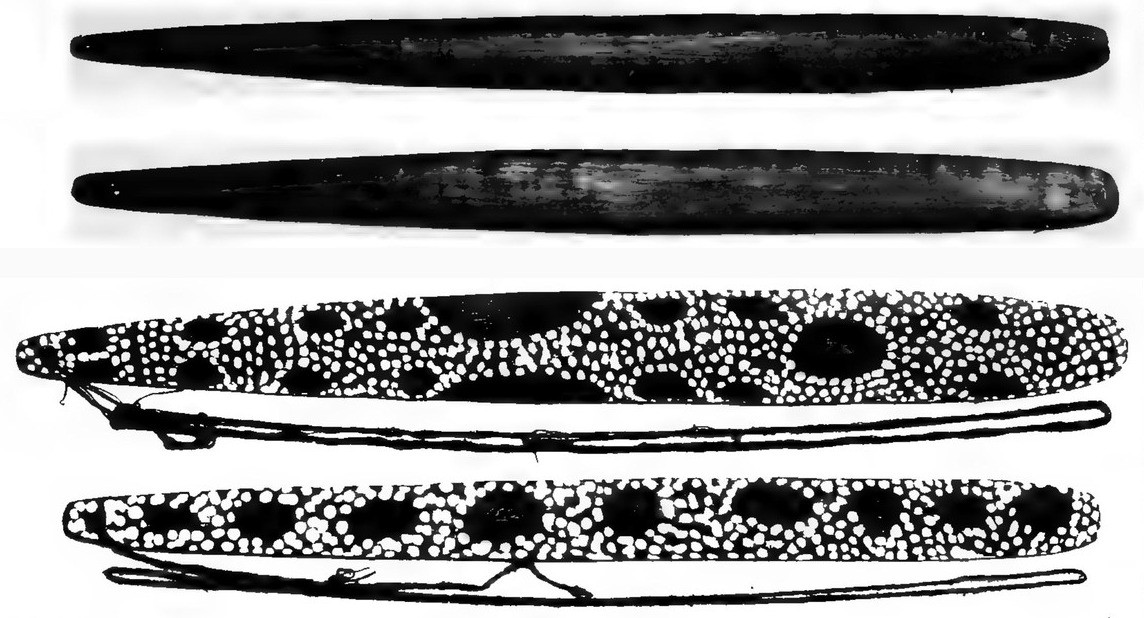
North of the Roper the Kunapipi’s roarer has a second public name, and it comes out of the songs. In the Kunapipi songs Berndt took down on the Roper, the first line of the first song is three names for one object: mu:muna maralpindi pundjarlari, each word glossed “bullroarer.” He explains the second:
In this song, however, the bullroarer is identified as the Snake, the maralpindi (or maralpan) being its belly: the wider end of the bullroarer is here said to be ‘the inside of the Snake’s …’
Ronald M. Berndt, Kunapipi (1951), p. 88
That song-word is the one Capell heard through the middle of the country. The Jawoyn of the Katherine River and the Yangman of the Elsey said maralgbindiri. The Rembarrnga, in the hills of south-central Arnhem Land, said bindi. The Ritharrngu, further east, said maralbindi. On the north coast the Djinang and the Burarra said maralbindi, and the Gupapuyngu of the Crocodile Islands said ralbindi. In Ngandi, on the upper Wilton River, the dictionary word is maralpiṇḍiʔ, the bullroarer and also the tree it is cut from.
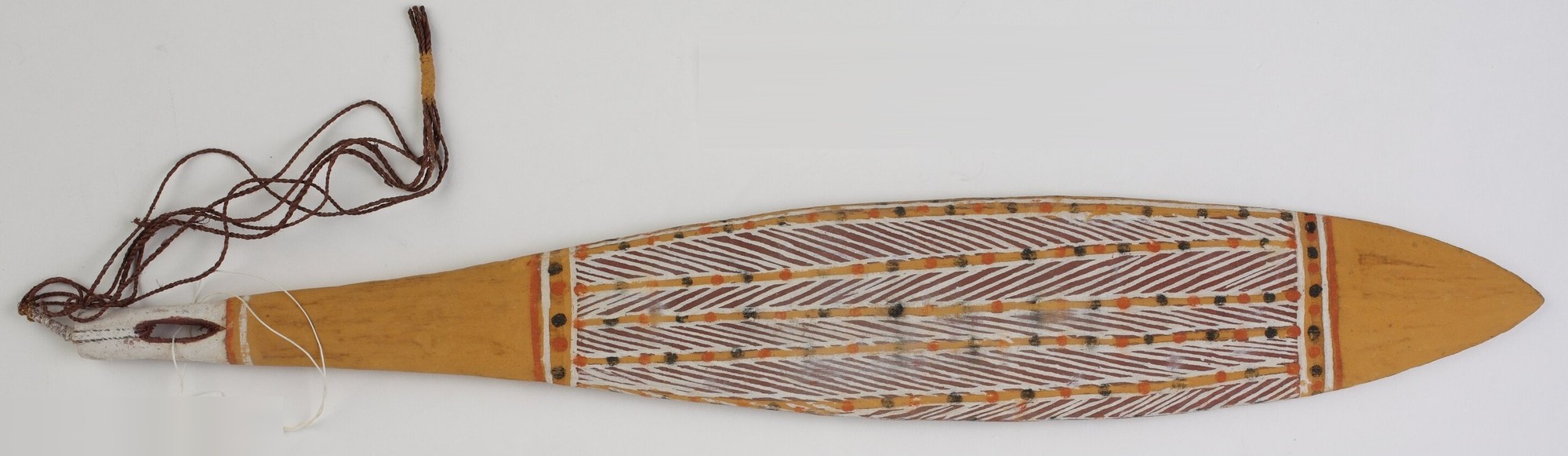
These are four language families: the Gunwinyguan languages of the south and west, the Pama-Nyungan Yolngu of the north-east, the Burarran languages of the north coast, and Mirndi on the Gulf. When Lloyd Warner worked among the Yolngu at Milingimbi in 1926–29, the first act of their Gunabibi was the roarer: “Mandelprindi, the bull roarer, is made” (Warner 1937, p. 290). Berndt, sorting the Kunapipi he found at Yirrkala in 1946, concluded that “the Yirrkalla version of the Kunapipi is not indigenous” (p. 144) and that “the Yirrkalla Wauwalak and Kunapipi have their origin in the Roper River region” (p. 185). The Jesuit scholar Ernest Worms, writing of the same roarer covered “with paint and blood,” went straight to the word:
The name is a southern loanword.
Der Name ist ein südliches Lehnwort.
Ernest A. Worms, in Nevermann, Worms and Petri, Die Religionen der Südsee und Australiens (1968), p. 181
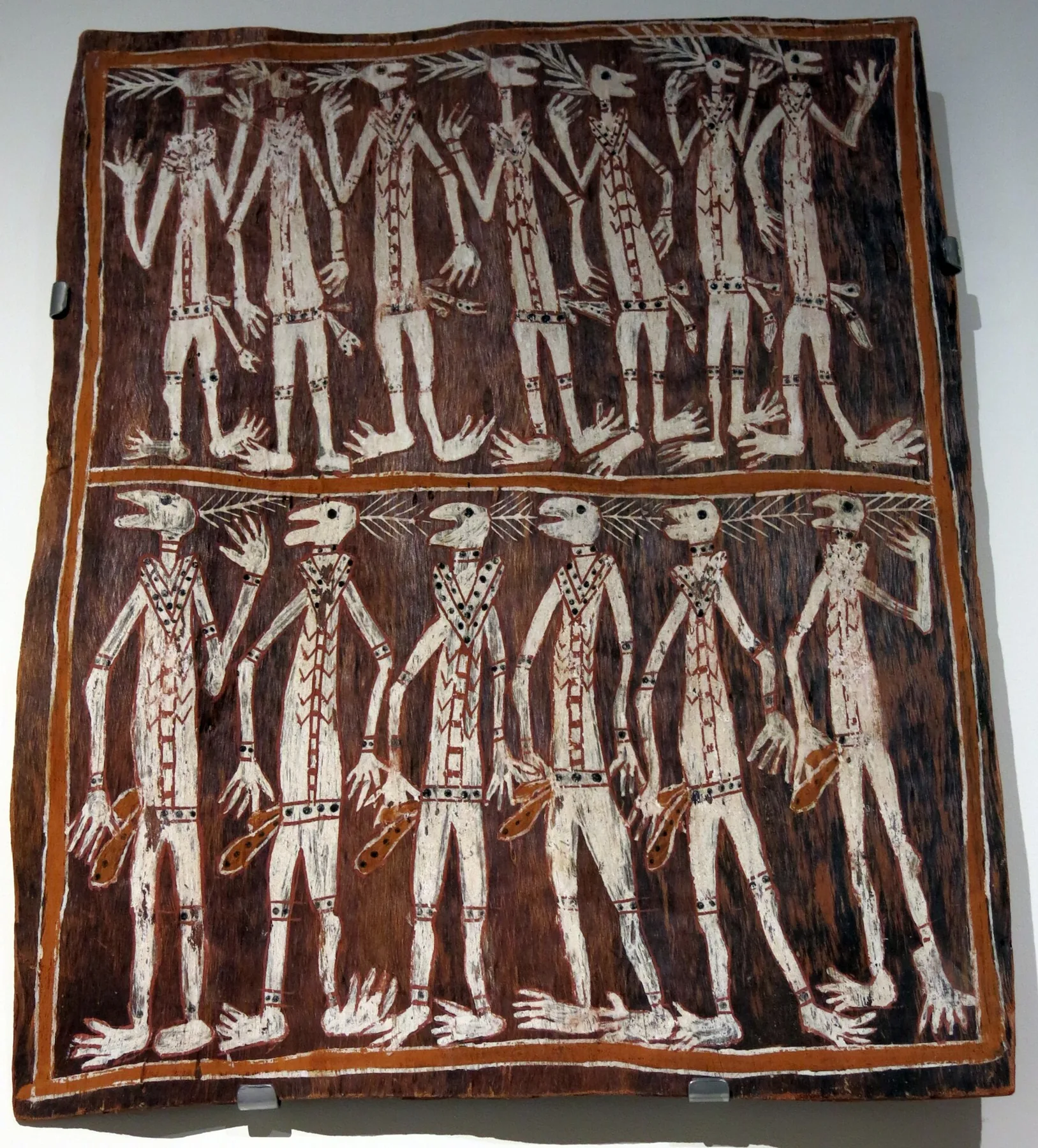
On Capell’s page, mumuna and gunabibi are the Gulf and Roper answers. Maralbindi runs north from the Jawoyn and the Yangman, through Rembarrnga and Ritharrngu country, to the Djinang and the Burarra on the Arafura coast.
The Mother is a log
West of the Burarra the column changes all at once. From the Liverpool River to Port Essington, every answer is one name: uwar in Mawng on Goulburn Island and in Iwaidja, Amurdak, Marrku and Kunbarlang; wubar in Gunavidji and Gurrgoni; gubar in Kunwinjku; uwarm in Mengerrdji and Urningangk on the Alligator Rivers. This is the Ubar, in 1948 the most important ceremony in western Arnhem Land. Garde sets out its names:
The name of the ceremony varies depending on the language. The Alligator rivers languages around Gunbalanya, such as Mengerr, Erre, Urningangk and Gaagadju, called the ceremony Ubarr. The Kunwinjku people who moved into the Gunbalanya region from the east use the name Wubarr. The Iwaidja equivalent—from North-West Arnhem Land—is Kuwarr, and in Mawng on Goulburn Island it is Uwarr.
Murray Garde, “The Forbidden Gaze” (2011), p. 407, n. 10
Capell’s forms answer Garde’s language for language: Mawng uwar to Uwarr, Kunwinjku gubar to Wubarr, Urningangk uwarm to Ubarr. And Capell settled it himself. In the Mawng vocabulary he published with Heather Hinch in 1970, the headword wuwar is glossed in two words: “Ubar ceremony” (Capell and Hinch 1970, p. 201). The word he had typed under bullroarer was the name of a rite.
The Ubar’s voice is not whirled. It is beaten. Its Mother is a hollow log, a long wooden gong, and the python Yirawadbad lives inside it. “The hollow log Yirawadbad made is represented now by the ubar drum, the focus of the rites,” write the Berndts (1970, p. 120), and one of their plates is captioned “Inside the ubar drum is Yirawadbad, in snake form” (p. xi). Ronald Berndt calls it “the ubar (Mother/Ngaljod) drum,” Ngaljod being the Rainbow Serpent (1974, p. 14). Louis Allen, collecting barks at Oenpelli, put it plainly: “an Ubar drum is beaten to represent the voice of the great snake” (1972, p. 13). As with the Kunapipi, the rite began with women: “several myth versions claim that women were first in possession of ubar ritual or had an equal opportunity to control it” (Berndt and Berndt 1970, p. 120).
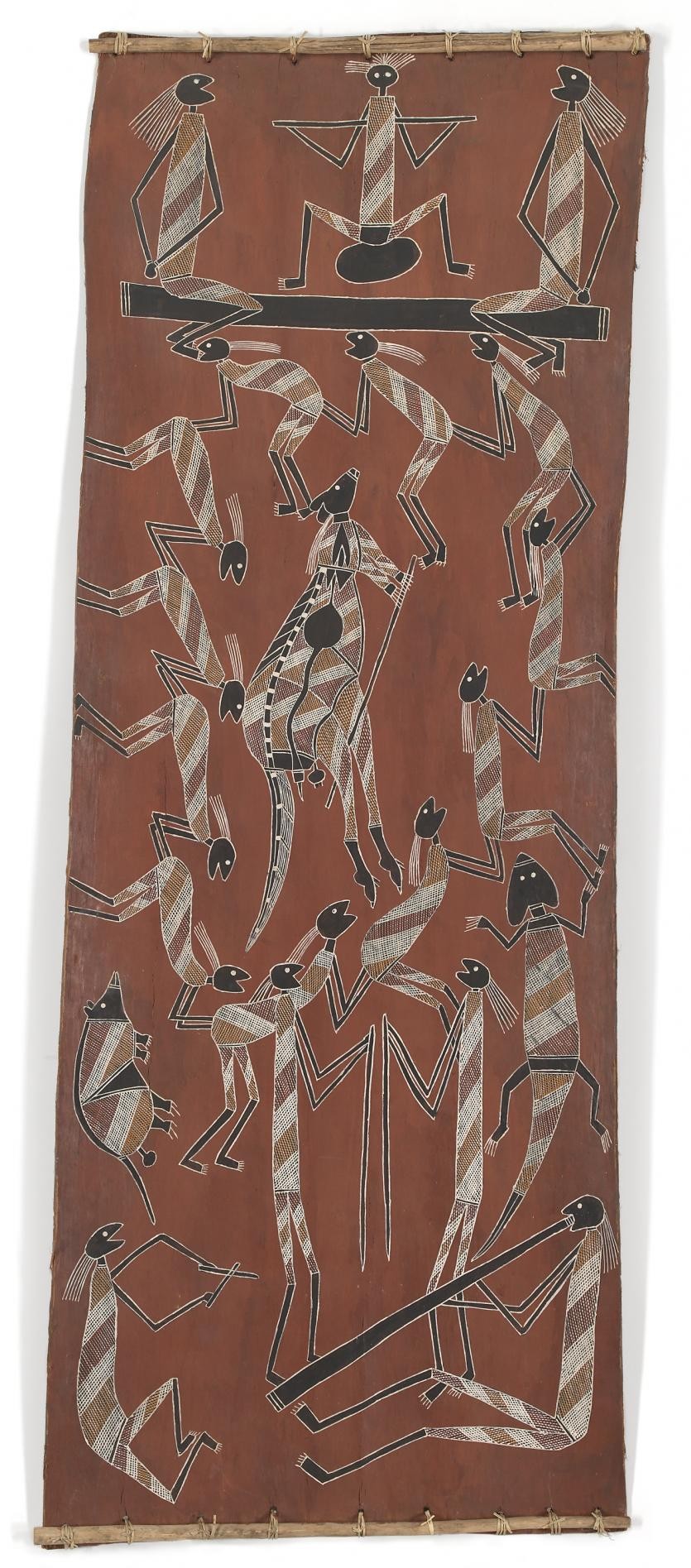
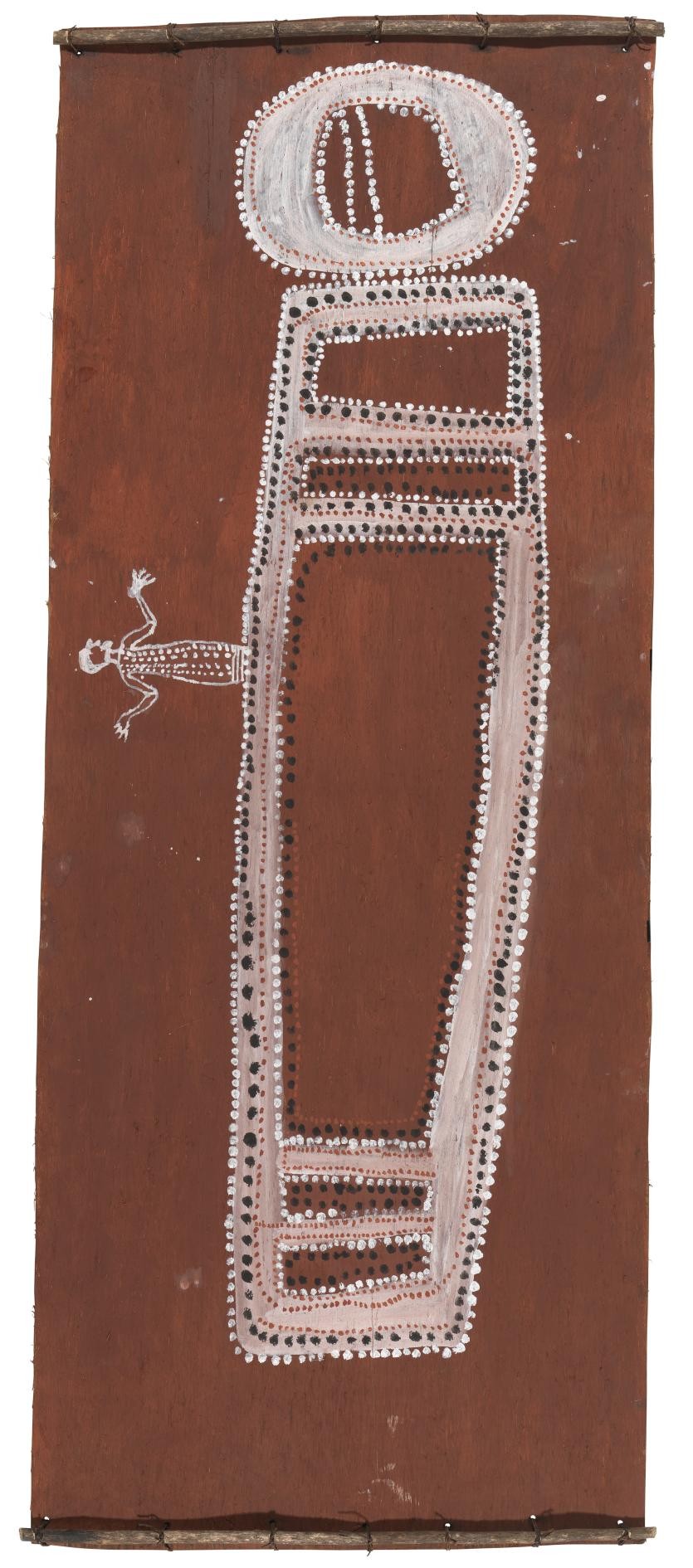
When Spencer went through this country in 1911–12 he wrote that among the Kakadu and their neighbours on the Alligator Rivers there were no bull-roarers at all (1914, p. 211). Capell’s Gaagudju line, the Kakadu, is blank. Further west, at Port Essington, the Iwaidja did whirl roarers, and Spencer says where. The boys were taken “to a special camp called koar, where a ceremonial ground has been prepared,” with a hollow log in the middle of it. “This special log is called piruakukka, a name that no lubra may bear” (p. 116). Then:
It is during the performance of these ceremonies that the boy is shown the bull-roarer, called by this tribe Kurrabudji. He sits down on the koar ground with his head bent low so that he cannot see what is taking place. Some of the old men paint themselves and come up behind him whirling the bull-roarers. The pappam tells the boy to look up, and then he sees the men and is told that the noise is made by the Kurrabudji.
Baldwin Spencer, Native Tribes of the Northern Territory of Australia (1914), p. 119
Spencer’s koar is Garde’s Iwaidja Kuwarr. The Iwaidja roarer sounded on the Ubar’s ground, beside the Ubar’s log, and when Capell asked an Iwaidja man for it a generation later he was given uwar, the name of the ground and the rite. The slat itself, for the men who handled it, was kurrabudji.
Oenpelli, 1950
When Capell passed, the Kunapipi had not yet come to Oenpelli. In 1974 Berndt wrote that “among Gunwinggu and Maung, the major ritual sequences are the ubar and the maraiin: a third, the kunapipi, has been introduced within the last thirty years or so” (p. 13). The Berndts were at Oenpelli for its arrival:
We were told that the kunapipi we witnessed early in 1950 was the first kunapipi shown at Oenpelli, although it is fairly certain that it was performed elsewhere in western Arnhem Land long before that date, especially on the Liverpool.
Ronald M. Berndt and Catherine H. Berndt, Man, Land and Myth in North Australia (1970), p. 124
The Liverpool is the river of the Burarra, Gunavidji and Gurrgoni, exactly where Capell’s column turns from maralbindi to wubar. When the Kunapipi did come west, its roarers did not take the local name. The Berndts’ glossary gives the Gunwinggu Kunapipi bullroarer two words, both from the east: “maralbindi: Kunapipi bullroarer,” and “mumana: Kunapipi bullroarer. (Also, ngalmamuna.) See also maralbindi” (1970, p. 246). A Kunwinjku man asked around 1940 said gubar. A Kunwinjku man at the Kunapipi of 1950 called the roarer maralbindi or mumana.
Two Mothers, one place in the rite
The Ubar travelled too, east into Yolngu country, where it became the Ulmark and carried its drum with it. Warner, at Milingimbi in the late 1920s, watched it arriving:
The Uvar drum seems to be fairly late because it is associated with the Ulmark ceremony wherever it is found, and the Ulmark is only partly distributed in the Murngin clans and also seems to be spreading in from the south.
W. Lloyd Warner, A Black Civilization (1937), p. 469
Ian Keen, working in the same country fifty years later, traced the Ulmark home: it “probably originated from the Wubarr of western Arnhem Land” (1994, p. 142). So in Warner’s Milingimbi the two Mothers met face to face, and Warner put their instruments side by side. The souls of the dead, he wrote, “are believed to be within the totemic trumpet itself (and within Mandelprindi and Yermerlindi in the Gunabibi ceremony and Uvar in the Ulmark ceremony)” (p. 280). The slat of the Kunapipi and the log of the Ubar hold the same thing.
Elkin, working the ceremonies south of Arnhem Land, said it in so many words of a third rite, the Yabuduruwa, whose voice is a hardwood gong (1972, p. 196):
It takes the place of the bullroarer of the Kunapipi, the hollow-log drum of the Ubar ritual of the Arnhem Land north coast and the rhythm-sticks of the Maraian of Mainoru.
A. P. Elkin, Two Rituals in South and Central Arnhem Land, 1972, p. 196Capell’s Kunwinjku speaker, asked for the bullroarer, gave gubar and then djabuluruwa, the Yabuduruwa. Both are rites with a sacred voice.
Page 18
Capell set out to record vocabulary, and on most of his six hundred lines that is what he got. On page 18, asked for an object, most of the men gave him a name they were free to say, and it belonged to a Mother. On the north-west coast it was the Ubar, the Mother in the hollow log. Through the middle of the country and down to the Gulf it was Mumuna, the Kunapipi, or the Snake’s belly from its songs. Set on the map, the answers fall into two countries that meet on the Liverpool River, ten years before the first Kunapipi was danced at Oenpelli.
Key sources
- Capell, Arthur. 1942. “Languages of Arnhem Land, North Australia.” Oceania 12(4): 364–392 — the 1938–9 and later fieldwork, p. 364.
- Capell, Arthur. 1956. A Vocabulary of 600 Words in Forty North Australian Languages. Typescript, Sydney. State Library of New South Wales, A 6929 — language key and p. 18, bullroarer.
- Capell, Arthur, and H. E. Hinch. 1970. Maung Grammar, Texts and Vocabulary. The Hague: Mouton — wuwar “Ubar ceremony,” p. 201.
- Berndt, Ronald M. 1951. Kunapipi: A Study of an Australian Aboriginal Religious Cult. Melbourne: Cheshire — mumuna as the outside word, p. 25; the song and maralpindi, pp. 87–88; the Yirrkala Kunapipi, pp. 144, 185; Mumuna and her cry, pp. 155–156.
- Berndt, Ronald M., and Catherine H. Berndt. 1970. Man, Land and Myth in North Australia: The Gunwinggu People. Sydney: Ure Smith — plates, p. xi; the ubar drum and women’s first possession, p. 120; the first Kunapipi at Oenpelli, p. 124; maralbindi and mumana, p. 139; glossary, p. 246.
- Berndt, Ronald M. 1974. Australian Aboriginal Religion. Iconography of Religions 5. Leiden: Brill — the kunapipi among Gunwinggu and Maung, p. 13; the ubar drum, p. 14.
- Spencer, Baldwin. 1914. Native Tribes of the Northern Territory of Australia. London: Macmillan — the Iwaidja koar ground and Kurrabudji, pp. 116–119; the Jawoyn Kunapippi, p. 162; the Ngalakan kunapippi and Mumanna, p. 176; no roarers on the Alligator Rivers, p. 211; the Mungarai Kunapippi, pp. 213–214 and Plate II.
- Spencer, Baldwin, and F. J. Gillen. 1904. The Northern Tribes of Central Australia. London: Macmillan — Mara watanurra, pp. 366–367; Anula mura-mura, pp. 372–373.
- Warner, W. Lloyd. 1937. A Black Civilization: A Social Study of an Australian Tribe. New York: Harper — souls in the trumpet, Mandelprindi and Uvar, p. 280; “Mandelprindi, the bull roarer, is made,” p. 290; the Uvar drum and the Ulmark, p. 469. (1958 edition, pp. 270, 280, 461.)
- Keen, Ian. 1994. Knowledge and Secrecy in an Aboriginal Religion. Oxford: Clarendon Press — the Ngulmarrk and the Wubarr, p. 142.
- Elkin, A. P. 1972. Two Rituals in South and Central Arnhem Land. Oceania Monograph 19. Sydney — the Yabuduruwa gong, p. 196.
- Worms, Ernest A. 1968. In H. Nevermann, E. A. Worms and H. Petri, Die Religionen der Südsee und Australiens. Stuttgart: Kohlhammer — mandelprindi as a southern loanword, p. 181.
- Garde, Murray. 2011. “The Forbidden Gaze: The 1948 Wubarr Ceremony Performed for the American–Australian Scientific Expedition to Arnhem Land.” In M. Thomas and M. Neale (eds), Exploring the Legacy of the 1948 Arnhem Land Expedition. Canberra: ANU E Press — the ceremony’s names, pp. 406–407 and n. 10; the elders’ statement, p. 407.
- Allen, Louis A. 1972. Australian Aboriginal Art: Arnhem Land. Chicago: Field Museum — the Ubar drum as the voice of the great snake, p. 13.
- Heath, Jeffrey. 1978. Ngandi Grammar, Texts, and Dictionary. Canberra: Australian Institute of Aboriginal Studies — maralpiṇḍiʔ, pp. 156, 175.
- National Gallery of Victoria: Thompson Yulidirri, Wubarr ceremony, 1989 (O.13-1990); Bardayal Nadjamerrek, Ubarr, 2006 (2006.362).