Atlas Essay —
The Wing and the Ghost
The bullroarer’s names on the Austronesian road, from Taiwan to Aotearoa
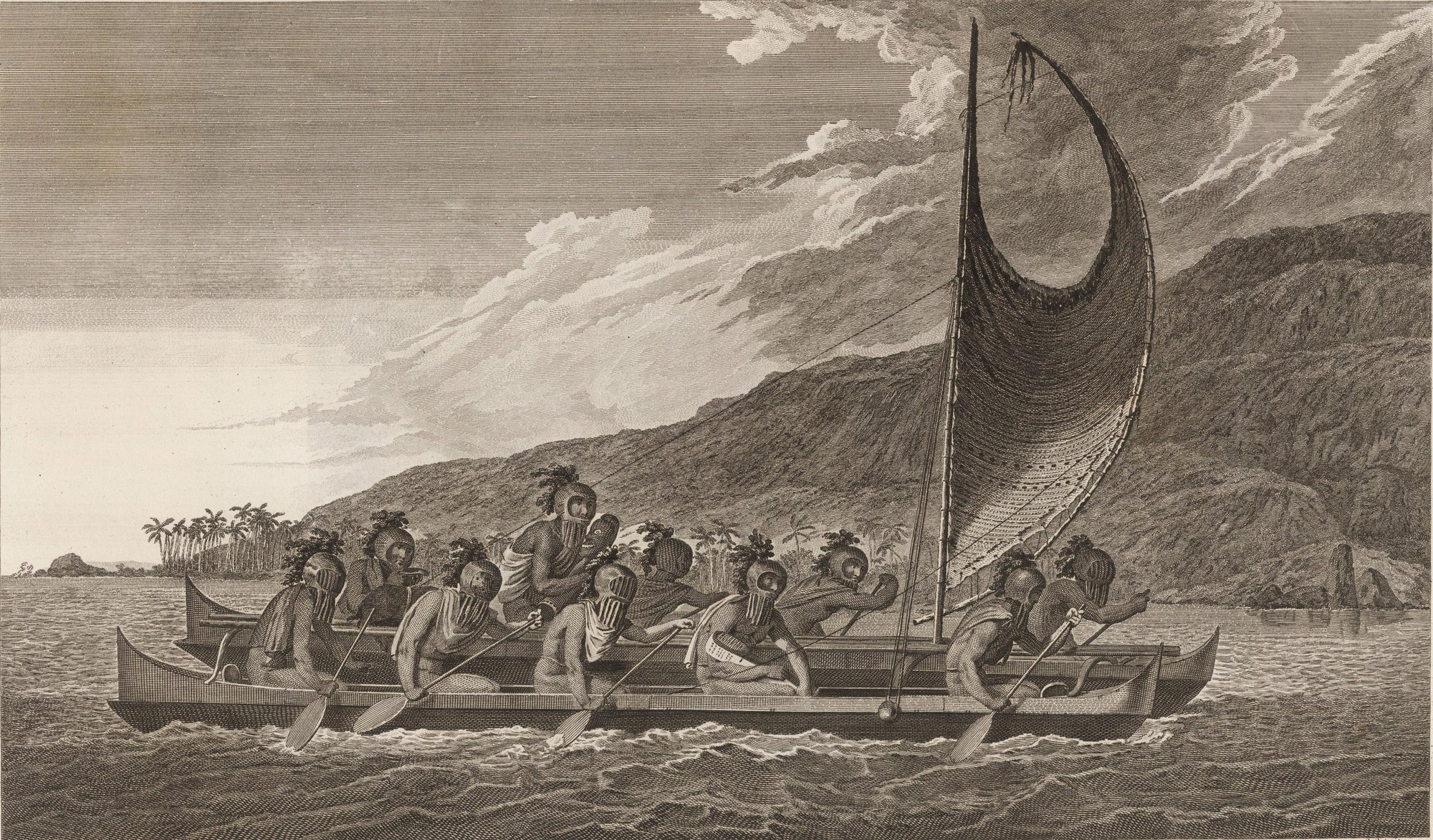
In the mountains of Taiwan a Tsou man swings a bamboo blade on a cord, and the drone runs down the valley to bring rain or warn of an enemy. Its name is the sound it makes. Nine thousand kilometres away and four thousand years down the same road, a Māori adept on the East Cape of Aotearoa whirls a carved blade to call a storm, and its name is the moth. Neither of them calls it a ghost. Between the two, on the coasts and islands around New Guinea, the same instrument is the voice of the dead, and is named for them.
Along the Austronesian road the bullroarer is mostly named for what it sounds like: a flutter, a buzz, a cry and, again and again, a flying insect. The names for the dead gather in one stretch of the road, around New Guinea, next door to the oldest roarer cults in the region.
In brief
- Where the voyage began, the roarer is named for its sound. In Taiwan and the northern Philippines it is euvuvu, bnbn, wiwiw; Sakizaya berber and Javanese wer-wer are built on an old root for “the sound of fluttering, flying.” It is swung for rain, against birds in the crops and to warn of enemies.
- Where the voyage ended, the sound has become the insect. Tonga and Samoa share a roarer name built on *lago, “fly,” older than the split between their languages; the fly returns on West Futuna and in Aotearoa, the dragonfly in the Tuamotus and the Marquesas, the moth among the Māori and the bee in New Caledonia.
- The names for the dead cluster around New Guinea: balum, “spirit of the dead,” on the Huon Gulf of Papua New Guinea; “death-maker” on Mota; the ghost-image on Malekula and Ambrym in Vanuatu.
- Those are the islands nearest the Papuan roarer cults of New Guinea. On the Huon Gulf the Papuan Kai call the roarer “grandfather” and their Austronesian neighbours call it “the Old One.”
- Even there, the toy kept the wing. In northern Vanuatu the children’s roarer was “a whirring string” on Maewo, while on Mota the men’s was the death-maker.

The road out of Taiwan
Some five thousand years ago, rice farmers on the island of Taiwan began the longest dispersal of a single language family before the age of European sail. Their descendants reached the northern Philippines by about 2200 BC, Borneo, Sulawesi and Java over the following centuries, and the Bismarck Archipelago, off the north-east coast of New Guinea, by about 1300 BC, where they made the stamped pottery archaeologists call Lapita. From there they crossed open ocean to Vanuatu and New Caledonia, then Fiji, Tonga and Samoa by about 850 BC. After a long pause their canoes went on to Tahiti and the Marquesas, and in a last burst to Hawai‘i, Rapa Nui and, around AD 1250, Aotearoa. Today some 1,250 Austronesian languages are spoken from Madagascar to Easter Island.
The bullroarer is found the whole length of that road: in the Taiwan mountains where the dispersal began, in the Philippine Cordillera and in Java, on the Huon Gulf of Papua New Guinea and on Malekula in Vanuatu, in Samoa and Tonga, in the Tuamotus and the Marquesas, and on the East Cape of Aotearoa. What it is called changes from island to island. What the names say does not change at random.
Linguists have looked for the instrument’s name in the mother tongue. The Lexicon of Proto Oceanic, the standard reconstruction of the language ancestral to most Pacific tongues, finds words for the conch trumpet, the nose flute, the slit gong and the jew’s harp. Its section on the bullroarer, by Meredith Osmond, describes a lens-shaped or rhomboid piece of wood on a string, “whirled round the head, producing a humming sound,” used only by men and “associated with initiation, secrecy, deception of women and spirit voices,” and places it in Melanesia as far east as Vanuatu, New Caledonia and Fiji. Then it stops:
“Although a handful of terms have been collected, none are cognate. Informants generally are extremely reluctant to speak of the instrument, and may resort to diversionary tactics when asked its name.”The Lexicon of Proto Oceanic, vol. 6, p. 207
The handful of terms came from Melanesia, where the roarer is a secret. Laid out along the whole road, the names tell a plainer story. They are not one word, but most of them say one thing. The table sorts them by what they call the instrument.
| It is called | Names | Built on |
|---|---|---|
| a flutter, a whizz or a hum | bnbn, euvuvu, berber (Taiwan); wiwiw, bawengweng (Luzon); wer-wer (Java); faurien “buzzing wood” (Sonsorol); tal-viv “whirring string” (Maewo); oeoe (Hawai‘i) | PMP *ber, “fluttering, flying”; PAn *beŋbeŋ, “buzz”; imitation of the sound |
| an insect | riwi-riwi (cricket, Nias); koembangan (bee, Java); maguk (bee, New Caledonia); ragohpa, langumumuhbu, lago mumu, rangorango (fly and bee, West Futuna, Tonga, Samoa, Aotearoa); vivi, pinao (dragonfly, Tuamotus, Marquesas); pūrerehua (moth, Aotearoa) | PAn *laŋaw, “fly,” and other insect words |
| a thing that cries | patangitangi, wakatangitangi, hakatangikugu (Cook Islands, Bellona); worung-tamb “a wailer” (Merlav) | PAn *Caŋis, “weep” |
| a thing that circles | baling (Malay); kitiran (Java) | western *baliŋ-baliŋ, “circle round” |
| an ear-slitter | navurvur ndalang, nevin or or ndeling (Malekula) | POc *taliŋa, “ear” |
| a ghost, the dead, the old one | balum, X lanqua “the Old One” (Huon Gulf); röko (Buka); nanamatea “death-maker” (Mota); temes, temigh wump (Malekula); tem’ar kil (Ambrym); hantu-hantuan “ghost-thing” (Borneo) | PNGOc *bara(q)um, PNCV *qata-mate, “spirit of the dead” |
The first three rows are names for what the roarer sounds like, and they run from one end of the road to the other. The last two are names for what it does in a rite and whom it speaks for, and nearly all of them lie in one stretch of the map: the north coast of New Guinea, the islands off it and the islands of Vanuatu.
The sound of wings
In the mountains of Taiwan the Tsou swing the euvuvu, a thin bamboo blade on a cord and handstick. Its drone carried down the valleys to warn of an enemy, and it was also sounded to pray for rain and to scare birds from the crops; its name is the sound, vuvu. Their Amis neighbours on the east coast call theirs bnbn, again the noise it makes, and the Sakizaya, who survived for a century by passing as Amis, remember a slice of stone on a long string called ber ber: “the thinnest stone made the loudest sound.” In the Cordillera of northern Luzon in the Philippines the Ifugao call the roarer wiwiw, the Sagada Igorot bawengweng and the Bontoc wedwed, names that whistle and hum like the thing itself.

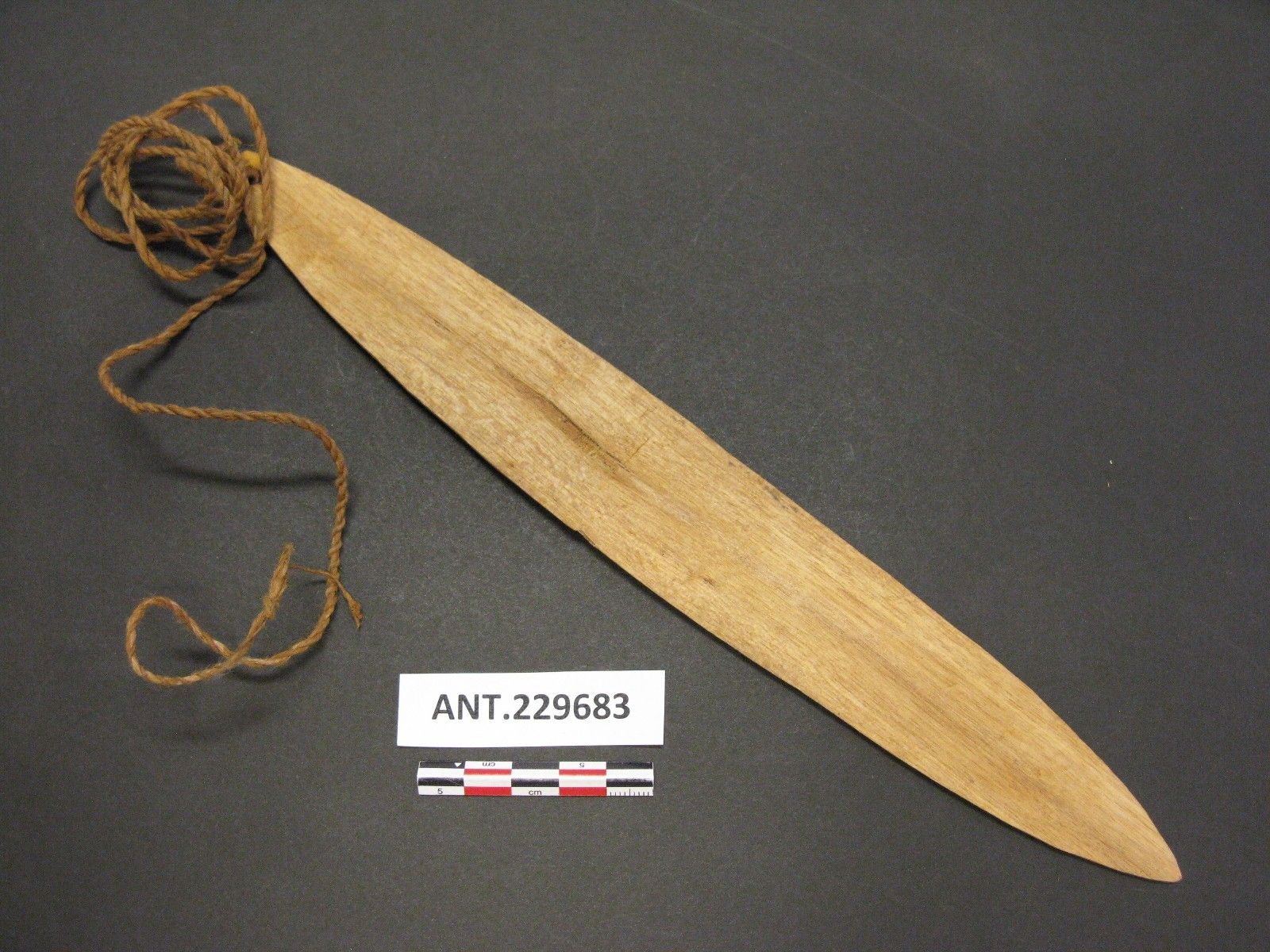
These are not idle imitations. Javanese wer-wer and Sakizaya berber, at the two ends of the western Austronesian world, are both built on Proto-Malayo-Polynesian *ber, which the Austronesian Comparative Dictionary glosses “the sound of fluttering, flying.” Amis bnbn sits beside Proto-Austronesian *beŋbeŋ, “buzz.” The first thing the roarer’s names say, at the source, is that it sounds like wings.
The insects are already there in the west. On Nias, off the coast of Sumatra, the roarer is riwi-riwi, a cricket. Among the names J. D. E. Schmeltz recorded for Java’s whirling toy in 1896 is koembangan, built on kumbang, the carpenter bee. Out in the western Pacific, Sonsorol in Palau called it faurien, “buzzing wood.” Only two names in the west, Malay baling and Javanese kitiran, describe the blade’s circling instead of its voice, and in the Malay villages of Jalor, in what is now southern Thailand, the baling was a farmer’s tool that drove elephants out of the plantations.
None of these western roarers is the voice of a ghost. They bring rain, scare birds and elephants, warn of raiders and amuse children, and they are named for the flutter and the buzz.
The fly, the bee, the dragonfly
At the far end of the road the sound has become a creature. Polynesians carried the old Austronesian word for the housefly, *laŋaw, into Proto-Polynesian as *lago, and the roarer wears it. In Samoa the leaf roarer was lago mumu, the carpenter bee, the “humming fly.” Te Rangi Hīroa, describing Samoan children’s toys, put it in one sentence:
The bull roarer from its humming noise takes the name of the buzzing fly.
Te Rangi Hīroa (P. H. Buck), Samoan Material Culture (1930), p. 552
In Tonga the boys’ leaf roarer was langumumuhbu, the same compound of fly and hum. Samoan and Tongan belong to different primary branches of the Polynesian family, so a compound they share is older than the split between them, which puts it among the first settlers of western Polynesia, nearly three thousand years ago. On West Futuna, a Polynesian island at the southern end of Vanuatu, the leaf whizzer was ragohpa, and rago there is the housefly. In Aotearoa one of the six Māori names Elsdon Best collected was rangorango, from rango, the blowfly. Here is a bullroarer word that has lasted since the canoes landed, and it is the name of an insect.
Where the fly gives way, another insect takes its place. In the Tuamotus the word for the roarer, vivi, is the word for the dragonfly, and as a verb it means “to make a buzzing, whirring, humming sound; as a dragonfly, top, whirligig.” On Fatu Hiva in the Marquesas the leaf whizzer is pinao, the dragonfly. In Pije, a language of northern New Caledonia, the coconut-leaf whizzer is maguk, the bee. The Māori roarer that Best put first is the pūrerehua, the moth.
The other Polynesian names hear a cry. On Aitutaki in the Cook Islands the leaflet roarer is patangitangi; on Pukapuka, wakatangitangi; on Bellona, a Polynesian island in the Solomons, hakatangikugu, which Bellona’s dictionary glosses “to roar, to sound loud,” the instrument a man named Moa swung to summon rain. All three are made on faka-tangi, “to make it cry.” They are names for the sound again, the thing that calls out when it is swung. Of the eleven Polynesian and New Caledonian names on the map, seven are insects, three are cries and one, Hawaiian oeoe, is the whizz itself.
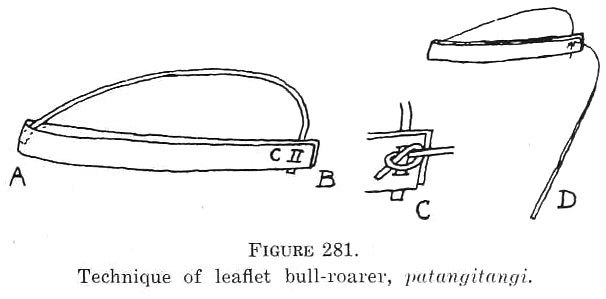
Most of these roarers are leaf toys, a strip of coconut leaflet whirled on its midrib that lasts a few days. Te Rangi Hīroa, who surveyed the material culture of half a dozen island groups, saw why they had been missed:
The more substantial nature of the Maori bull-roarer drew attention to it, whilst the perishable form of the Aitutaki patangitangi probably led to its being overlooked by writers. This has led to the statement that the bull-roarer is unknown to the Polynesians, with the exception of the Maori branch. The cocoanut leaflet patangitangi has as much right to the generic name of bull-roarer as the more stable wooden purerehua.
Te Rangi Hīroa (P. H. Buck), The Material Culture of the Cook Islands (Aitutaki) (1927), p. 345
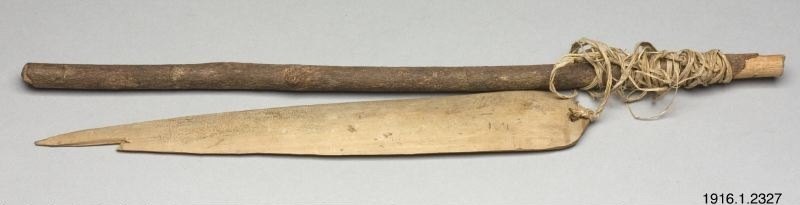
Where the Polynesian roarer did serious work, the work was weather, as it was in Taiwan. The Māori pūrerehua is cut from matai heartwood and swung on a long flax cord. Among Ngāti Porou of the East Cape an adept threw ashes toward the rainy south, whirled the turorohu until it roared, bared his buttocks to that quarter and recited a karakia to insult it into sending a storm; children were scolded for sounding it lest a storm come. On Bellona it summoned rain. Nowhere in Polynesia is the roarer named for a ghost.
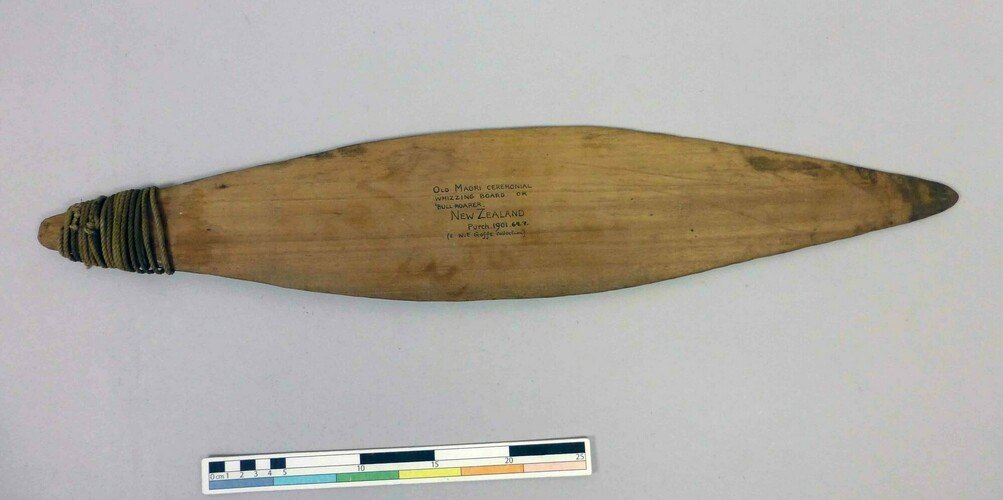
The wider pattern, of peoples on every continent naming the roarer for the fly, the bee, the beetle and the dragonfly, is followed in The Voice on the Wing. On the Austronesian road it is not scattered. It runs from the flutter of Taiwan to the moth of Aotearoa.
Where the dead speak
Around New Guinea the names change their subject. On the Huon Gulf, on the north-east coast of Papua New Guinea, the Yabim and Bukaua peoples gave the bullroarer, the monster that swallowed the boys at circumcision, and the souls of the dead one name, balum. The Lexicon of Proto Oceanic traces the word to *bara(q)um, “spirit of a dead person,” in the ancestor of the Oceanic languages of New Guinea, with cousins across the Papuan Tip: Kilivila baloma, Malinowski’s Trobriand spirits of the dead. In the Trobriands, where there is no roarer cult, baloma stayed a ghost. Only on the Huon Gulf did the ghost-word come to mean the instrument.
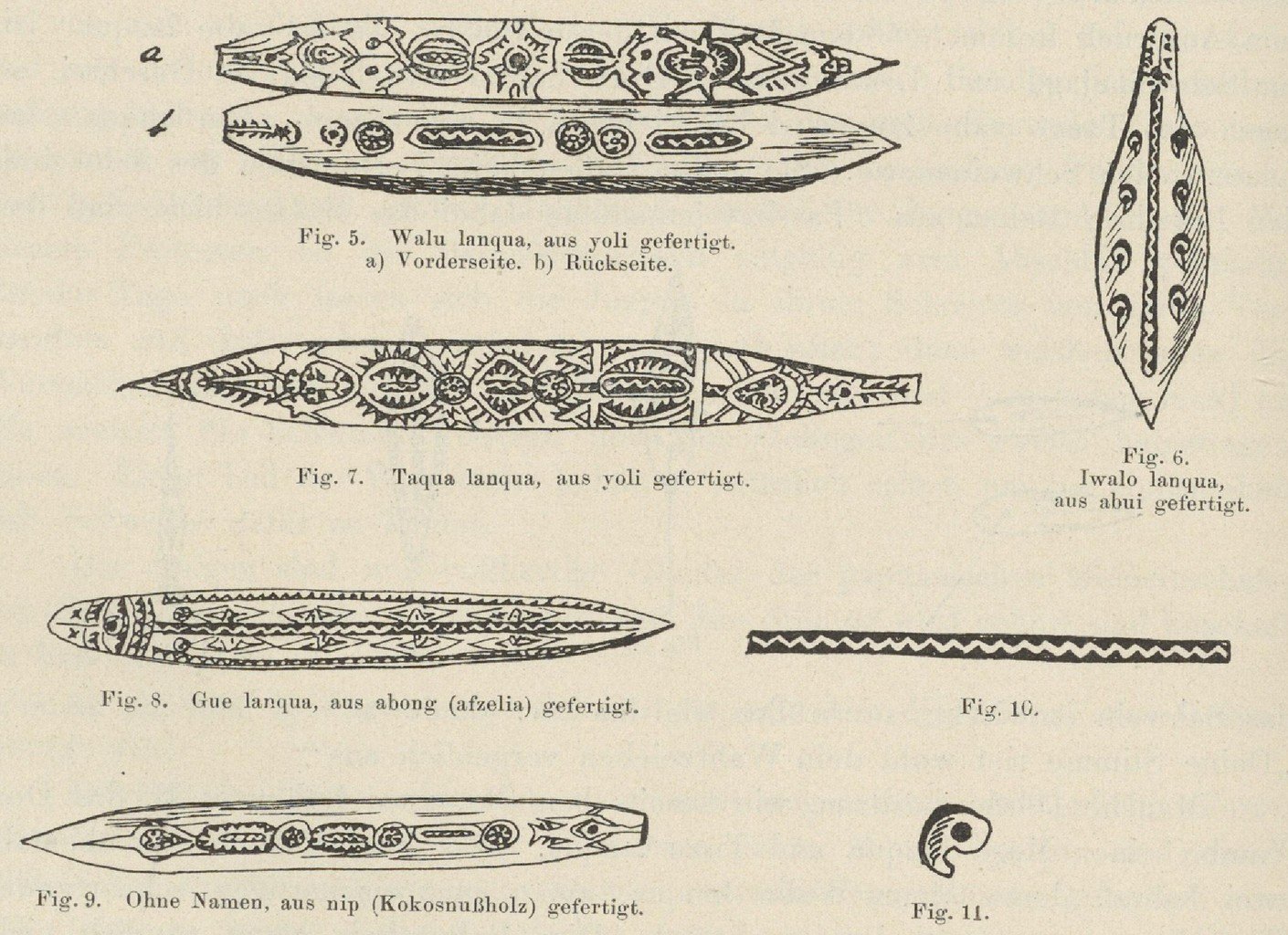
The Bukaua named each clan’s ruling roarer for a particular dead man, with the honorific lanqua, “the Old One,” and the likeness could be exact: the roarer named for Gumba was carved with two humps for his jutting hip-bones, and at Uwaung the roarer named for Wabo hung askew on its cord so that it rasped instead of humming, because Wabo had a mutilated nose and spoke indistinctly. On the Tami Islands, off the same coast, the monster was kani, addressed with the word for old age. On Buka, at the northern tip of Bougainville, the roarer was röko, the spirit of the initiation.
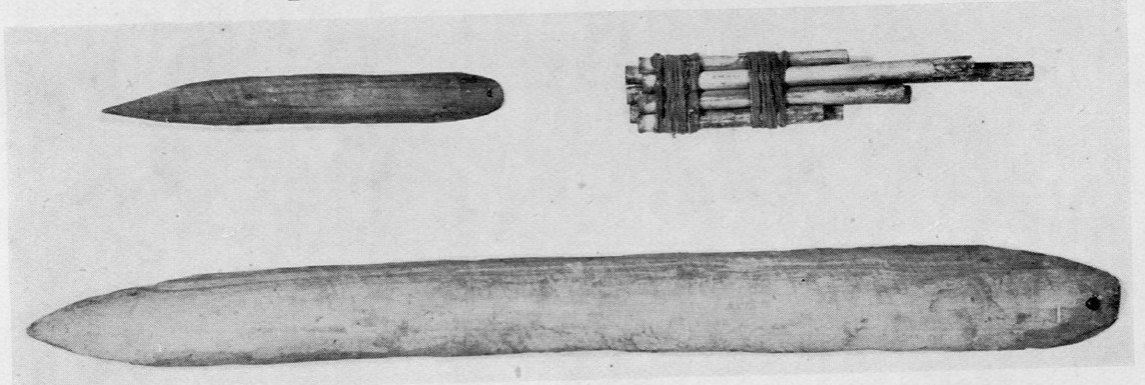
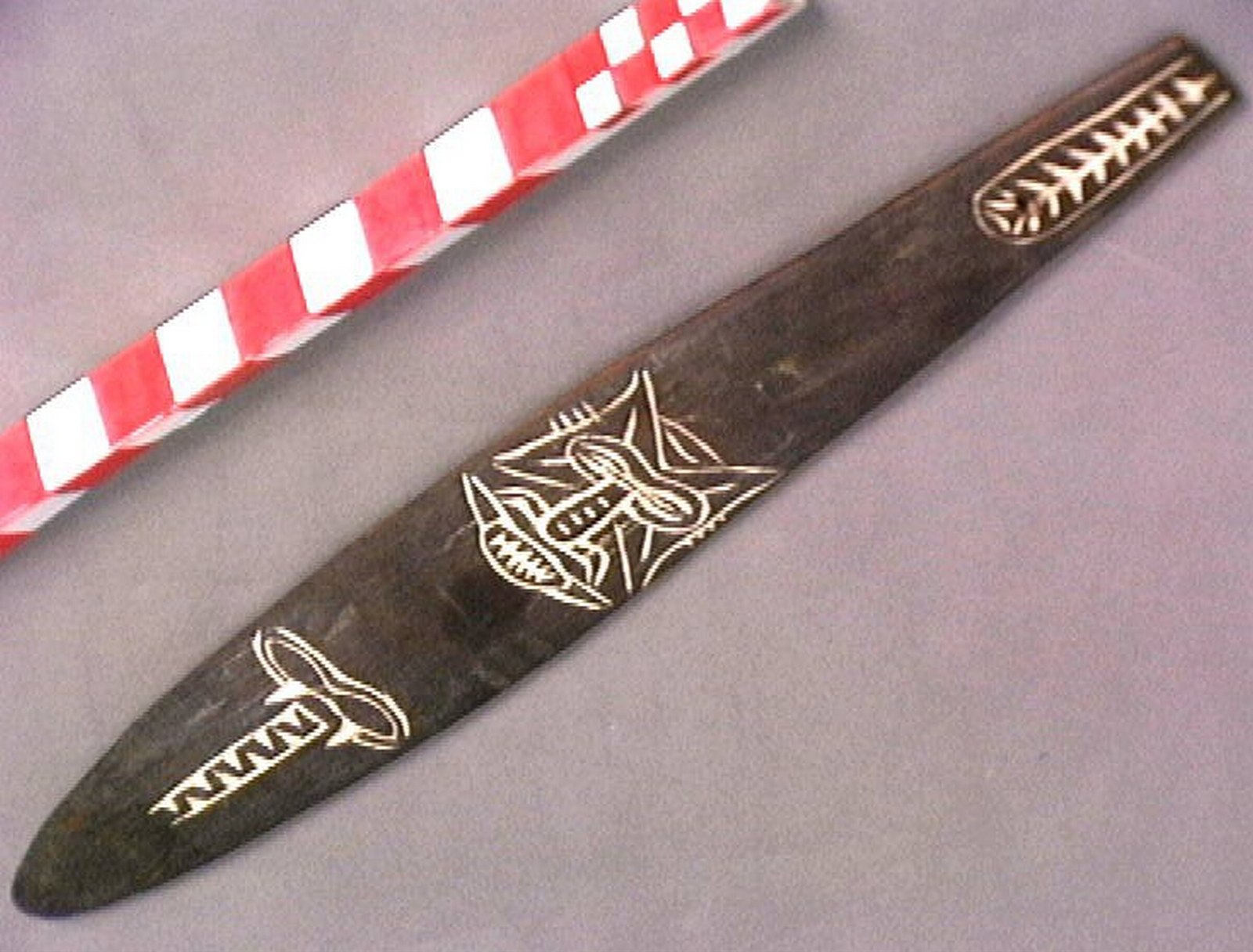
Two thousand kilometres to the south-east the same thing happened with a different word. The old word for a ghost in the languages of northern and central Vanuatu is *qata-mate, “dead person.” On Mota in the Banks Islands it is tamate, the dead man, the ghost, and the name of the secret societies whose members came out of the bush as ghosts; there the roarer was nanamatea, “death-maker.” On Merlav it was worung-tamb, “a wailer,” and was swung the night after a death. On Malekula the Seniang word temes means “a ghost,” and also “an effigy set up for … Nimangki … in which an ancestral spirit is believed to reside intermittently”; in Senbarei on the east coast the temigh is the image raised for the grade rites, and the temigh wump is the bullroarer of the Ruan rites. In north Ambrym, where each village bought its secret rites from their owners, the rite called pato kil had no effigy at all, only the roarer, the tem’ar kil; a tem’ar is an ancestor figure, a spirit.
Malekula also names the roarer for what it does to the boys. Where boys were incised it is the navurvur ndalang, “the ear-slitter,” in Lambumbu in the north, and nevin or or ndeling, “the woman ear-slitter,” in Seniang in the south. At Lambumbu the large roarer is also “The Mother” and nitemah tokhtokh, “the Ghost that abides”; the small one is “The Child” and “The Warrior.” A cult instrument gathers names, and here every one of them belongs to the rite.
On Nggela in the Solomon Islands, on the nights when the ghosts went up inland, the women shut fast their houses and pushed food out through small holes in the walls. Outside in the dark something whirred. “Who are you,” the women called, “are you Siko?” The answer was a whistle. Siko was a deified ancestor who had become a ghost, and the roarer was his voice.
West of New Guinea there is a single ghost name, and it comes from a museum label: a Dyak roarer from southern Borneo that reached the Smithsonian as hantu-hantuan, from the Malay hantu, a ghost. Every other name for the dead on the map lies within a short canoe passage of New Guinea, from the Huon Gulf through Buka and the Solomons to the Banks Islands and Malekula.
The older cults
The voyagers did not come to an empty New Guinea. People had lived there for more than forty thousand years, and the Papuan peoples of its Highlands and coasts kept the strongest bullroarer cults in the region. Mervyn McLean, the great historian of Pacific music, mapped the instruments of 518 tribal areas of New Guinea and found the roarer in a cluster with the ocarina, the bamboo trumpet and the sacred flutes, centred on the Highlands and “adjacent to Australia whence bullroarers would have come,” the property of men’s houses that kept “spirit voices to frighten women and uninitiated boys.” From that core his map fades:
“…with attenuation west to east into Island Melanesia, with bullroarers, for example, losing their significance as esoteric voices and eventually becoming no more than toys for children.”Mervyn McLean, Music, Lapita, and the Problem of Polynesian Origins (2014), p. 16
No instrument of his cluster goes east of central Vanuatu, and that is where the names for the dead stop.
On the Huon Gulf the two stand side by side. The Papuan Kai of the mountains call their roarer ngosa, “grandfather.” Their Austronesian neighbours on the coast call theirs “the Old One” and balum, the ghost. The idea is the same in both languages: the roarer is the voice of the ancestors.
Rites in Melanesia travel. They are bought, taught and carried across language lines: the villages of north Ambrym bought theirs from their owners; young men from Nggela went to the Banks Islands to learn “what ghost mysteries really were”; the Bariai tibura, “forest breath,” crossed into another branch of Oceanic as Bola tuvura. The simplest reading of the map is contact. Where Austronesian speakers lived beside the Papuan cults, the roarer took on the cults’ meaning and was named for the dead in Austronesian words; beyond their reach, it stayed a thing with wings.
The wing kept
Even in the cult country the toy kept the old sense. R. H. Codrington, the missionary who knew the islands of Vanuatu and the Solomons better than any outsider of his century, recorded the children’s names in the same islands where the men’s roarer was the death-maker:
It is a common plaything; in Vanua Lava they call it mala, a pig, from the noise it makes; in Maewo it is tal-viv, a whirring string; in Araga it is merely tavire bua, a bit of bamboo.
R. H. Codrington, The Melanesians (1891), p. 342
And when a cult fell, its roarer went back to the children. On Nggela, Codrington watched it happen:
At length, as said before, the man who knew how to sacrifice to Siko became a Christian, the sacred precincts were explored, bull-roarers became the playthings of the boys, and the old men sat and wept over the profanation and their loss of power and privilege.
R. H. Codrington, The Melanesians (1891), p. 99
Read along the whole road, the names mostly say one thing. The Tsou hear a flutter, the Javanese a bee, the Samoans a fly, the Tuamotuans a dragonfly and the Māori a moth. Only in the islands around New Guinea does the roarer become the ghost, the Old One and the death-maker, and there, in the same villages, the children were still swinging a whirring string.
Key sources
Ross, M., Pawley, A. and Osmond, M., eds. The Lexicon of Proto Oceanic, vol. 6: People: Society, ch. 6 (M. Osmond, “Recreation”), §2 on musical instruments: conch, flutes, jew’s harp, drums and slit gongs (§§2.1–2.7); bullroarer (§2.9, p. 207), “none are cognate”; ch. 7 (“The spirit world”), PNGOc *bara(q)um (p. 238) and PNCV *qata-mate (p. 237).
Blust, R. and Trussel, S. Austronesian Comparative Dictionary. PWMP *baliŋ baliŋ, PMP *ber, PAn *beŋbeŋ, PAn *Caŋis, PMP *paka-taŋis, PAn *laŋaw. Greenhill, S. J. and Clark, R. POLLEX-Online: FAKA-TAGI, LAGO.1, MUU.1, WIIWII, PIIGAO.
Codrington, R. H. 1891. The Melanesians: Studies in Their Anthropology and Folk-Lore. Oxford: Clarendon — the Tamate device and the roarer “too well known” (p. 80); the Matambala of Nggela and its downfall (pp. 98–99); ghosts driven away (p. 267); nanamatea, worung-tamb, mala, tal-viv, tavire bua (p. 342).
McLean, M. 2014. Music, Lapita, and the Problem of Polynesian Origins. Auckland: Polynesian Origins Project — the Papuan gradient (p. 16); Distribution C and Australia (p. 32); no Distribution C instrument east of central Vanuatu (p. 35). McLean, M. 1994. Diffusion of Musical Instruments and Their Relation to Language Migrations in New Guinea. Kulele 1, p. 43.
Te Rangi Hīroa (P. H. Buck). 1927. The Material Culture of the Cook Islands (Aitutaki). New Plymouth: Board of Maori Ethnological Research — patangitangi (pp. 321–322, fig. 281, p. 345). 1930. Samoan Material Culture. Bishop Museum Bulletin 75, p. 552.
Deacon, A. B. 1934. Malekula: A Vanishing People in the New Hebrides. London: Routledge — navurvur ndalang, “The Mother,” “the Ghost that abides” (p. 252, plate XVII); Nevinbur (p. 462); temes and temigh (glossary). Guiart, J. 1951. “Société, rituels et mythes du Nord Ambrym.” Journal de la Société des Océanistes 7, p. 59 (tem’ar kil).
Lehner, S. 1911. “Bukaua.” In R. Neuhauss, Deutsch Neu-Guinea, vol. 3. Berlin: Reimer, pp. 407–413 and figs. 5–11. Keysser, C. 1911. “Aus dem Leben der Kaileute,” ibid., pp. 34–38. Frazer, J. G. 1913. Balder the Beautiful, vol. 2, on balum, ngosa and kani.
Best, E. 1925. Games and Pastimes of the Maori. Wellington: Dominion Museum, pp. 293–296. Elbert, S. H. 1975. Dictionary of the Language of Rennell and Bellona, p. 287. Stimson, J. F. and Marshall, D. S. 1964. A Dictionary of Some Tuamotuan Dialects, p. 611. Moyle, R. 1987. Tongan Music. Auckland University Press, free aerophones. Cheng, L. J. 2015. Taxonomies of Taiwanese Aboriginal Musical Instruments. PhD thesis, University of Otago, pp. 78, 120. Schmeltz, J. D. E. 1896. “Das Schwirrholz.” Verhandlungen des Vereins für naturwissenschaftliche Unterhaltung zu Hamburg 9, p. 103; the Javanese names after J. S. Brandts Buys and A. Brandts Buys-van Zijp (1926), p. 328. Friederici, G. 1912. Beiträge zur Völker- und Sprachenkunde von Deutsch-Neuguinea, p. 196 (tibura).
Bellwood, P. 2017. First Islanders: Prehistory and Human Migration in Island Southeast Asia. Hoboken: Wiley Blackwell. Kirch, P. V. 2017. On the Road of the Winds, 2nd ed. Berkeley: University of California Press. Wilmshurst, J. M. et al. 2011. “High-precision radiocarbon dating shows recent and rapid initial human colonization of East Polynesia.” PNAS 108: 1815–1820. The dates on the map and in the text are rounded from these.