No. MINE2026-079
Fort McDowell Yavapai medicine and toy bullroarers
United States · Fort McDowell Reservation · lower Verde River, Maricopa County, Arizona · North America · Southwest
Sacred / spirit
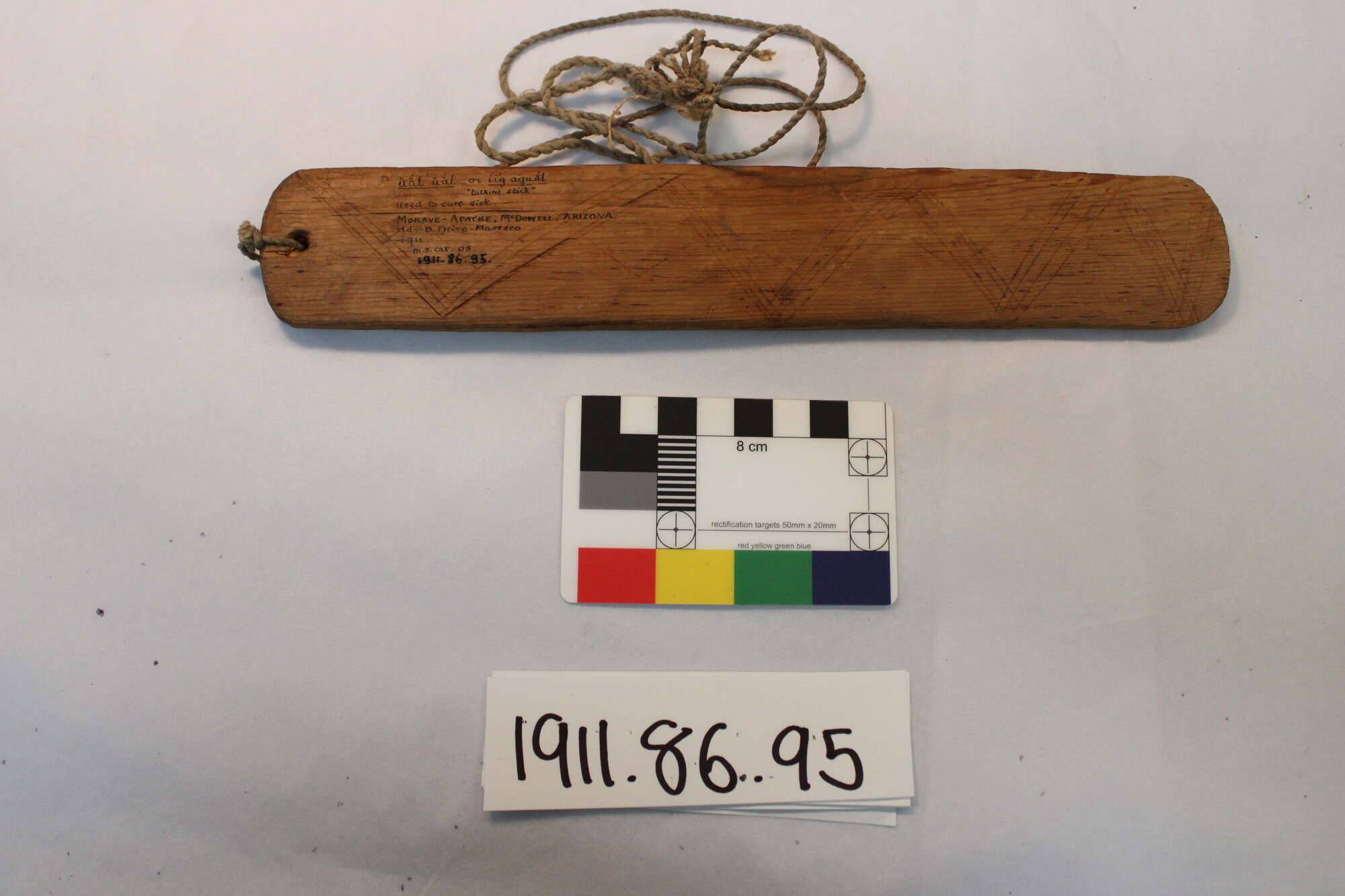
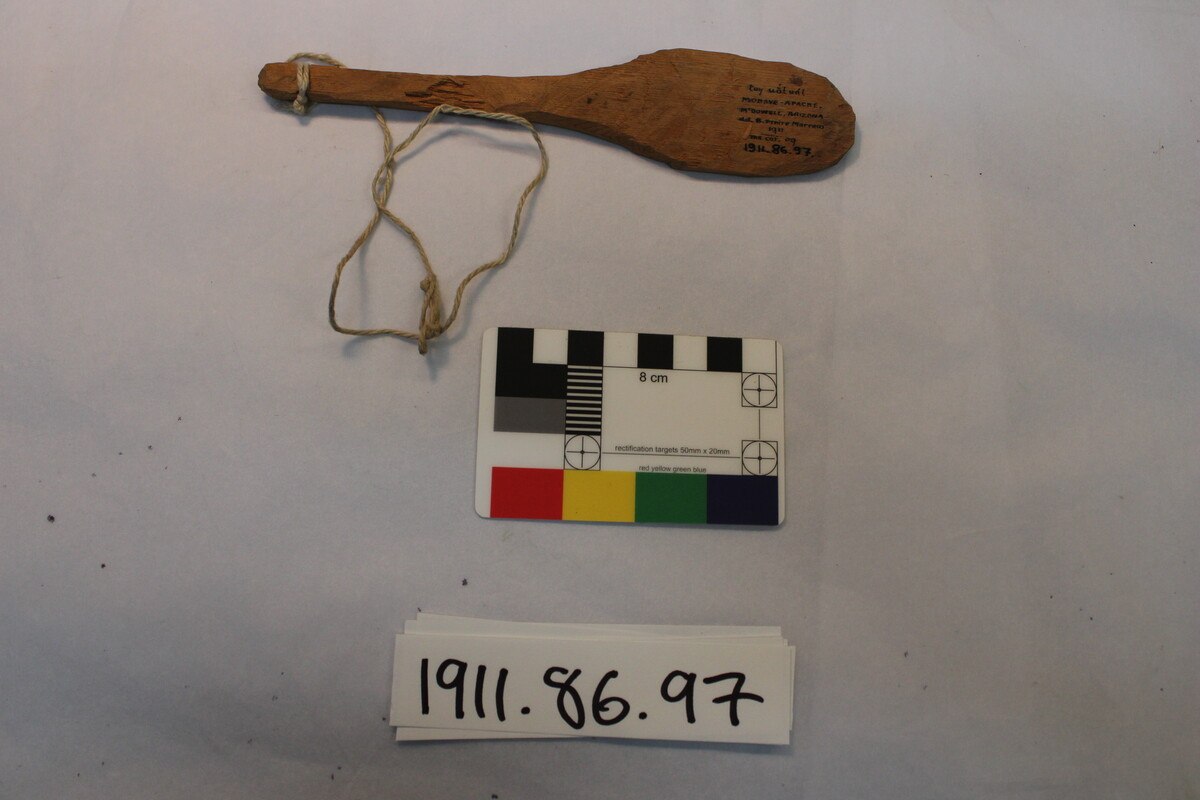
ual ual ii'g agual
Source term: bull-roarer
ual ual ii'g agual — Yavapai name recorded for the medicine bullroarer; smaller toys were ual ual.
Before a night of healing, a Yavapai shaman walked away from camp and whirled the bullroarer to summon the Kakaka, mountain spirits who command wind and weather — in Yavapai memory, little people who lived in the peaks before any humans, spoke Yavapai, and gave their teaching only to the medicine men. The Kakaka taught the people their masked Mountain Spirit Dance, Kakaka Iima, danced through the night to cure the sick, and the whirled roarer called them down to it. The dancers who took the spirits’ part were kept from outsiders — to speak of them was thought to bring bad luck on the teller — and in the reservation years the army banned the dances and wounded dancers to stop them. At Fort McDowell the medicine form, ual ual ii’g agual, was cut from lightning-struck cottonwood and scored with zigzag lightning lines; it belonged to “doctors” or “dreamers.” Boys made smaller ual ual as toys.
The Kakaka are just like Indians. But little, tiny Indians. They live in the mountains...(and) they talk Yavapai, but they don't talk to everybody; just to the teacher, the leader--like medicine men.
Mike Harrison and John Williams, Oral History of the Yavapai (2012)
Particulars
- Object
- A cottonwood medicine bullroarer, 265 × 45 mm, cut from a lightning-struck tree and incised with zigzag lightning lines; cotton-seed-fibre string through a hole at one end (PRM 1911.86.95). Two small toy bullroarers, ual ual (1911.86.96–97), came in the same accession.
- Function
- Medicine bullroarer used by doctors or dreamers in curing and to summon the Kakaka; smaller forms were schoolboys’ toys.
Sources
- Pitt Rivers Museum, Annual Report (1911), Freire-Marreco accessions 1911.86.95-97 View · archived
- E. W. Gifford, 'The Southeastern Yavapai,' University of California Publications in American Archaeology and Ethnology 29(3) (1932), p. 237
- Theodore A. Seder, 'Old World Overtones in the New World,' Museum Bulletin (University of Pennsylvania) XVI(4) (1952), pp. 51-54
- Mike Harrison and John Williams, Oral History of the Yavapai (2012)