No. GIFFORD1940-002
Cibecue roarer sounded in the open
United States · Cibecue Creek, east-central Arizona · North America · Southwest
Sacred / spirit
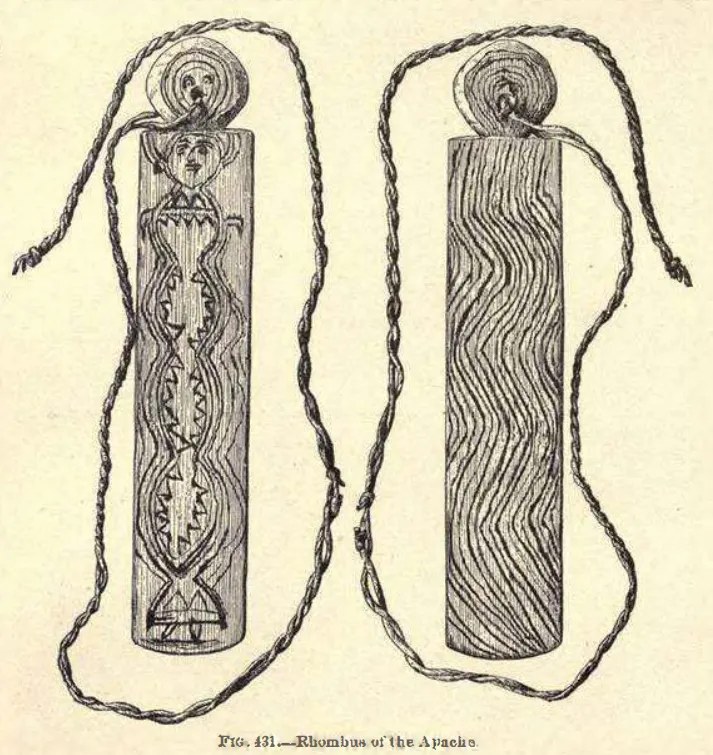
Source term: bull-roarer
Nine inches of flat wood on three feet of cord made the Cibecue Apache bullroarer that Toggie Nightjar described: sounded openly, before everyone, and whirled during dances, though he named no particular one. A generation later some of David McAllester's Apache informants placed the instrument in the Crown Dance; the Crown Dance he watched at Cibecue in 1953 had none.
...the bull-roarer (a flat stick whirled at the end of a cord to make a humming sound). The latter was said by some of my informants to be used in the Crown Dance, but there was none in the Crown Dance I saw at Cibecue in 1953.
McAllester 1960:471.
Particulars
- Object
- Wooden blade about 9 by 2.5 inches, whirled on a cord about three feet long.
- Function
- Sounded openly in public and during dances; not used for curing, and not merely a toy.
Source
E. W. Gifford, Culture Element Distributions: XII, Apache-Pueblo, Anthropological Records 4:1 (1940), pp. 2, 58-59, 151; David P. McAllester, The Role of Music in Western Apache Culture (1960), p. 471