Atlas Essay —
The Old One and His Wives
Spirit households on the Huon Gulf, Papua New Guinea
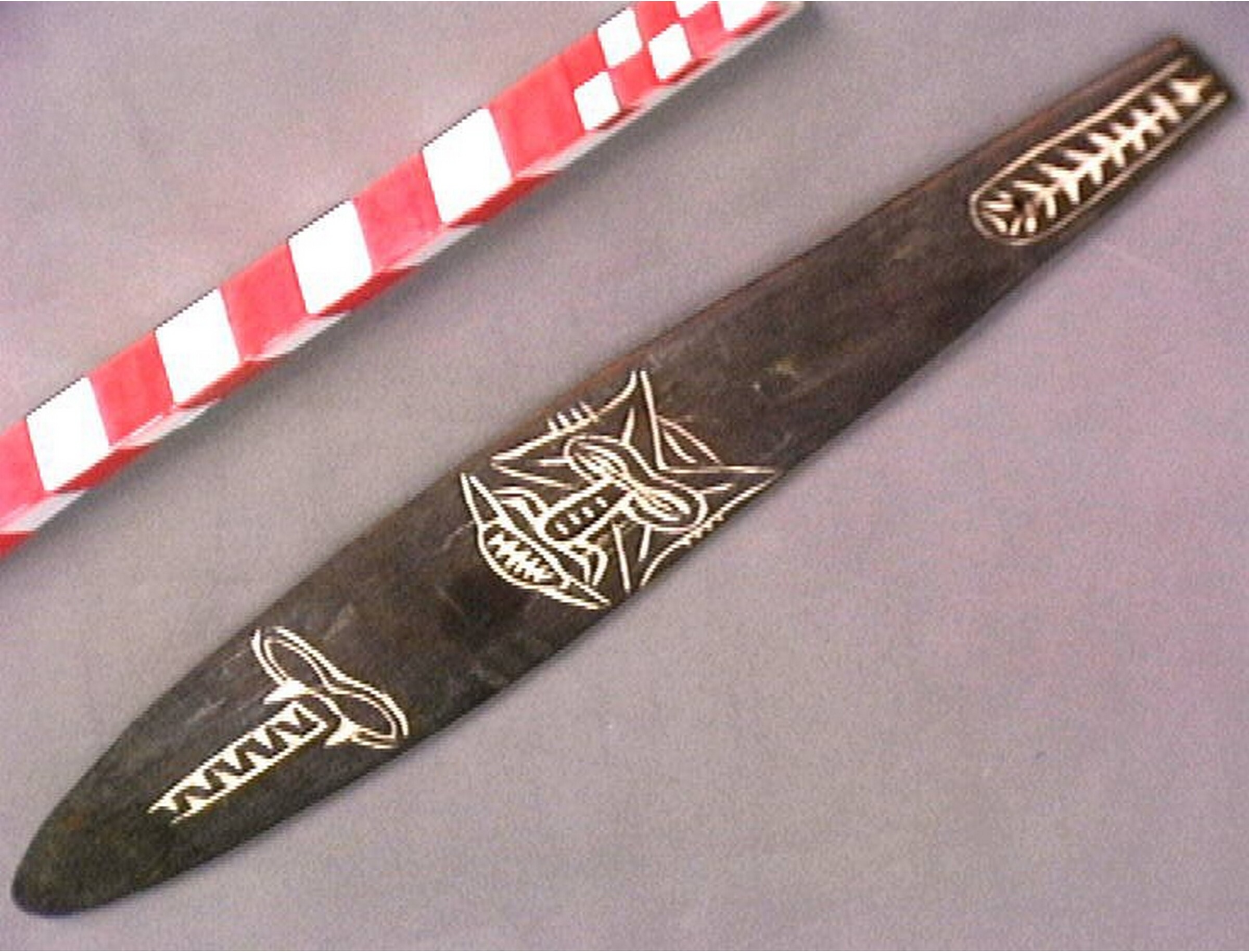
Wabo had a damaged nose, and he spoke indistinctly. After he died, the Bukaua people of the Huon Gulf in Papua New Guinea made him a wooden voice with the same flaw. They tied the bullroarer’s cord on at an angle, so that the blade hung crooked and gave out a peculiar grating rasp. When it sounded, that was Wabo the Old One. The man was gone; the catch in his speech remained.
Around Papua New Guinea’s Huon Gulf, bullroarers gave senior spirits a household: a name, a voice that was theirs alone, wives who sounded alongside them, and authority over the boys becoming men.
In brief
- Among the Bukaua of Papua New Guinea, the ruling bullroarers carried the names of actual dead men, with the title “Old One.” Wabo’s rasp and Gumba’s projecting hipbones kept one man’s traits alive in wood.
- Small Bukaua bullroarers were the voices of the ruling ancestors’ wives. They formed a class of their own, distinct from the servant bullroarers.
- On the nearby Tami Islands, also in Papua New Guinea, the principal spirits bore the same senior title but rarely a human personal name. Their wives were three bamboo flutes.
- In both places a blade touched the novice’s jaw or chin as he was taught to keep the secret, and the same ceremonies taught him hospitality.

Wabo’s rasp and Gumba’s hips
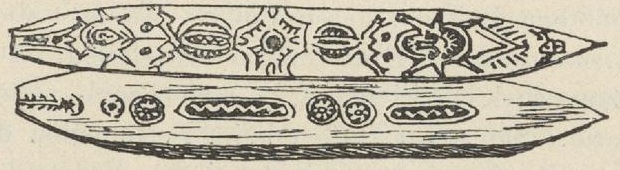
In Bukaua villages the bullroarer and the spirit whose voice it made shared one word, balum. Every village had many of them, cut from different woods and made in different sizes, some richly decorated. They also had rank. The ruling instruments were called abumtau, the serving ones ngasengomi, and each village clan kept a ruling bullroarer among its servants. When war drove villages together, two rulers might end up in one village; two villages that had grown from a single clan might share one.
The rulers carried the names of outstanding men who had died, and their shapes and sounds could recall those men’s bodies: a nasal voice, a conspicuous feature, the hipbones of a thin man. To each name was added lanqua, “the Old One,” a title of remembered seniority. Generation after generation, a particular old man went on belonging to his village. Lehner, pp. 410–411.
Wabo belonged to the village of Uwaung. Stefan Lehner, whose account of the Bukaua appeared in 1911, explains how the cord gave the blade its voice:
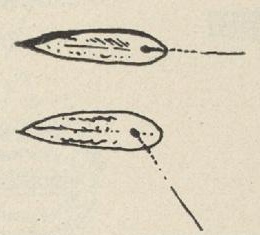
“The bullroarer does not hang vertically, but obliquely, from the string … If one asks the reason, the answer is: ‘Wabo had a mutilated nose; consequently he spoke indistinctly.’ This peculiarity is taken into account by the wood assigned to him.”
Stefan Lehner, “Bukaua” (1911), p. 411; translated from German. Original page.
Gumba’s blade worked through shape. Raised projections on its two sides recalled his prominent hipbones. When someone on a path or in a field bumped against a gnarled stump, he might strike it with his axe and call out, “Are you perhaps Gumba the Old One?” The man’s body could be met again in wood, even outside the ceremony.
These were close, particular ways of keeping the dead among the living. Wabo was remembered by the grain of his speech, Gumba by the set of his bones. A bullroarer could make a terrifying collective roar, yet whoever made Wabo’s had to attend to one man’s sound. The crooked cord was part of his likeness.
The wives’ brighter voices
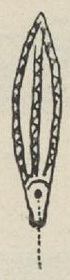
The ruling Old Ones were married. Their wives’ voices came from special small blades called auwi lanqua, which gave a brighter, higher tone when swung, like the voices of women. They were the wives of the ruling ancestors, and they were not servants.
The line between wife and servant matters, because the servants too bore the names of the dead, and they mattered most to those people’s own descendants. A smaller or humbler blade was not automatically a wife. There were rulers, servants, and wives, each standing in its own relation to the others, and together the instruments made up a household.
“In Bukaua, alongside the woods which express the voices of the male ancestors, there are also special small woods, clearly to be distinguished from the ‘serving’ ones, which represent the voices of the balum women, that is, the wives of those rulers.”
Lehner, “Bukaua” (1911), p. 412; translated from German. Original page.
A listener could hear a difference of sex as well as a difference of character. Wabo’s rasp picked out one man; the wives’ higher tones marked their place beside their husbands. The relationship and the sound were made together, and the size of a blade served the voice it had been given.
Three bamboo wives
Across the water, on the Tami Islands off the coast of Papua New Guinea, the Tami spirits also had senior names and wives. The map above shows how close the island and mainland communities lay. The Tami word kani meant “spirit” and was used for both bullroarers and masks. Principal kani had names, and every one of them carried lanqa, “the Old One,” an honour given only to outstanding men.
The names themselves followed a different pattern. Georg Bamler, who wrote the Tami account, says that human personal names were rare among them. The Tami Old Ones shared the Bukaua title, but as a rule they were not remembered men like Wabo. Beside them were plain working blades, the “short-legged ones” or gegetu, which carried a principal kani’s name.
The kani was the male, the husband, and his wives were bamboo flutes. Bamler names three. The largest, Naling, about fifty centimetres long, played long tones, and a plant stalk slid in and out of it changed the pitch. A smaller flute, qadji diwi, twenty to twenty-five centimetres long, was played in a lively staccato. The third, Gela auwi, was a long, slender bamboo tube with one or two finger holes burnt through it. Bamler, p. 501.
So the same relationship appears in two different sound technologies. On the mainland the wives were smaller whirled blades with higher voices; on Tami they were breath in bamboo. “Wife” named a place beside the senior male spirit, and more than one kind of sounding object could fill it.
The ceremony was therefore a company of distinct voices, not a mass of interchangeable noise. The short-legged blades sounded under a principal’s name, and the flutes were the wives. At the centre stood a named spirit, and the differences among the voices around him were part of what they meant.
A heavy mouth and an open fire
Boys entered these spirit households through their own bodies. Among the Bukaua, the novices had never before seen or heard a bullroarer. Now a dreadful noise surrounded them. Men shouted, and concealed objects rattled in the crowns of nearby trees. The boys were led out with their eyes covered and their hands tied behind them. Before circumcision a blade was drawn upward over each boy’s body and struck his lower jaw against the upper. His mouth was to stay shut about balum before women and the uninitiated. Lehner, p. 407.
The lesson came again once the wound had healed. After two or three more months under supervision, the boys were taken into the forest before an assembly of men, and once more the blade travelled upward and closed the jaw. The demand for secrecy came with an appalling threat against the betrayer and his kin. Other rules followed: keep your fire burning and shining for others, which meant be hospitable; do not block the women’s way; do not steal. Only then were the boys decorated for their return. Their mothers met them amid horns, drums, singing, and the delight of the crowd. Lehner, pp. 409–410.
On Tami, visiting villages brought their principal kani and short-legged blades to the gathering. The bearers formed a line and held the instruments up, and the novices passed beneath them with their attendants. This was called being swallowed by the spirit. Before passing through, each novice was struck with a blade on the forehead and on the chin.
“The blow on the forehead means: be hospitable towards your friends … the blow against the chin means: let your mouth be heavy, so that you do not betray the secret.”
Bamler, “Tami” (1911), p. 502; translated from German. Original page.
Two duties, given side by side: an open welcome and a closed mouth. The same instrument taught how to treat a guest and how to speak of the spirit. The welcome was being practised at that very gathering. Delegations had come from other villages and pigs were bought, and most of the outsiders had gone before circumcision began.
On Tami the secret had a social shape as well. Bamler calls the ceremony a public secret known to every married woman, and under threat of punishment the women gave no sign that they knew. The boundary lay in conduct as much as in knowledge. A novice was learning when to keep silent, before whom, and at what cost.
Old Ones held in trust
The Tami told Bamler that kani had been imposed on them by mainland people, on whom they depended for food. Bamler took those people to be the nearby Jabim and Bukaua of the Papua New Guinea mainland, and suggested that they had pressed their strict secrecy on the Tami. What was imposed, he proposed, may have been the form of the practice more than the practice itself. Bamler, p. 494.
Rights in kani also passed along family lines. A man could receive a blade from a village where his father or uncle had already held such a right. Bamler describes an uncle asking for his grown nephew to be invested, then stepping back from active part himself. Maternal relatives could carry these connections from one community to another. Each identity had keepers and successors, and it lasted through the people entitled to bring it forward. Bamler, p. 498.
At that scale the Old One comes most clearly into view. He belonged to a village, a ceremony, a line of inherited rights, and a company of distinct voices. His wives might sound from small wooden blades or from bamboo flutes. His authority reached a boy’s jaw and taught the adult duties of silence and welcome.
Wabo’s crooked cord gives all of this a single face. His bullroarer did more than announce that some ancestor was near. Its makers attended to how this one man had spoken, and the Old One came back with his own rasp, among the other Old Ones, their servants, and their wives.
Key sources
- Stefan Lehner, “Bukaua,” in Richard Neuhauss, Deutsch Neu-Guinea, vol. III (Berlin: Dietrich Reimer, 1911), pp. 407–412. Novice ceremonies and jaw gesture: pp. 407, 409–410; ranks and named deceased men: pp. 410–411; Wabo and Gumba: p. 411; wives distinguished from servants: p. 412. Page 411; page 412.
- Georg Bamler, “Tami,” in Neuhauss, Deutsch Neu-Guinea, vol. III (1911), pp. 494, 497–498, 501–502. Mainland introduction and women’s knowledge: p. 494; senior titles and names: p. 497; working blades and inherited rights: p. 498; flute wives: p. 501; swallowing procession, forehead and chin lessons: p. 502. Page 497; page 501; page 502.
- All quoted passages are translated here from the German originals. Complete digitised volume · archived.