No. GIFFORD1940-004
The sickness circuit, east to north
United States · Ligaishak · Mogollon Rim, Arizona · North America
Sacred / spirit
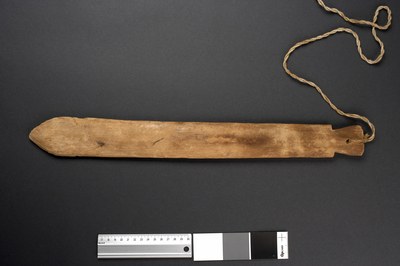
Source term: bull-roarer
When sickness was everywhere, one man went out to meet it. A Southern Tonto shaman of the sixth semiband, in the Apache country below the Mogollon Rim, travelled in order toward the east, then the south, then the west, then the north, whirling the bullroarer at each turn to drive the illness away. The same ten-inch blade, carried on three and a half feet of cord in a small pouch at the belt, announced the masked gan when the Mountain Spirit dancers came — and outlived both offices as a toy in the hands of boys. Among the Tonto, John G. Bourke noted, the great medicine-man was the brother of the head chief, Cha-ut-lip-un.
Cord wound up on leg, then instrument whirled.
Gifford 1940:152
Particulars
- Object
- Wooden blade about 10 by 2 inches on a cord about three and a half feet long, carried in a small belt pouch.
- Function
- Whirled by a shaman travelling east, south, west and north to drive away widespread sickness; also used to announce the masked gan, and used by boys as a toy.
Source
E. W. Gifford, 'Culture Element Distributions: XII, Apache-Pueblo,' Anthropological Records 4:1 (1940), pp. 58-59 and 151-152; T. A. Seder, 'Old World Overtones in the New World,' University Museum Bulletin 16(4) (1952), pp. 53-54; J. G. Bourke, 'The Medicine-Men of the Apache,' Ninth Annual Report of the Bureau of Ethnology (1892), p. 457