No. GIFFORD1940-005
Eighteen inches of sotol stalk
United States · Huachuca Mountains, Arizona · North America
Play / practical
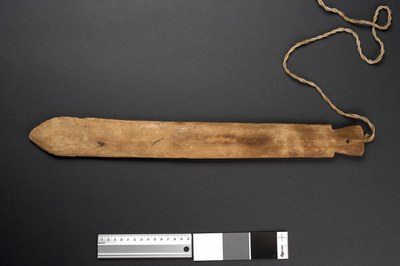
Source term: bull-roarer
Most Apache roarers in Gifford's Southwestern lists run eight to twelve inches. The Shaiahene band's, from the Chiricahua country of the Huachuca Mountains in southeastern Arizona, is eighteen by three — and it is not cut from pine or ash at all but from the thick woody base of a sotol stalk, the desert rosette whose flower spike shoots up taller than a man and whose crowns the Apache roasted for food. The band named the wood, the size, and the use: a toy only. While the neighbouring San Carlos and White Mountain bands swung the roarer in curing and to announce the masked gan dancers, the Shaiahene band had the biggest blade in the whole survey and used it for play.
Particulars
- Object
- Unusually large blade, about 18 by 3 inches, cut from the base of a sotol stalk, on a cord about two and a half feet long with a small grip stick.
- Function
- Played with as a toy.
Source
E. W. Gifford, 'Culture Element Distributions: XII, Apache-Pueblo,' Anthropological Records 4:1 (1940), pp. 58-59 and 151-152