No. SEA-002
Dyak Hantu-Hantuan Southwest Kalimantan bullroarer
Indonesia · Southwest Kalimantan · Borneo · Southeast Asia
Function not recorded
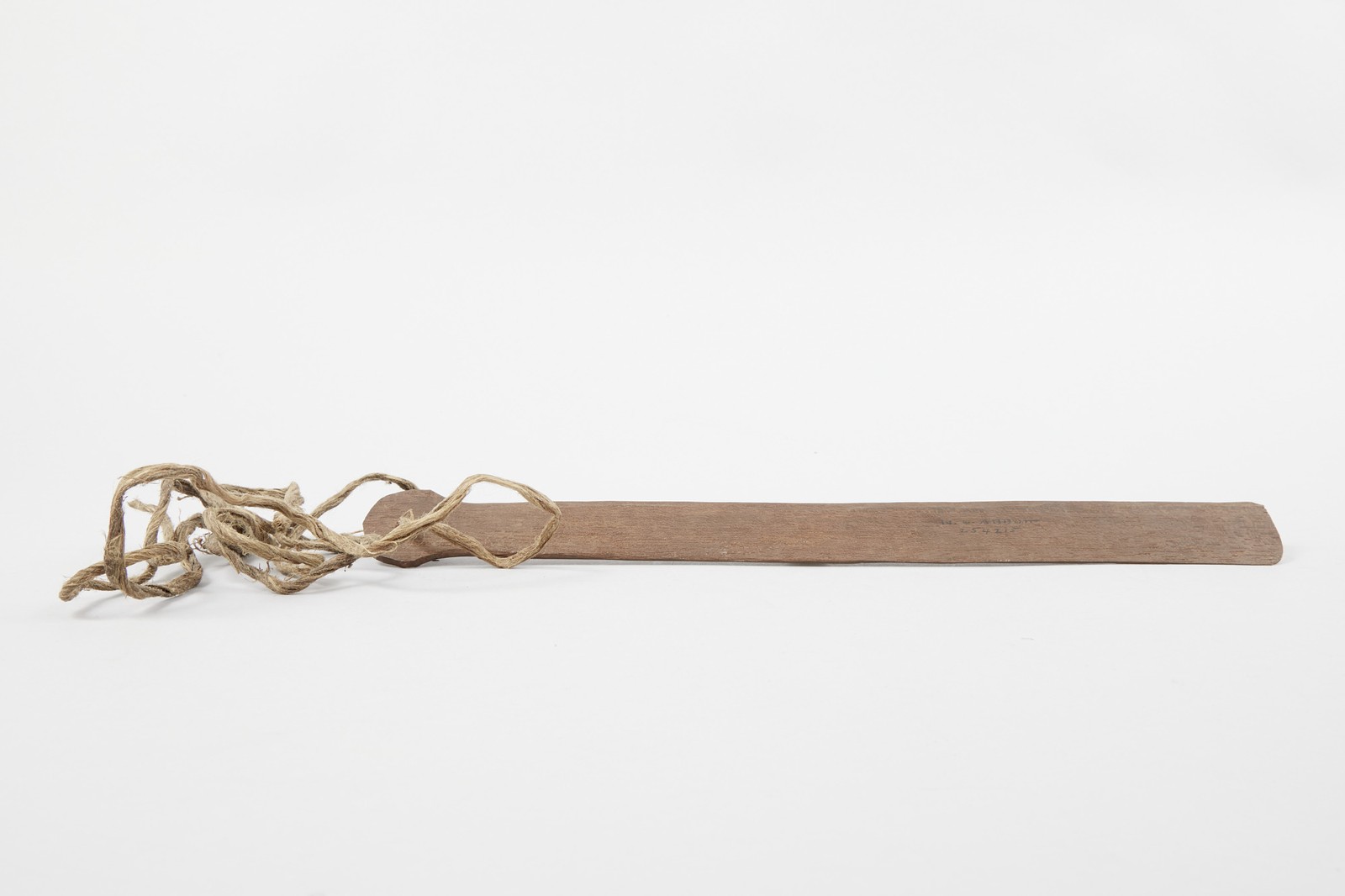
hantu-hantuan
Source term: Bull-Roarer Hantu-Hantuan
hantu-hantuan — Malay/Indonesian, a reduplicated form of hantu ("ghost, spirit"), roughly "the spirit thing" or "spirit-like."
Etymology. A reduplication of Malay hantu, 'ghost, spirit'.
A bullroarer collected among the Dyak of southwestern Kalimantan and catalogued by the Smithsonian under the name hantu-hantuan, a reduplication of the Malay word hantu, ghost or spirit — roughly "the spirit thing." It was one of more than seventeen hundred Bornean objects gathered by the American naturalist William Louis Abbott, mostly between 1905 and 1909, working from his schooner the Terrapin. Its own use is a blank. Across Borneo the bull-roarer was a boys' toy with a single further office: when jungle was cleared for padi, a few trees were spared for the Toh, the spirits of the place, and a bull-roarer was sometimes hung on a cross-piece lashed to such a tree "to dangle and flicker in the breeze." Hose and McDougall, who set that down in Pagan Tribes of Borneo (1912), knew of no other use.
Particulars
- Function
- Not recorded.
Source
Smithsonian Institution, National Museum of Natural History, Department of Anthropology, 'Bull-Roarer Hantu-Hantuan', Dyak, Southwest Kalimantan, Borneo (W. L. Abbott collection); Hose & McDougall, The Pagan Tribes of Borneo (1912), vol. II, p. 23