No. POLY2026-001Oceania
Māori pūrerehua bullroarer
New Zealand · Aotearoa · Oceania · Polynesia
Sacred / spirit
- Spirit voice
- Death and rebirth
- Agriculture / crops
- Rain & weather
pūrerehua / pūrorohū / turorohu / unuunu garara
Source term: purerehua / bullroarer
pūrerehua = "moth/butterfly" (the instrument is named for the moth whose whirring wing-sound it imitates); the synonym rangorango refers to the blowfly, for the buzzing note; turorohu/purorohu are further names for the same bullroarer. mamae — the Taranaki name, where the instrument sings a farewell to the dead (Hamilton p. 430; Te Ara). unuunu garara (short form garara; also ngārara, kārara) — the Kāi Tahu name in Te Wai Pounamu: its sound is the moth's wings, and the skinks that eat the moth turn negative energy positive (Rua McCallum in Solly 2023); hamumu ira garara, 'summoner of food', a southern name from its use in enticing lizards (Nunns 2001).
Etymology. The instrument name is tied to wing-sound imitation: purerehua is moth/butterfly and also the Maori bullroarer.
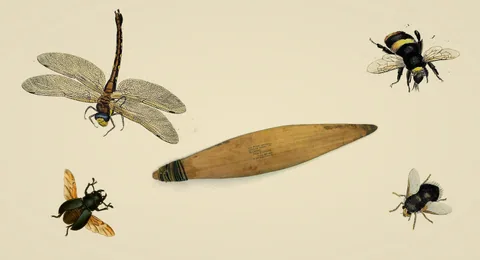
The pūrerehua is named for the moth, and its roar recalls the moth's wings; another name, rangorango, likens it to a blowfly. Its great work was calling rain. Tuta Nihoniho of Ngāti Porou described an expert flinging ashes to the south, whirling the blade, baring his buttocks to the rainy quarter and reciting an insulting karakia to goad the sky. It summoned tears at funerals and coaxed lizards out from under rocks; in the south it was the hamumu ira garara, summoner of food. A tohunga could turn that blowfly drone on a harmful spirit, drawing it out in the shape of a bright green lizard, then catching, killing and eating the lizard to destroy its power. Kāi Tahu knowledge-holder Rua McCallum calls the instrument unuunu garara. Its whirr is the moth, a creature of transformation, and when the little skinks eat the moth their dark energy turns good. So it is swung to clear the air at tangihanga and moko ceremonies, though she warns that grief sometimes needs to stay a while. One kuia called the roar "the voice of the mother." It sounds in public life again: at Parihaka in 2017 Rangi Kipa swung one to gather the spirits before the Crown apologised for the sack of 1881, and at Te Rau College, the Anglican theological college in Gisborne, it is one of the taonga pūoro brought into the teaching of prayer, meditation and liturgy.
Pūrerehua or turorohu create eerie sounds as they spin on the ends of their cords. Stories are told of them calling rain, summoning tears and even enticing food from hiding places.
Flintoff, Te Ara: The family of Papa – rhythmic instruments (Māori musical instruments – taonga puoro, page 3)
5 more plates
Particulars
- Object
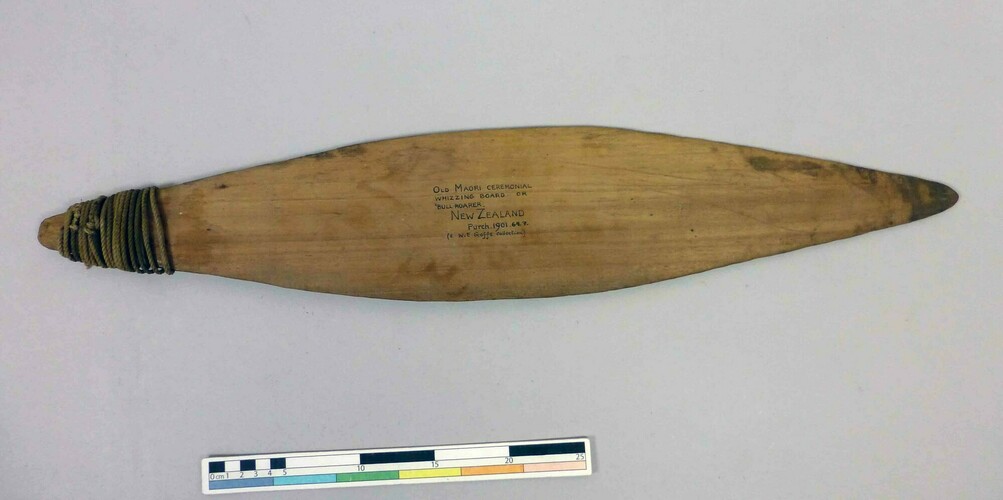
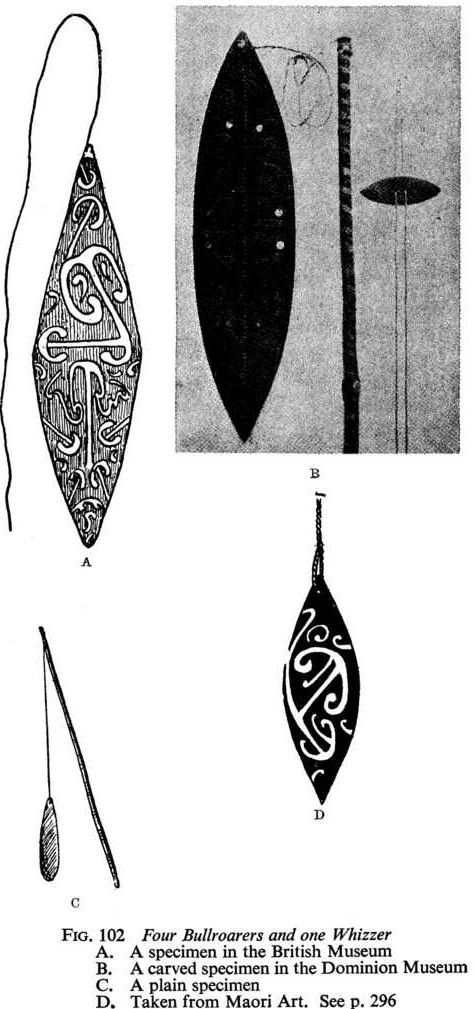
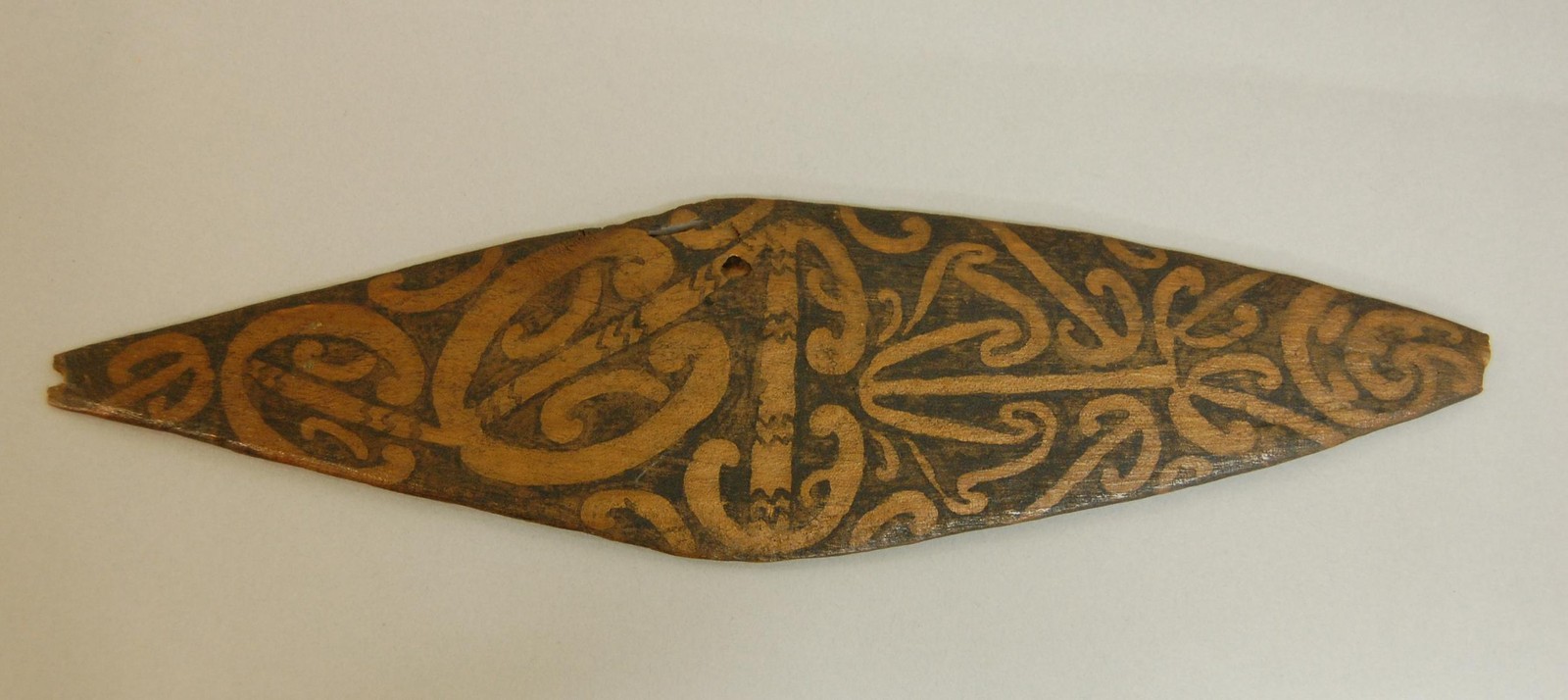
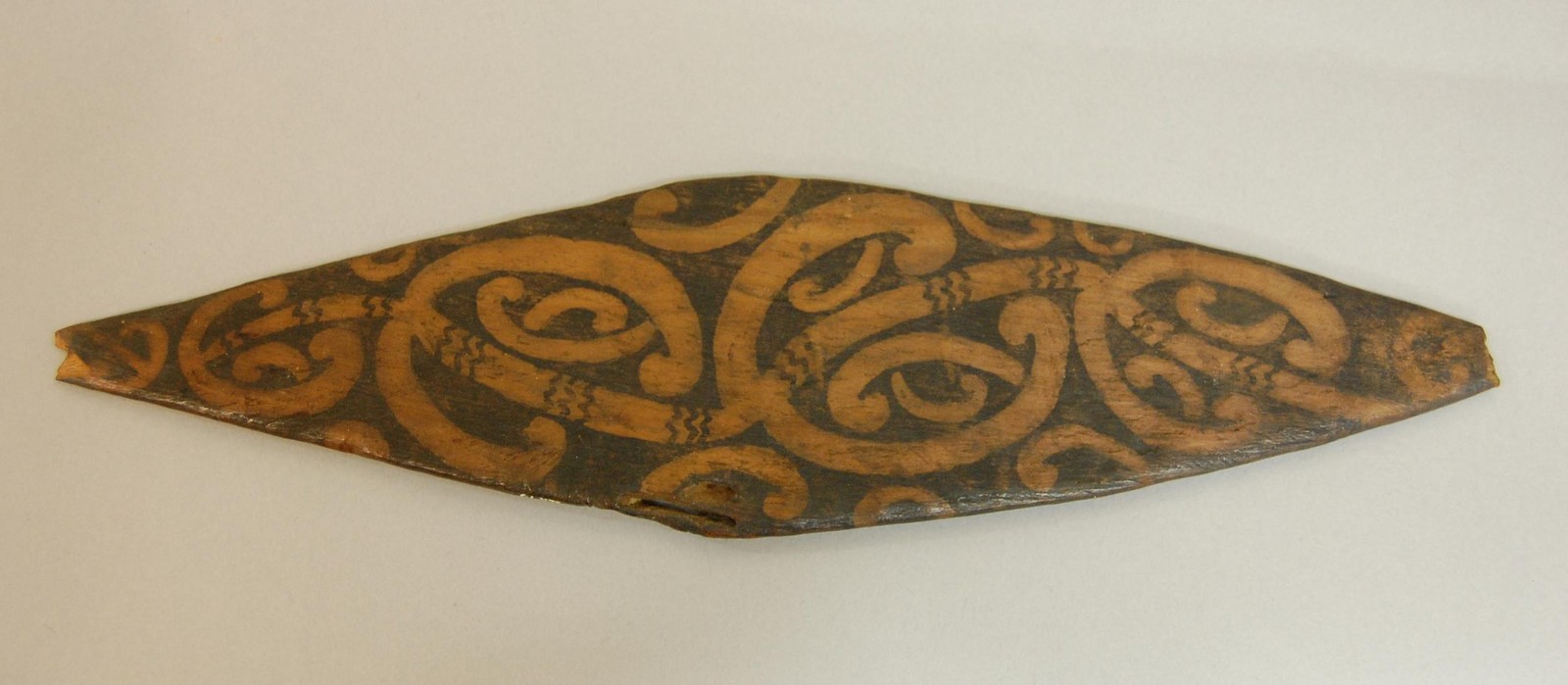
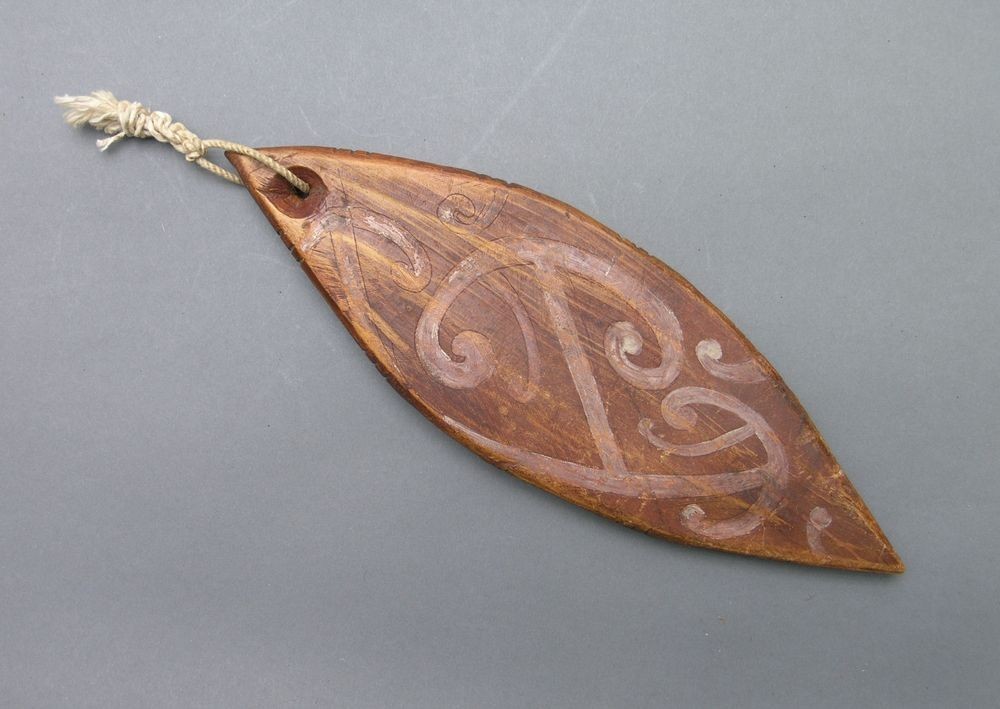
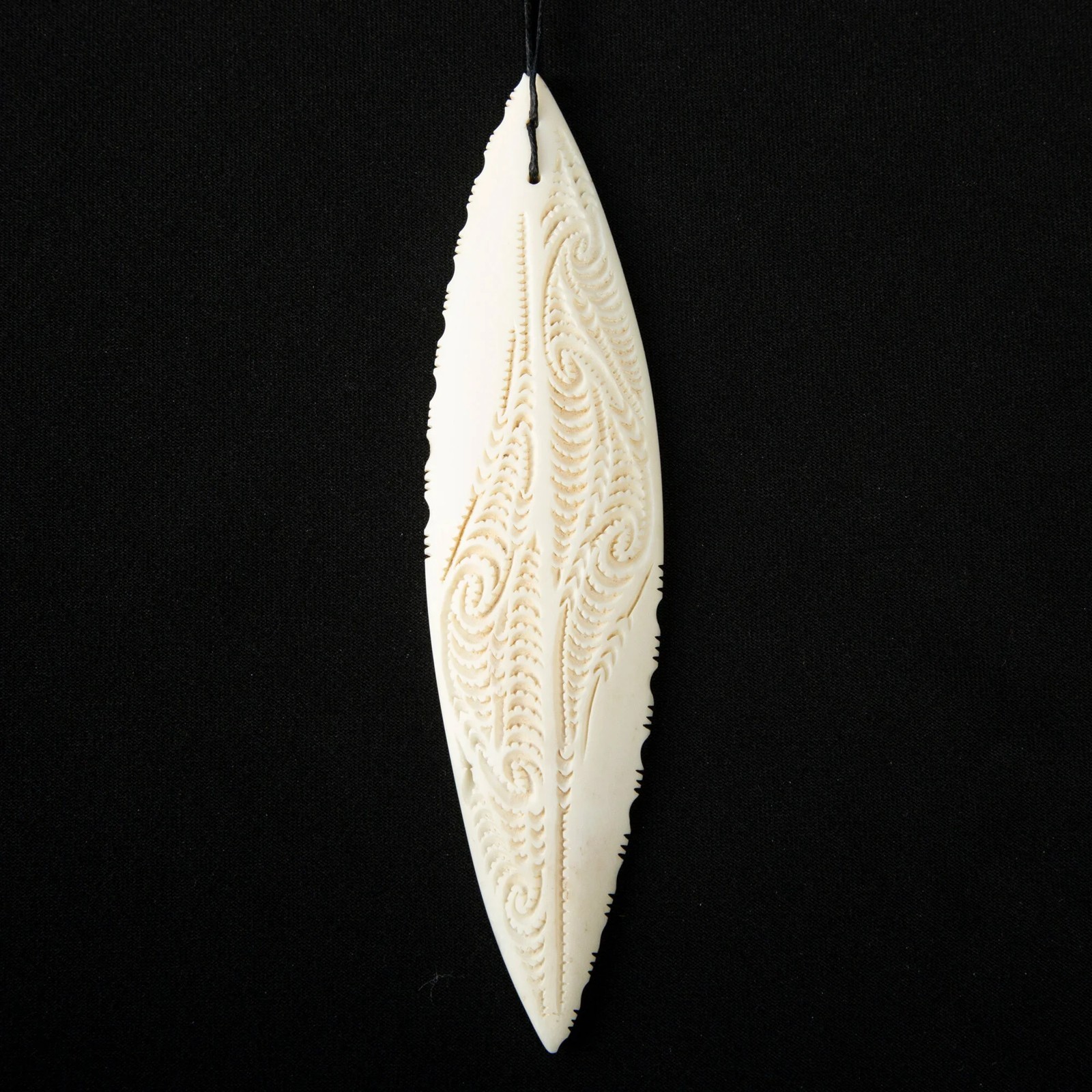
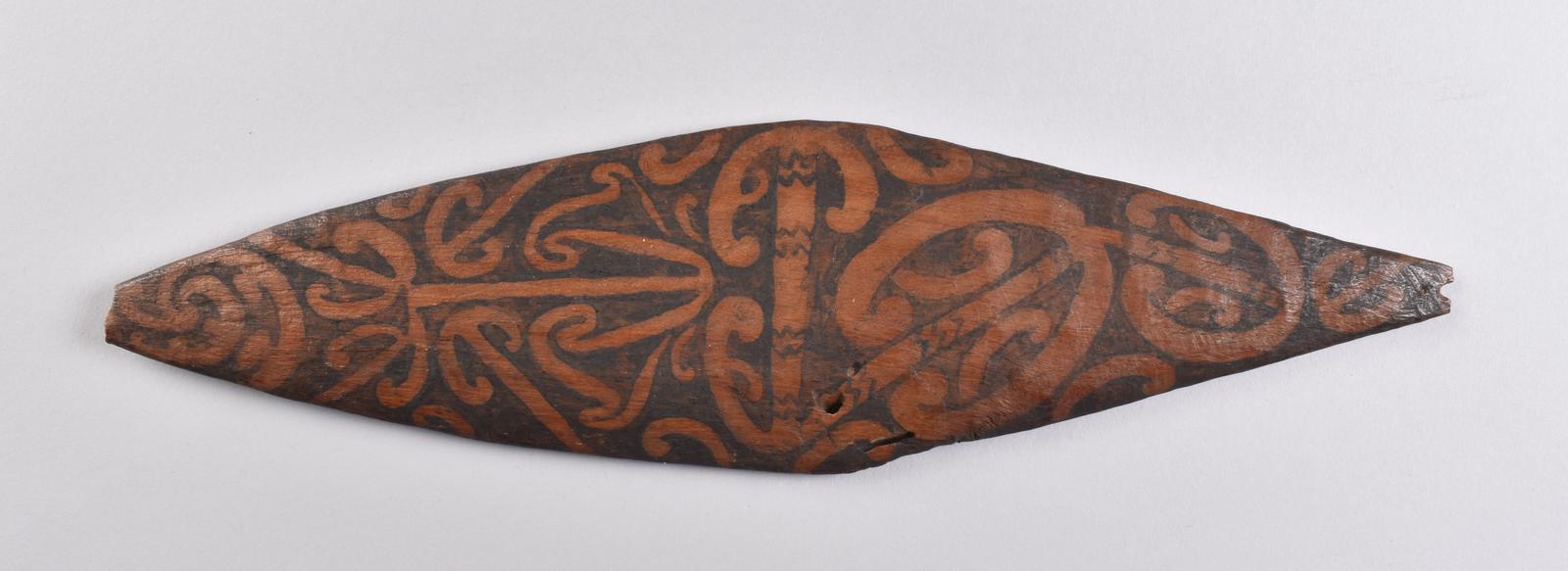
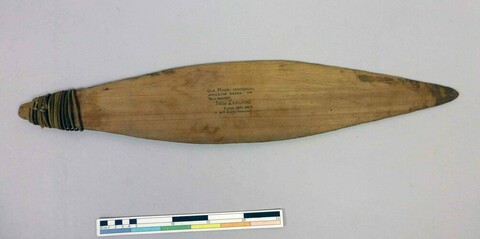
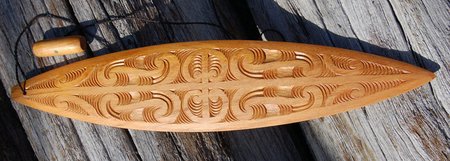
- The pūrerehua is a slat of wood, stone or bone swung on a long cord. Pitt Rivers 1901.64.7 is an exceptionally large example, a lenticular carved board 625 x 115 mm pointed at both ends, its twisted fibre passed through a terminal perforation and bound and knotted around the tip. A smaller painted one in the British Museum, Oc.4879, is an oval blade pointed at both ends, 29 by 7.5 centimetres and half a centimetre thick, with pitau-series kowhaiwhai in bare wood across a black ground on both faces, its cord still at one end. Te Papa's ME016169 is a modern maker's piece: a wooden pūrerehua 427 × 60 × 13 mm (149 g), made and given to the museum by Bernard Makoare in 1997.
- Function
- A taonga pūoro for calling rain and for spirit work: swung beside a chief lying in state to drive off evil spirits, to summon tears and clear negative energy at tangihanga and moko ceremonies, to draw a harmful spirit out in the form of a lizard, and to entice lizards as food.
Discussed in 6 essays
 The Voice on the Wing
 The Wing and the Ghost
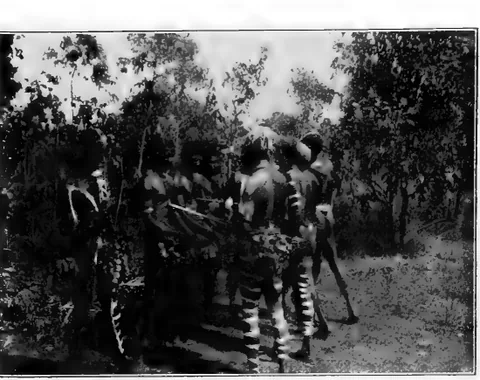 Grandfather and Mother
 Pūrerehua: The Māori Bullroarer, Its Sound and Meaning
Sources
- Elsdon Best, 'Spiritual Concepts of the Maori,' Part I, Journal of the Polynesian Society 9(4) (1900): 173-199, p. 181
- Pitt Rivers Museum, Oxford, object 1901.64.7
- Museum of New Zealand Te Papa Tongarewa, object 440435
- Te Aka Māori Dictionary, s.v. pūrerehua View · archived
- Brian Flintoff, Te Ara, Māori musical instruments – taonga puoro, page 3, "The family of Papa – rhythmic instruments," rainmaker section
- Edward Tregear, The Maori Race (1904), pp. 54-55
- J. Macmillan Brown, Maori and Polynesian (1907), p. 206
- Elsdon Best (1925), pp. 293-296, Tuta Nihoniho account cited by Flintoff
- Shannon Haunui-Thompson and Robin Martin, 'Tears as Crown apologises for Parihaka atrocities,' Radio New Zealand, 9 June 2017 View · archived
- Te Karaka 48 (October 2010), pp. 28–29 View · archived
- Cunnane, MPhil thesis, Auckland University of Technology (2018), pp. 45–46 View · archived
- Karl Chitham, 'Tears of Tāwhirimātea: carvings by Todd Couper,' Garland, 1 December 2017 View · archived
- Richard Nunns, 'Te Ara Puoro: The Pathway of Sound,' Voices: A World Forum for Music Therapy 1(3) (2001) View
- Ruby Mae Hinepūnui Solly, He Hauora! He Hauoro! The use of Taonga Pūoro in Hauora Māori, PhD thesis, Massey University (2023), pp. 77, 131, 164 View · archived
- Te Rau College, “The Voice of Creation” (Taonga Pūoro programme) View · archived
Nearby in the atlas
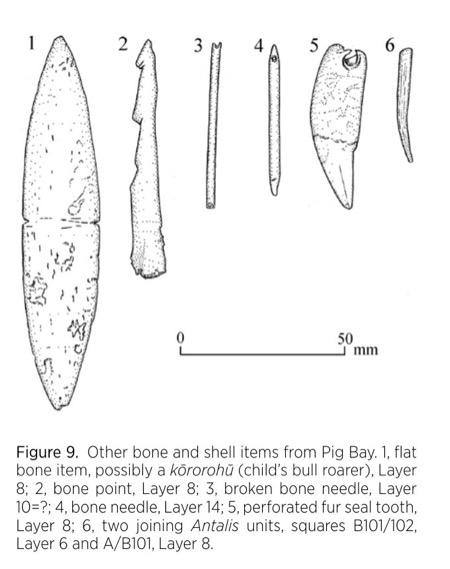 Pig Bay notched bone bladec. 1400–1500 AD · New Zealand · Play / practical
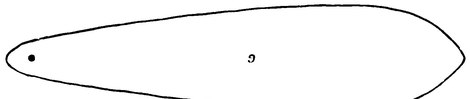 Biripi blades as the Holy Spirit's voiceNew Zealand · Auckland (presentation); painted by a Biripi elder, mid-north coast of New South Wales, Australia · Sacred / spirit
 Lamplit pūrerehua at MaungapōhatuNew Zealand · Maungapōhatu, Te Urewera, North Island · Sacred / spirit
 Ngati Porou (turorohu rain rite)New Zealand · East Cape / Waiapu Valley, North Island · Weather / fertility magic
 Whanganui (huhū, the buzzing toy)New Zealand · Whanganui River district, west-central North Island · Play / practical
 Aitutaki patangitangi leaflet bullroarerCook Islands · Aitutaki · Play / practical