No. EA-TW-TSOU-001
Tsou euvuvu bullroarer warning signal
Taiwan · Central Mountain Range · Alishan-Tsou area · East Asia
Weather / fertility magic
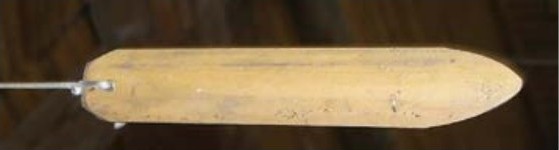

euvuvu
Source term: Euvuvu (bull-roarer)
vuvu imitates the bullroarer's sound.
Etymology. Cheng parses eu- as inducing wind and vuvu as the sound.
Among the Tsou of the Alishan mountains, a thin bamboo blade tied to a cord and handstick was swung until it revolved around the player, spinning about the cord and periodically reversing its rotation. Its valley-borne drone warned that an enemy was coming, but the euvuvu was also sounded to pray for rain and to scare birds. Later it became a children's plaything and a greeting at the opening of the fona life-bean festival. Its name carries its sound: vuvu, an imitation of the drone.
Euvuvu is the Tsou name for the bullroarer, a previously undocumented instrument. The term is composed of the prefix eu- and the onomatopoeic vuvu, in which vuvu indicates the sound of the bullroarer. It functioned as a signal to inform villagers by means of the echo of valleys that an enemy was coming.
Cheng 2015:120 (§12.6), 'Native Terminology and Classification of Taiwanese Musical Instruments'
Particulars
- Object
- Tsou euvuvu: a thin bamboo blade tied to a cord and bamboo handstick, revolved around the player while the blade spins about the cord and periodically reverses its axial rotation; Hornbostel-Sachs 412.22.
- Function
- Valley-echo warning signal; also used to pray for rain and scare birds, later as children's play and at the opening of the fona life-bean festival.
Source
Lancini Jen-hao Cheng, 'Native Terminology and Classification of Taiwanese Musical Instruments,' Ensayos 19(28) (2015), section 12.6, p. 120 and fig. 54; Cheng, Taxonomies of Taiwanese Aboriginal Musical Instruments (PhD thesis, University of Otago, 2015), fig. 6.15.6.1 and p. 742; Liu, Hsieh, Liao and Tu, Chinese Physics Education 8(1) (2007): 33-40