No. PNG168
Bariai
Papua New Guinea · West New Britain · Oceania · Sahul
Restricted
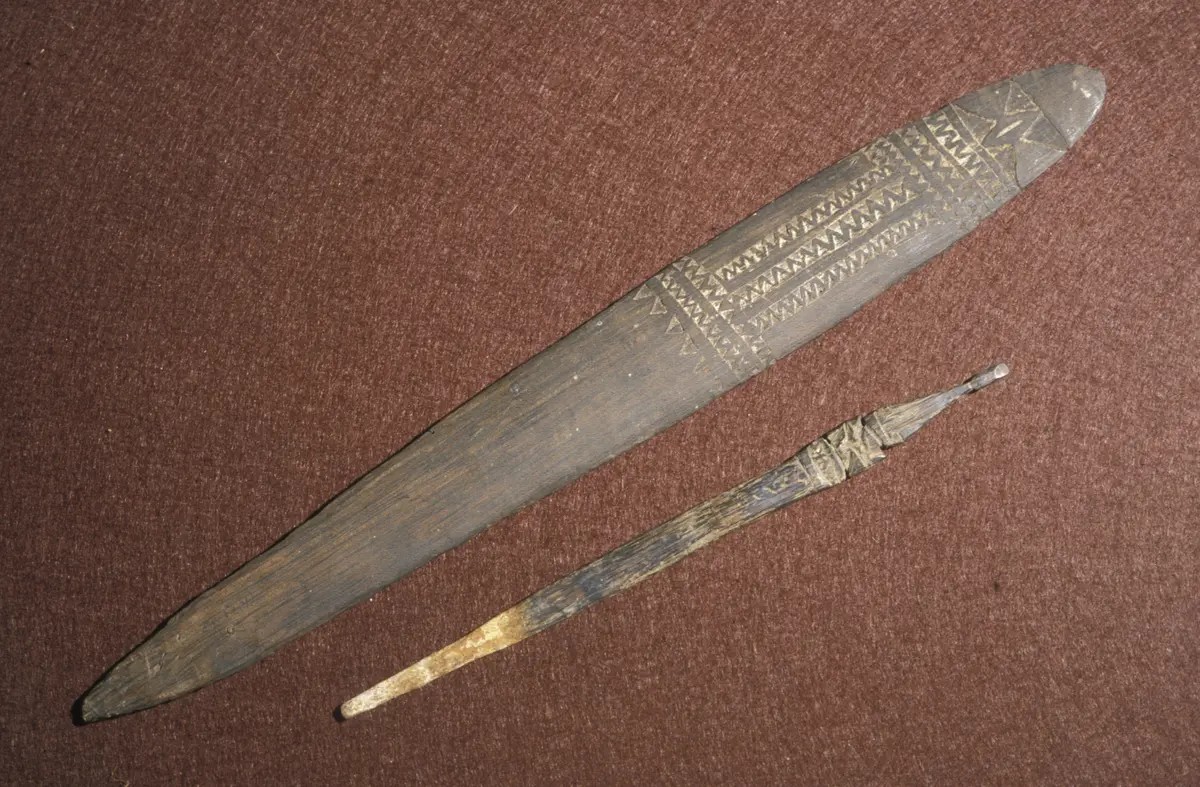
Tibuda
Source term: bullroarer
Tibuda: the Bariai name for the Bullroarer, at once instrument and spirit being.
Women invented the Bariai bullroarer. In the story Naomi McPherson recorded, women cutting firewood from a Taltalnga mangrove sent a chip flying off with a whirr — 'Oh, how wonderful!' — made it sing again, carried it home, and hid it from the men. On feast days their messenger Ola, in ceremonial finery, sent the men out of the village, and the Bullroarer, Tibuda, came into the plaza to sing and eat pork and roasted taro with the women. Then an old man tripped during the exodus, spilled his lime powder, and conspired: on the appointed day the men's-house groups killed every female from the oldest grandmother to the littlest girl, sparing only infants at the breast. The men captured the Bullroarer, but the knowledge died with its owners — no woman now knows how to make it sing, and women flee its fearsome presence. Only initiates may watch the aulu and bokumu mask dances it guards: seeing the instrument cost one pig, entering the dance a second.
‘What’s going on?’ he exclaimed angrily. ‘These women have us running in all directions while they stay here and do things with their Bullroarer.’
McPherson, 'Black and Blue: Shades of Violence in West New Britain, PNG,' in Engendering Violence in Papua New Guinea (ANU Press, 2012), p. 52
Particulars
- Object
- Bullroarer sounded outside the aulu or bokumu cylindrical-mask dance.
- Function
- Warned the uninitiated away; initiation into its mysteries was paid for in pigs.
Source
W. H. R. Rivers, The History of Melanesian Society, vol. II (Cambridge, 1914), pp. 512-513, citing G. Friederici, Beitraege zur Voelker- und Sprachenkunde von Deutsch-Neuguinea (1912), p. 102; Naomi McPherson, 'Black and Blue: Shades of Violence in West New Britain, PNG,' in Engendering Violence in Papua New Guinea (ANU Press, 2012), pp. 47-72, at p. 52