No. MUS2026-367Oceania
Matahenua hakatangikugu, the rain-summoner
Solomon Islands · Matahenua, Bellona Island (Mungiki), Rennell and Bellona Province · Oceania · Polynesian outliers
Weather / fertility magic
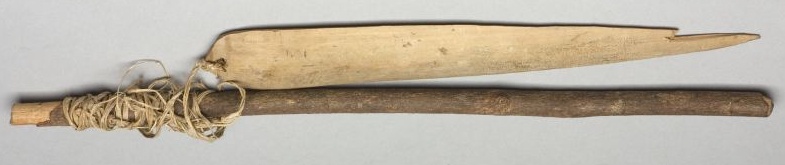
hakatangikugu
Source term: svingtræ
hakatangikugu: bullroarer; to roar, to sound loud; to swing one. From tangi, “to cry, sound, ring”. aho ’ua: “to summon or provoke rain, as by swinging the bull-roarer”.
Bellona is a ridge of raised coral ten kilometres long, walled in by cliffs, and the Polynesians who settled it call it Mungiki. From Matahenua at its western end comes this whirling rig, a hundred and sixty-three centimetres from blade to cord’s end: a slip of ghaimenga, the tree whose lasting timber Bellonese prize above all others for canoes and use for their houses too, and whose own forest god canoe-makers appeal to; the cord is hau, the hibiscus bast they twist into rope. They call it hakatangikugu, from tangi, to cry out. Bellonese music was sung rather than played, and this was no instrument of song. The one sentence anyone wrote about it is in Samuel Elbert’s dictionary, and it names a man: Moa of Hutuna, on Rennell, swings his hakatangikugu to summon rain. The same Moa, in the entry alongside, breaks the oven stones that the rain taboo protects along the south coast, because rain follows when the taboo is broken.
KO Moa e hakatangikugu i tena hakatangikugu ke aho ’ua.
Moa swings his bull-roarer to summon rain.
Samuel H. Elbert, Dictionary of the Language of Rennell and Bellona, Part 1 (1975), s.v. hakatangikugu
Particulars
- Object
- Complete whirling rig 163 cm overall: a blade of ghaimenga wood (Palaquium erythrospermum) on a cord of hau, Hibiscus tiliaceus bast.
- Function
- Swung to summon rain.
Source
Nationalmuseet, Copenhagen, I.6199; Samuel H. Elbert, Dictionary of the Language of Rennell and Bellona, Part 1: Rennellese and Bellonese to English (Copenhagen: National Museum of Denmark, 1975), s.v. hakatangikugu (p. 287), aho ’ua (p. 10) and tapu ’ua (p. 290)