No. SCHMELTZ1896-001
Java kitiran child toy bullroarer analogue
Indonesia · Java · Southeast Asia
Play / practical
Kitiran
Source term: Kitiran / Schwirrholz
Kitiran: a Javanese term for a spinning or whirling toy, and one of the Central Javanese names for the bullroarer, beside oewoeng-oewoengan and koembangan; around Banyuwangi in the east it was oewèr-oewèran, an imitation of its sound, or matjan-matjanan, a name that recalled the tiger (Brandts Buys and Brandts Buys-van Zijp 1926:328).
Etymology. Kitiran is the Javanese name of the toy windmill that the wind sets spinning in the trees; in Central Java it was also, less aptly, a name for the whirled bullroarer toy.
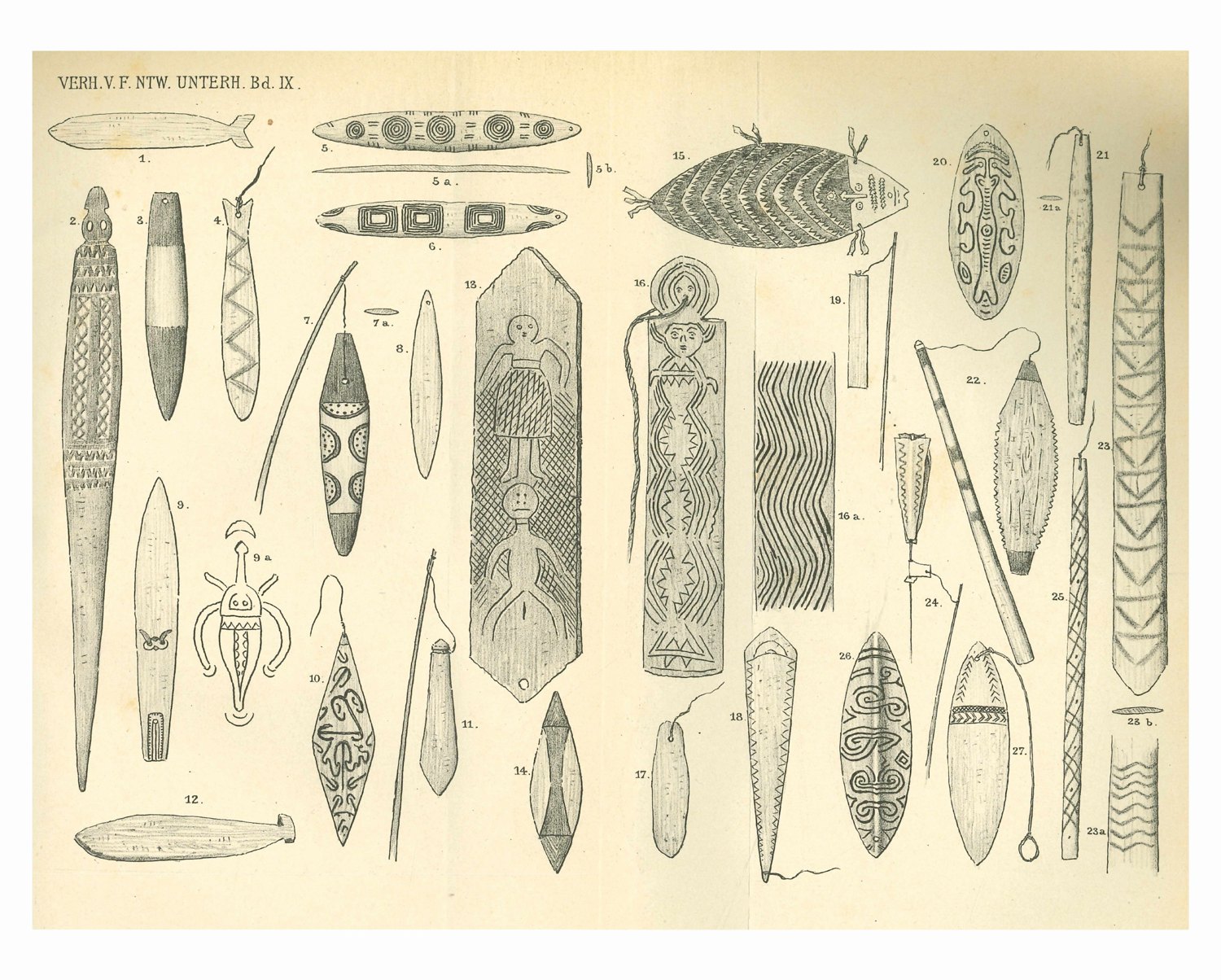
Surveying bullroarers worldwide in 1896, the ethnographer J. D. E. Schmeltz found only two in the whole Malay Archipelago: a Toba-Batak toy from Sumatra, and a Javanese children's plaything called the kitiran. He worked from an object in the Ethnographical Museum at Leiden, no. 625/2: a thin bamboo stick split halfway down its length, the split halves faced with brown paper cut to a truncated pyramid and marked with two red wavy lines, a square of tin slid onto the rest and tied by a thread to a thicker, longer piece of bamboo. Javanese children had many names for it: kitiran, oewoeng-oewoengan or koembangan in Central Java, and around Banyuwangi in the east oewèr-oewèran, after its whirr, or matjan-matjanan, a name that recalled the tiger.
Die Behandlung ist die gleiche wie beim Schwirrholz und auch die erzielte Wirkung stimmt mit der desselben überein.
The handling is the same as with the bullroarer, and the effect produced agrees with it as well.
Schmeltz 1896:103 (Das Schwirrholz. Versuch einer Monographie)
Particulars
- Object
- A thin bamboo stick split halfway down its length, the split halves faced with brown paper and a square of tin, tied by a thread to a thicker, longer bamboo handle; swung on its thread exactly as a Schwirrholz is, and to the same effect (Leiden 625/2).
- Function
- A children's toy, whirled on its thread like a bullroarer.
Source
J. D. E. Schmeltz, Das Schwirrholz; Versuch einer Monographie, Verhandlungen des Vereins fur naturwissenschaftliche Unterhaltung zu Hamburg 9 (1896): 92-128; Zobodat public PDF