No. CHENG2015-001
Sakizaya berber bullroarer, Guo Fu Community
Taiwan · Guo Fu Community · Hualien City · East Asia
Play / practical
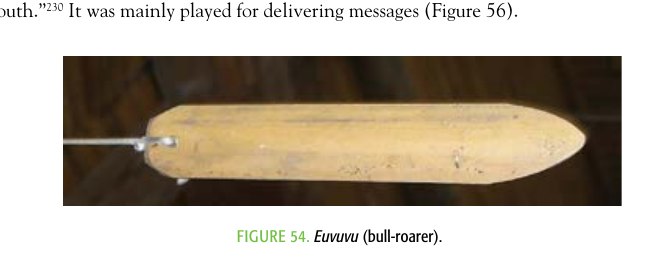
berber / ber ber
Source term: bullroarer; distinct from same-named whirring disc
berber / ber ber = Sakizaya name shared by the bullroarer and a separate whirring disc.
For more than a century after Qing troops crushed them in the 1878 Takobowan battle, the Sakizaya survived by hiding in plain sight — living as Amis, keeping their language indoors, until Taiwan recognized them as its thirteenth indigenous people in 2007. Out of that guarded childhood world the elder Jin-wen Huang remembered the ber ber: a thin slice of stone tied to a long string and spun until it sounded. 'The thinnest stone made the loudest sound.' A toy, nothing more — and today elders teach schoolchildren to make it again.
Children played it just for amusement.
Jin-wen Huang, in Cheng, Taxonomies of Taiwanese Aboriginal Musical Instruments (2015), p. 942.
Particulars
- Object
- Slender oval bullroarer; in practice a thin stone slice tied to a long string and spun. The same name also covers a separate two-hole whirring disc.
- Function
- Children's toy; revived by elders as a plaything in schools and cultural associations.
Source
Lancini Jen-hao Cheng, Taxonomies of Taiwanese Aboriginal Musical Instruments (PhD thesis, University of Otago, 2015), §6.10.5, pp. 613-615, and p. 942 (interview with Jin-wen Huang, 12 July 2009, Guo Fu Community, Hualien City)