No. HAD1898-024
Mota Banks Islands nanamatea
Vanuatu · Oceania
Sacred / spirit
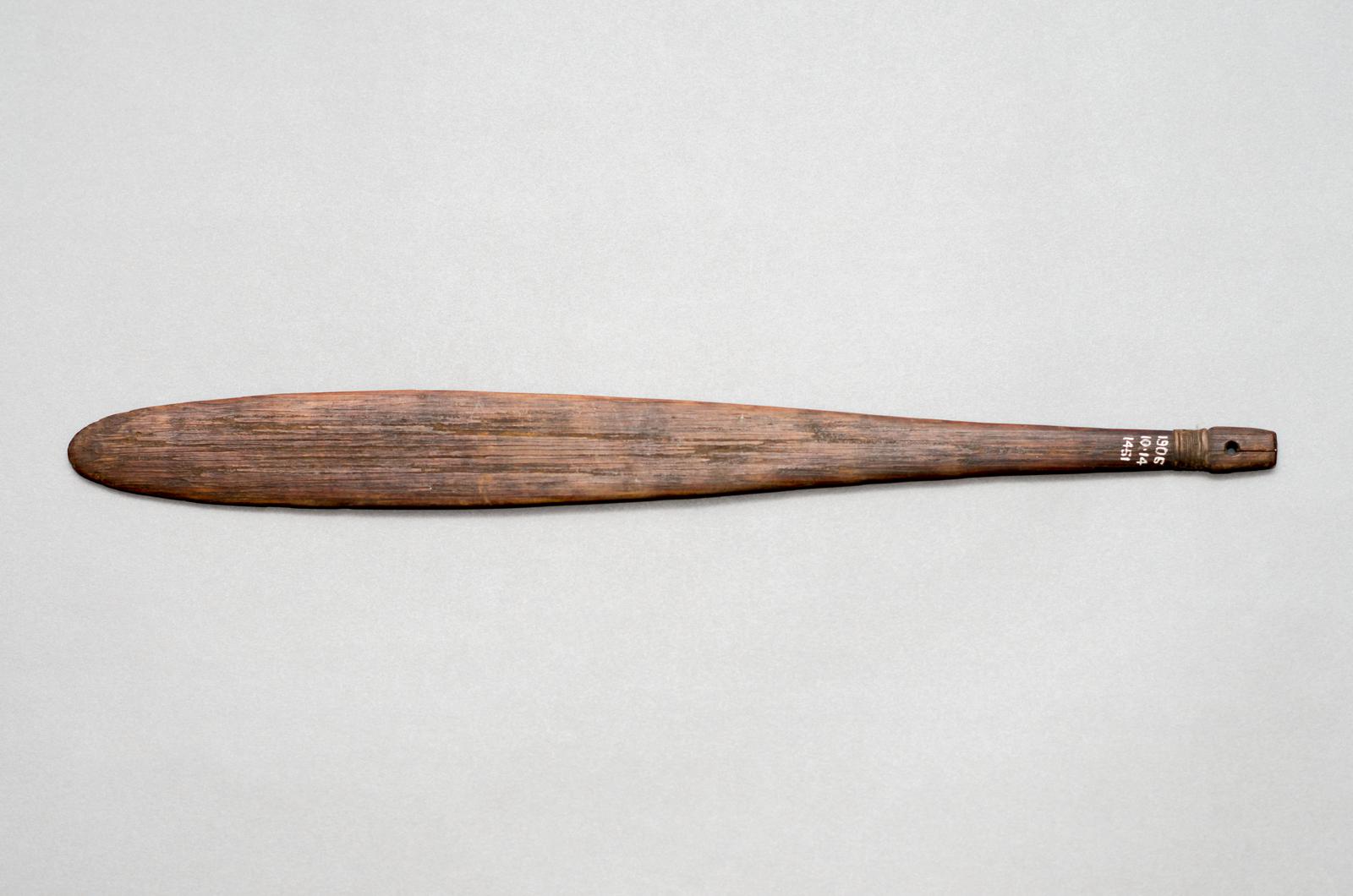
nanamatea
Source term: nanamatea / death-maker
nanamatea: Mota (Banks Islands) "death-maker," the name for the bullroarer swung to drive off a ghost.
Etymology. The Mota bullroarer name is a transparent death/ghost-driving term (Haddon after Codrington).
On Mota the dead did not leave at once. A soul might even be caught on its way out: a Mota woman once heard one fluttering in her house like a moth, cupped it between her hands and ran to the house of death to release it over the corpse's mouth, too late. Once gone, the ghost lingered five or ten days, making noises in the house and lights over the grave, and in the Banks Islands it was not thought good for it to stay past the fifth day. Then it was driven off with shouts and conch blasts, and with the bullroarer, which Mota called nanamatea, "death-maker." The roarer itself held no secret. In the Banks Islands it was too familiar a plaything to serve the mysteries of the men's societies.
There is no mystery about it when it is used in the Banks' Islands to drive away a ghost, as in Mota, where it is called nanamatea, death-maker, or to make a mourning sound, as in Merlav, where it is called worung-tamb, a wailer, and used the night after a death.
Codrington 1891, The Melanesians, ch. 17
Particulars
- Function
- Bullroarer used to drive away a ghost.
Source
R. H. Codrington, The Melanesians: Studies in their Anthropology and Folk-Lore (Oxford: Clarendon Press, 1891), pp. 80, 267, 342 (ch. XVII, Toys)