No. DEACON1934-002
Lambumbu and Uerik Malekula sacred bullroarer
Vanuatu · Central-west Malekula · Lambumbu · Oceania · Melanesia
Restricted
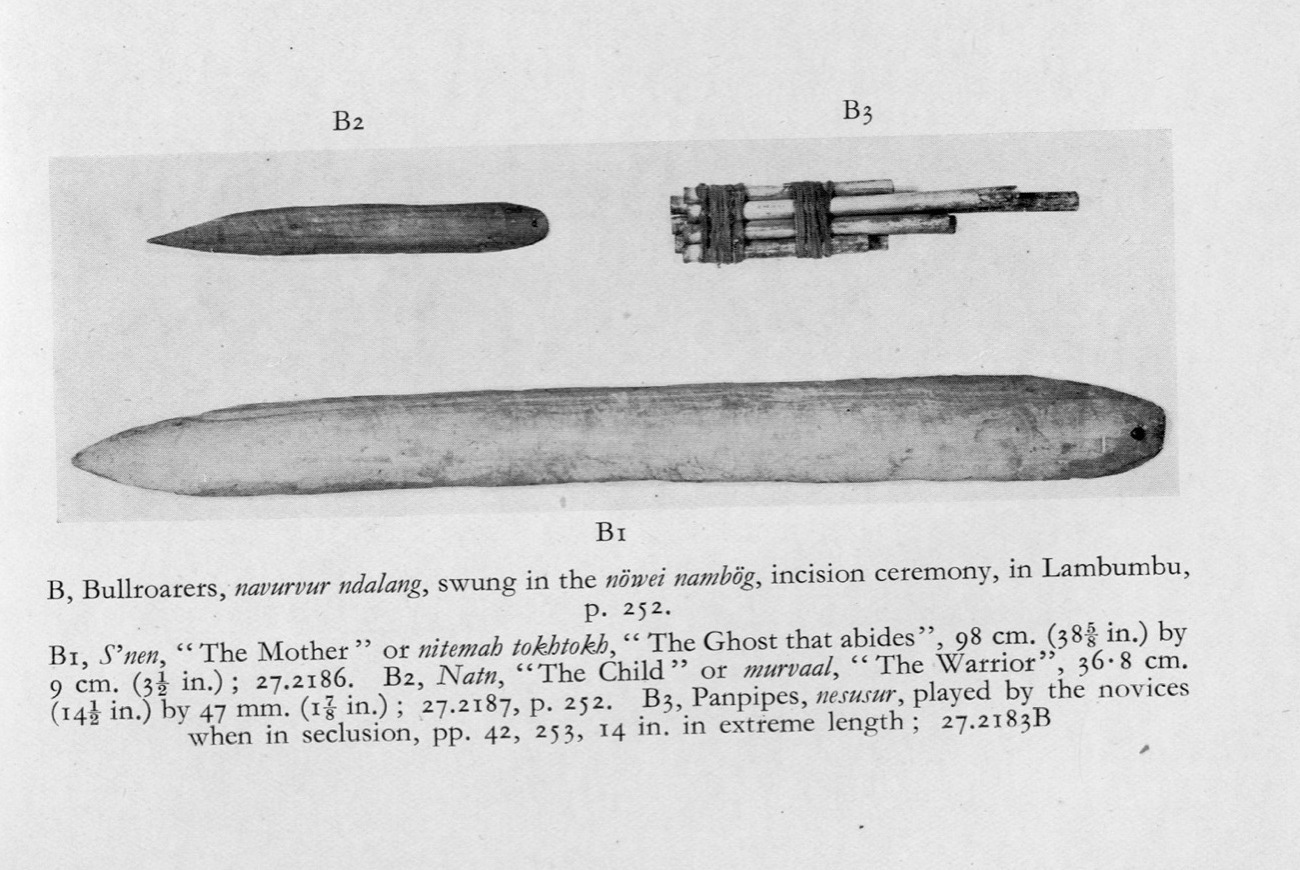
navurvur ndalang (Lambumbu); nangamgar nrlalinge (Uerik)
Source term: bullroarer
navurvur ndalang (Lambumbu) — “ear-slitter” or “slit ear”; s’nen — “The Mother”; natn — “The Child”; nitemah tokhtokh — “the ghost that abides” or “the ghost that waits”; murvaal — “The Warrior.” nangamgar nrlalinge is the Uerik name; its literal meaning is unrecorded.
In Lambumbu, incision made puberty public: after seclusion, a boy’s altered body announced his new standing. The bullroarer was the transition rite’s “principal sacred instrument”—the defining sound of a passage cut into the body. In neighbouring Uerik, novices were finally shown the nangamgar nrlalinge during incision and taught to swing it themselves: guarded sound became knowledge they could now produce.
The bullroarer in this part of the country is called navurvur ndalang, which means "the ear-slitter", or, perhaps, "the slit ear". There are two varieties of these: a long one measuring from about 2 ft. 6 in. to 3 feet, called "The Mother" (s'nen), and a small sharply pointed one some eight inches long, called "The Child" (natn).
A. B. Deacon, Malekula: A Vanishing People in the New Hebrides (1934), p. 252
Particulars
- Object
- Two instruments used together, named as kin. ‘The Mother’ (s’nen) is a 2 ft 6 in to 3 ft blade whirled horizontally at about head height for a continuous hum. ‘The Child’ (natn) is a sharply pointed blade about eight inches long, attached like a fish on a line to a stout stake and swept from side to side for a shrill, pulsing whirr. The big one is also nitemah tokhtokh, ‘the ghost that abides’ or ‘the ghost that waits’; the small one is sometimes murvaal, ‘The Warrior.’
- Function
- In Lambumbu, sounded from hidden places within and outside the seclusion house while each novice runs a gauntlet of whipping men in the dark, immediately after the incision operation; the novices are told one story about whose voice it is and the women a different one, and the real nature of the sound is revealed to the lads only on the last day of their seclusion.
Source
A. B. Deacon, Malekula: A Vanishing People in the New Hebrides (1934), pp. 244 and 250-253, esp. p. 252 and pl. XVIIB; Royal Anthropological Institute MS 98, files 6/8 and 7/4