No. HAD1898-023
Florida Solomon Islands Matambala buro
Solomon Islands · Oceania
Restricted
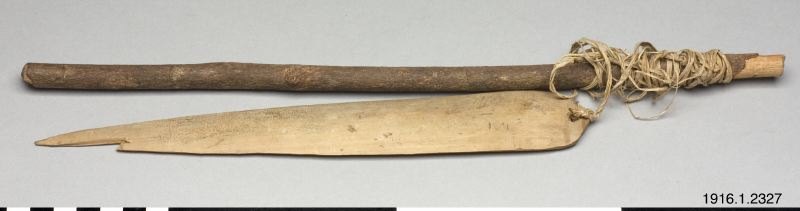
buro
buro = the Florida (Nggela) word for the bull-roarer; seesee = bundles of coconut fronds beaten over a stick; Matambala = the Florida secret society/mystery cult; Siko = its tutelary deified ancestor (now a tindalo or ghost) who came from Bugotu in Ysabel.
On Florida (Nggela) in the Solomon Islands, the men of the Matambala society came up from the beach after dark whirling the buro and beating the seesee, bundles of coconut fronds thrashed over a stick. Whistling and clucking, they entered the village, and the women shut themselves in. The women had prepared small holes in the house walls to push food out through, a contrivance that kept the men's hands unseen and unfelt; when a whistle came they would ask, "Who are you, are you Siko?" and the man would whistle back and take the food. Siko was a deified ancestor out of Bugotu in Ysabel, by then a tindalo or ghost invoked with sacrifices, and the whole secret cult turned on his worship. It ended in 1883 when the one man who knew how to sacrifice to Siko became a Christian: the sacred precincts were explored, the bull-roarers became the playthings of the boys, and the old men sat and wept over their loss of power. Haddon reported the case in his 1898 survey, drawing it straight from Codrington's account.
they beat the seesee and whirl the buro, and come into the village; and they whistle and cluck, and all the women in the village shut fast their houses and are much afraid, because they think that they are surely ghosts
Codrington 1891, The Melanesians, ch. 5 (pp. 98, 342); cited in Haddon 1898:300-301
Particulars
- Function
- Whirled in the Matambala society's night mysteries.
Sources
- R. H. Codrington, The Melanesians: Studies in their Anthropology and Folk-lore (Oxford: Clarendon Press, 1891), ch. V, pp. 98–99; comparative Mota account p. 342 View
- A. C. Haddon, The Study of Man (1898), pp. 300–301, citing Codrington (1891), pp. 98, 342