No. EXH2026-004
Ngati Porou (turorohu rain rite)
New Zealand · East Cape · Waiapu Valley, North Island · Oceania
Weather / fertility magic
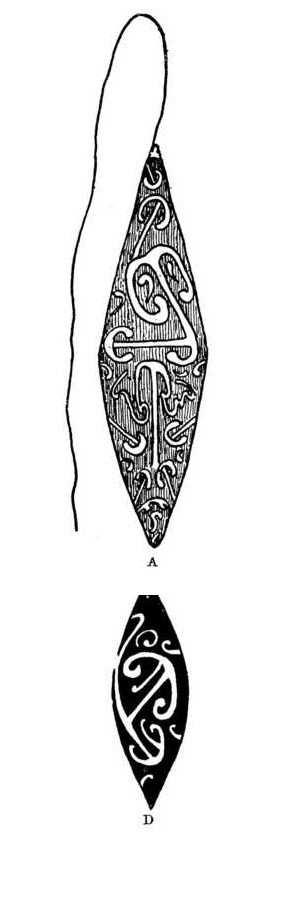
turorohu / huhu
Source term: bullroarer (turorohu, huhu)
turorohu (also huhu): Ngati Porou names for the swung bullroarer used in the rain rite; the same words also denote the humming whizzer-toy.
Etymology. huhū is the Maori onomatopoeic verb "to hiss, whiz, buzz, whirr, swish, hum," naming the instrument from its humming roar; the same word hums in pōtaka huhū, the humming top.
Among Ngati Porou of the East Cape, the bullroarer was an instrument of weather magic. The Ngati Porou chief Tuta Nihoniho described the rite to Elsdon Best, who recorded it in his Games and Pastimes of the Maori (1925): when rain was needed for the crops, an adept threw a handful of ashes toward the south, the rainy quarter, swung the turorohu until it gave its dull roar, bared his buttocks to the south, and recited a karakia meant to insult and anger that quarter into sending a storm. The blade was a thin, elongated piece of matai heartwood, swung on a long cord tied to a rod handle, and some said its whirring boom came from the swinger's own soul.
Particulars
- Object
- Thin flat blade of matai heartwood, elongated oval, 12-18 in., on a 4-ft cord tied to a 3-ft rod handle.
- Function
- Rain-making rite: adept throws ashes toward the south, swings the turorohu and recites a karakia to anger the rainy quarter; children chided that sounding it brings storms. Explicitly ceremonial, not a toy (Best).
Source
Elsdon Best, Games and Pastimes of the Maori (Dominion Mus. Bull. 8, 1925), pp. 294-295: Tuta Nihoniho's account (Ngati Porou), karakia text included