No. OCEXP-001
Vanua Lava, Banks Islands — mala toy
Vanuatu · Banks Islands, New Hebrides · Oceania
Play / practical
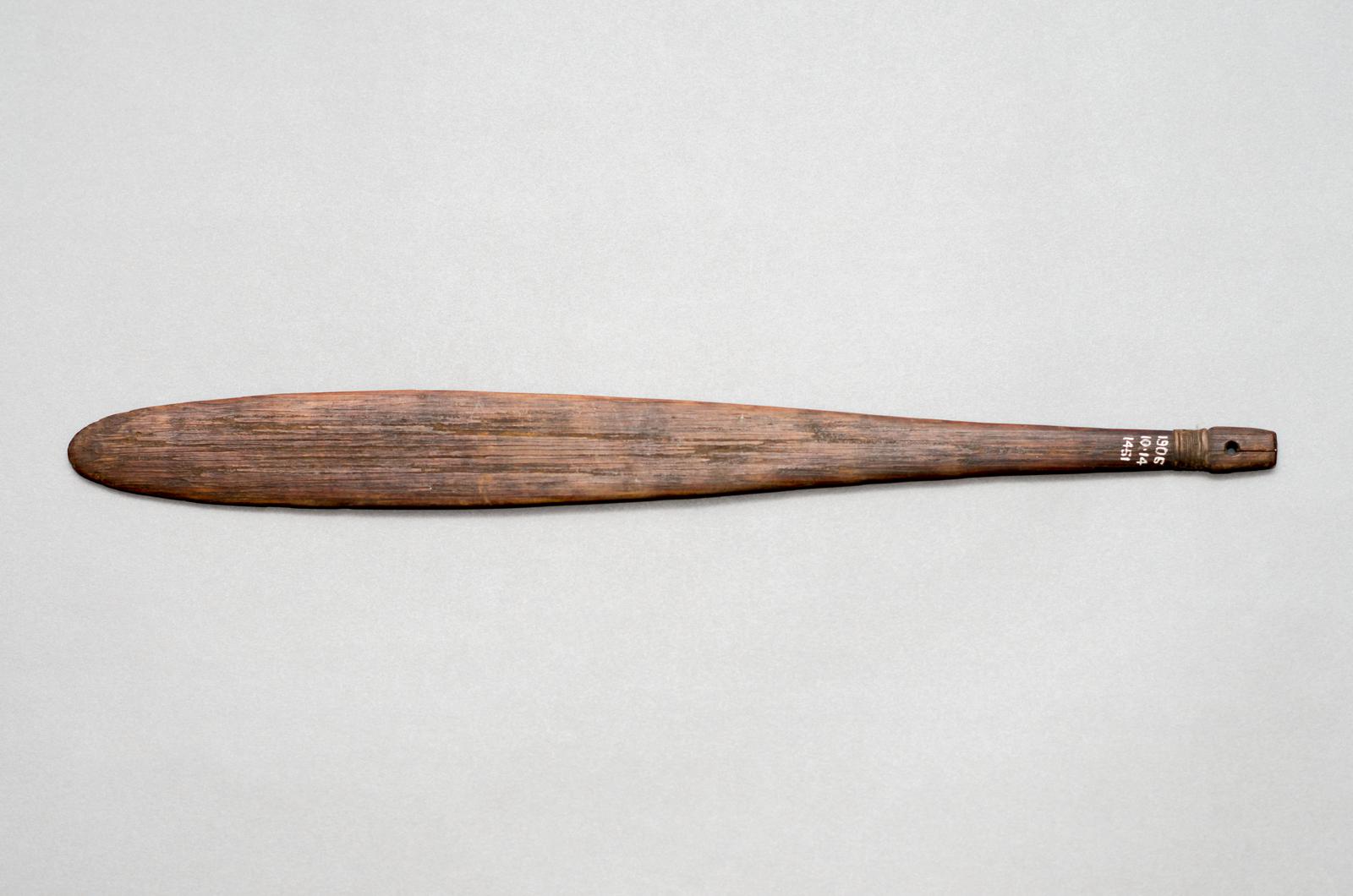
mala
Source term: bull-roarer
mala — "a pig" in the Vanua Lava language; the bull-roarer is named for the grunting noise it makes when swung.
Etymology. The toy bullroarer is named from pig-like grunting noise when swung.
On Vanua Lava the bull-roarer is a common plaything, called mala, "a pig," from the grunting noise it makes when swung. Codrington, who gathered these names across the Banks Islands and the northern New Hebrides, noted that here it carries no superstitious character at all. The same whirring slat is no toy elsewhere in the group: at Mota it is the nanamatea, the "death-maker," sounded to drive a ghost away, and at Merlav it is the worung-tamb, "a wailer," used the night after a death. Only at Florida, to the north, where it was called buro, did it belong to the men's Mysteries; there alone, Codrington wrote, did any superstitious character belong to it.
It is a common plaything; in Vanua Lava they call it mala, a pig, from the noise it makes; in Maewo it is tal-viv, a whirring string; in Araga it is merely tavire bua, a bit of bamboo.
Codrington, The Melanesians (1891:342)
Particulars
- Object
- Swung-cord aerophone described as a common plaything; local name means 'a pig' from the noise it makes.
- Function
- Secular toy named 'mala' (pig) after its sound; Codrington notes no superstitious character here.
Source
Codrington, The Melanesians (1891), Ch. XVII: Dances, Music, Games