No. POLY2026-012
Anaa vivi, the dragonfly whirligig
French Polynesia (France) · Anaa, Tuamotu Archipelago · Oceania
Play / practical
vivi
Source term: whirligig, bull-roarer
vivi (Tuamotuan, Anaa): "a dragonfly"; "a whirligig, bull-roarer"; as a verb, "to make a buzzing, whirring, humming sound, as a dragonfly, top, whirligig".
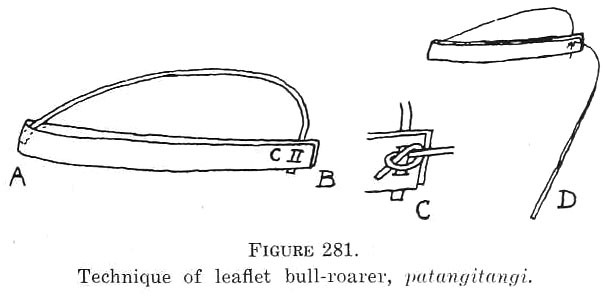
On Anaa, an atoll in the Tuamotus, children bent a coconut rib into a bow, tied it to a string and swung it from the end of a stick. The toy was called vivi, which is also the word for the dragonfly. Vivi is a verb as well: to buzz, whirr or hum, the way a dragonfly does, or a spinning top. In the Tuamotus the bullroarer, the insect and the sound shared one word.
A whirligig, bull-roarer; the use of the whirligig as a child's amusement; this is made with a bent coconut-rib tied to a string attached to the end of a stick.
J. F. Stimson and D. S. Marshall, A Dictionary of Some Tuamotuan Dialects (1964), p. 611, s.v. vivi.
Particulars
- Object
- A bent coconut rib tied to a string fastened to the end of a stick.
- Function
- A child's amusement, swung to buzz.
Source
J. Frank Stimson and Donald Stanley Marshall, A Dictionary of Some Tuamotuan Dialects of the Polynesian Language (The Hague: Nijhoff, for the Peabody Museum of Salem, 1964), p. 611, s.v. VIVI (iii)