No. POLY2026-004
Aitutaki patangitangi leaflet bullroarer
Cook Islands · Aitutaki · Oceania · Polynesia
Play / practical
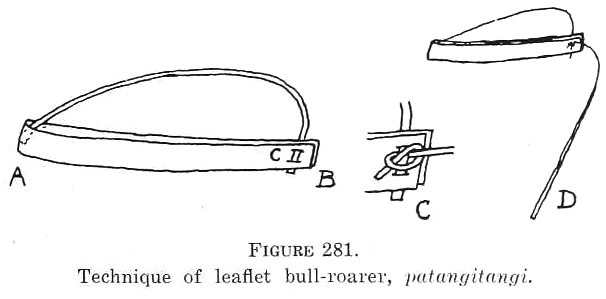
patangitangi
Source term: leaflet bull-roarer
patangitangi (Cook Islands Maori): "bullroarer, a child's toy," from pa- + tangi ("to sound, cry"), reduplicated; made from a coconut leaflet.
Etymology. Transparent sound-word formation for an Aitutaki coconut-leaflet toy bullroarer.
On Aitutaki the bull-roarer was a children's plaything made from a strip of coconut leaflet rather than carved wood, and whirled for its hum. The Cook Islands dictionary records it plainly as "Bullroarer. (child's toy)," with the sample phrase "there is a coconut leaf to make a bullroarer out of." Te Rangi Hīroa (Peter Buck) catalogued the leaf toys of Aitutaki in his 1927 material-culture volume, and when he later turned to Samoa he noted that the local version was "made in the same way as at Aitutaki" — there it was the lango mumu, taking its name from the buzzing fly because of its humming noise, made alongside a leaf windmill (pe'ape'a) and a spinner (moamoa).
The more substantial nature of the Maori bull-roarer drew attention to it, whilst the perishable form of the Aitutaki patangitangi probably led to its being overlooked by writers. This has led to the statement that the bull-roarer is unknown to the Polynesians, with the exception of the Maori branch. The cocoanut leaflet patangitangi has as much right to the generic name of bull-roarer as the more stable wooden purerehua.
Te Rangi Hīroa (P. H. Buck), The Material Culture of the Cook Islands (Aitutaki) (1927), printed p. 345.
Particulars
- Object
- A strip of coconut leaflet, about 9 inches by three-quarters of an inch, doubled at its midpoint; a green leaflet midrib pinned through the free ends and bowed back into the fold to hold the blade taut, with a long leaflet midrib as cord and handle.
- Function
- A child's toy, swung on its midrib cord for the hum.
Source
Te Rangi Hiroa (P. H. Buck), The Material Culture of the Cook Islands (Aitutaki) (1927), pp. 321-322, fig. 281, and p. 345