No. POLY2026-014
Pukapuka wakatangitangi, the crier
Pukapuka, northern Cook Islands · Oceania · Polynesia
Play / practical
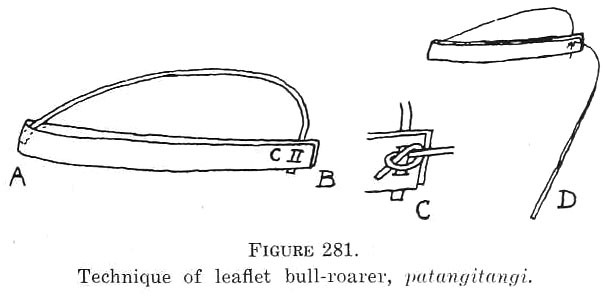
wakatangitangi
Source term: leaf-whizzer
wakatangitangi (Pukapukan): "made to cry", from waka- (causative, Polynesian faka-) + tangitangi, reduplicated tangi, "to cry, sound".
On Pukapuka, a remote atoll in the northern Cook Islands, children made a coconut-leaflet roarer like the patangitangi of Aitutaki, and called it wakatangitangi: the thing made to cry. The name is built on faka-tangi, to make something sound or weep. Aitutaki's patangitangi comes from the same root, and so does Bellona's hakatangikugu, the roarer swung to call rain in the Solomons. Where Tongans and Samoans named the whirled leaf for a fly, these islanders named it for its voice.
Particulars
- Object
- A coconut-leaflet toy, made like the Aitutaki patangitangi.
- Function
- A children's toy.
Source
New Grove Dictionary of Musical Instruments (1984), vol. 3, s.vv. "Wakatangitangi" and "Patangitangi"; Mervyn McLean, Weavers of Song: Polynesian Music and Dance (Auckland University Press, 1999), p. 89, citing Ernest and Pearl Beaglehole, Ethnology of Pukapuka (Bishop Museum Bulletin 150, 1938)