No. EA-TW-AMIS-001
Amis bnbn toy and bird-scarer bullroarer
Taiwan · Ciwidiyan · Shuilian, Shoufeng Township, Hualien · East Asia
Play / practical
bnbn
Source term: Bnbn (bullroarer)
bnbn — Amis name for the bullroarer, onomatopoeic
Etymology. Cheng treats the Amis form as onomatopoeic.
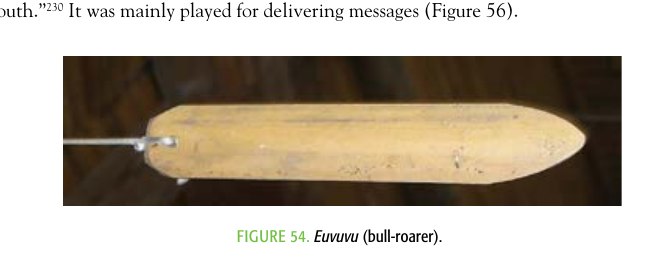
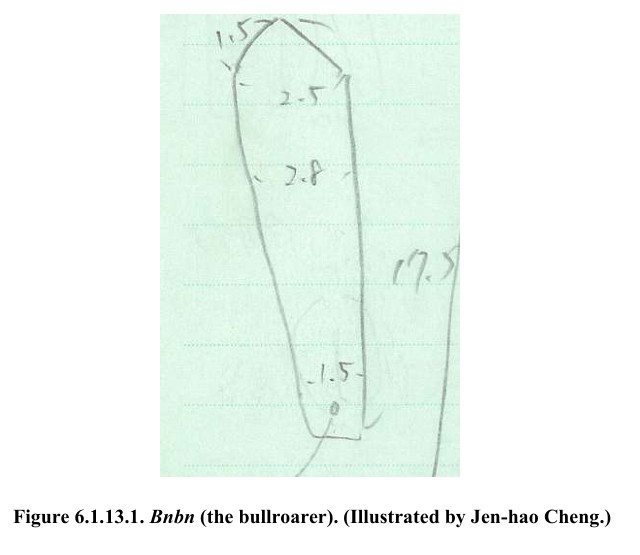
Among the Amis of eastern Taiwan the bullroarer is called bnbn, a name the ethnomusicologist Lancini Jen-hao Cheng records as onomatopoeic. At Ciwidiyan — Shuilian village on the Hualien coast — it was a childhood toy and a crop-guard, swung to scare birds off the fields. When Cheng visited, the sub-tribe's chieftain De-rang Sung, a primary-school teacher, was making bnbn with his pupils so the plaything would pass down: bamboo sawn and shaved to a slender oval, a hole drilled at the top, a cotton string tied through.
Nowadays, the bnbn is not simply a toy, but it is an indicator of Amis cultural revival. For Amis elders, playing bnbn (the bullroarer) helps invoke childhood memories.
Cheng, Taxonomies of Taiwanese Aboriginal Musical Instruments (PhD thesis, University of Otago, 2015), §6.1.13, p. 341
Particulars
- Object
- Bamboo shaved to a slender oval, holed at the top and strung with cotton. The wooden bnbn kept in the Academia Sinica's ethnology museum is a tapering slat about 17.5 cm long and 2.5 cm wide.
- Function
- Children's toy or bird-scarer used to protect arable crops.
Source
Lancini Jen-hao Cheng, 'Native Terminology and Classification of Taiwanese Musical Instruments,' Ensayos 19(28) (2015), section 1.13, p. 78; Cheng, Taxonomies of Taiwanese Aboriginal Musical Instruments (PhD thesis, University of Otago, 2015), §6.1.13, pp. 340-343