No. HAD1898-025
Merlav Banks Islands mourning bullroarer
Vanuatu · Oceania
Sacred / spirit
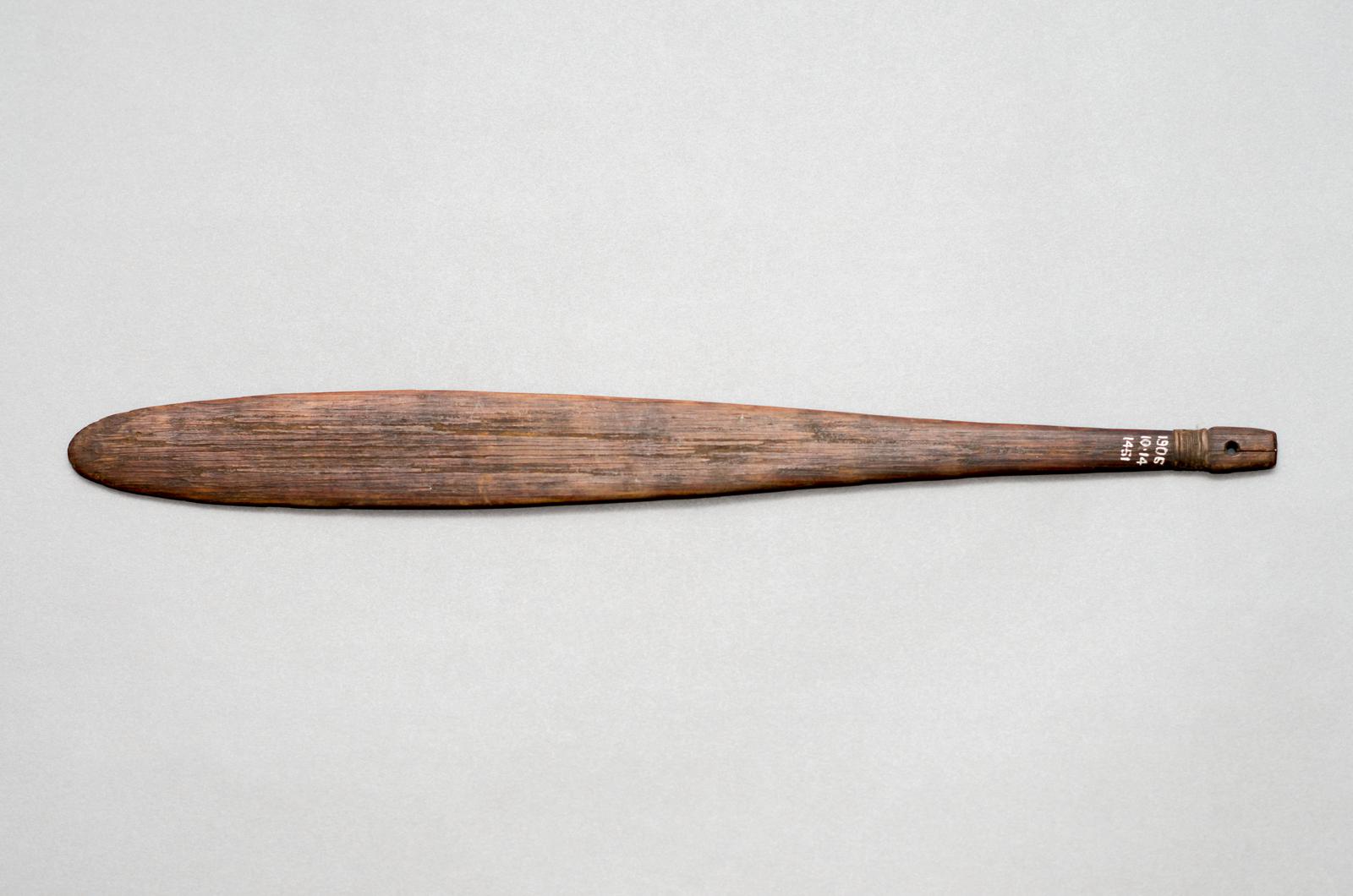
worung-tamb
worung-tamb: Merlav (Banks Islands) name for the bull-roarer, glossed by Codrington as "a wailer," from its use to make a mourning sound the night after a death. naborbor — the modern Merelava name for the coconut-leaf bullroarer recorded at Tesmet in 2005 (Francois & Stern), beside Codrington's worung-tamb.
Etymology. The source ties worung-tamb to the moaning or wailing sound made after a death.
On Merlav in the Banks Islands the bull-roarer was swung the night after a death, and was called worung-tamb, "a wailer." Codrington, who recorded it firsthand, was emphatic that the instrument held no mystery in these islands: on neighbouring Mota the same whirling slat was the nanamatea, "death-maker," sounded to drive a ghost away, while on Vanua Lava, Maewo and Araga it was an open plaything with names like "pig" and "a bit of bamboo." Only in Florida, he wrote, did it carry any secret weight. In Merlav its work was not to frighten the dead off but to mourn them, a wailing made through the night after a death.
There is no mystery about it when it is used in the Banks' Islands to drive away a ghost, as in Mota, where it is called nanamatea, death-maker, or to make a mourning sound, as in Merlav, where it is called worung-tamb, a wailer, and used the night after a death.
Codrington, The Melanesians (1891), ch. XVII
Particulars
- Function
- Bullroarer used to make a moaning sound the night after death.
Source
Codrington, R. H., The Melanesians: Studies in their Anthropology and Folk-lore (Oxford: Clarendon Press, 1891)