No. POLY2026-009
Tongan langumumuhbu, the boy's bullroarer
Tonga · Oceania · Polynesia
Play / practical
kokalu; langumumuhbu
Source term: boy's bullroarer
langumumuhbu (Tongan): built on lango, "house-fly", and mumu, "to hum"; McLean spells it langumumubu. kokalu: the other Tongan name, unglossed.
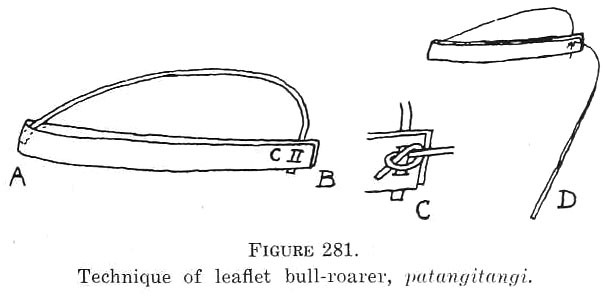
Tongan boys bent a doubled coconut frond open on a bow cut from a leaf midrib, tied on a second midrib for a cord, and whirled it fast until it hummed. They called it kokalu, or langumumuhbu. The second name is built on lango, the Tongan house-fly, and on the same humming mumu that Samoan children put into their lago mumu. Tongan and Samoan sit on the two main branches of the Polynesian family, so a toy name the two share may be nearly as old as Polynesian itself. The only description of it comes from W. C. McKern, who worked in Tonga for the Bishop Museum in 1920–21.
A doubled frond from a coconut leaf was held distended by a bow, made from the midrib of a coconut leaf frond … which could then be whirled rapidly to produce a humming noise.
W. C. McKern, manuscript p. 669, quoted in Richard M. Moyle, Tongan Music (1987), "Free aerophones".
Particulars
- Object
- A doubled coconut frond held open by a bow of leaf midrib tied to both ends, with a second midrib as the cord.
- Function
- A boy's toy, whirled fast for its hum.
Source
Richard M. Moyle, Tongan Music (Auckland University Press, 1987), section "(f) Free aerophones", citing W. C. McKern's manuscript (n.d.), p. 669; Mervyn McLean, Weavers of Song: Polynesian Music and Dance (1999), Tonga chapter