No. PNG172
Haku
Papua New Guinea · Bougainville · Oceania · Sahul
Restricted
rus
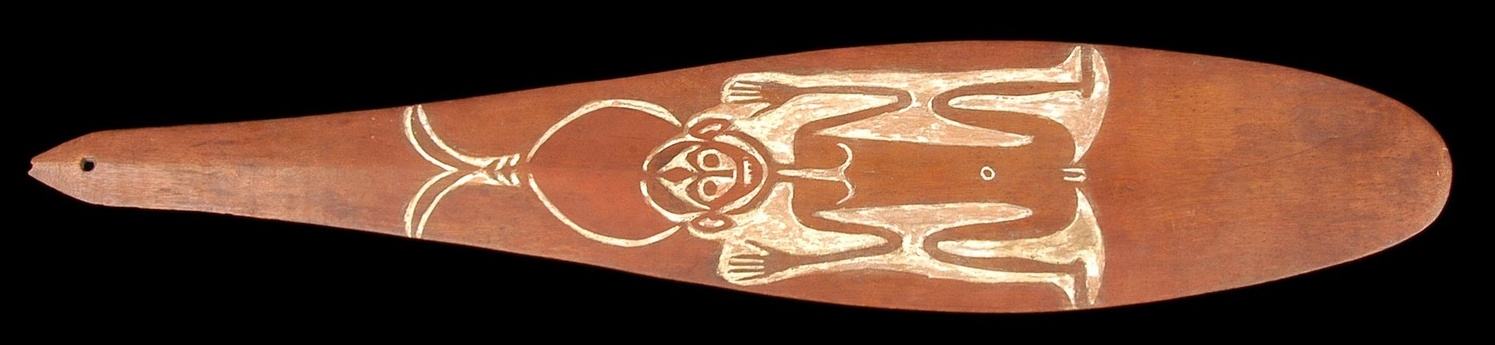
rus: the spirit of boys' initiation, and the bullroarer.
On Buka a boy taken for the upe disappears into a forest school for up to three years, his head bound in a woven cone; no woman may see him, or even cross ground he has walked. Among these northern islanders Gourlay's 1975 survey marks two sounding things — the slit-gong and the swung bullroarer, the wooden voice that men across Buka Passage lent to the ancestral dead. The Halia language of Haku holds both halves of the secret in one word: rus is the spirit that attended boys' initiation, and rus is the bullroarer, 'an object swung around to make a frightening sound.'
Source
K. A. Gourlay, Sound-Producing Instruments in Traditional Society: A Study of Esoteric Instruments and Their Role in Male-Female Relations (New Guinea Research Bulletin 60; Canberra and Port Moresby, 1975), Table 1, entry 172; Halia Dictionary (SIL), entry rus 2