No. MUS2026-027
Woman-slit-my-ear, the Nevinbur voice
Malekula, Vanuatu · Oceania · Melanesia
Restricted
nevin or or ndeling
Source term: bull-roarer
nevin or or ndeling — "the female ear-slitter", or "woman slitting ear". Nevinbur (Nivivbur in the museum register) — the most sacred secret society of Seniang, South West Bay, Malekula.
Etymology. The bullroarer of the Nevinbur, the secret society of South West Bay, Malekula, carries the local name nevin or or ndeling, which its collector A.B. Deacon glossed 'woman-slit-my-ear'.
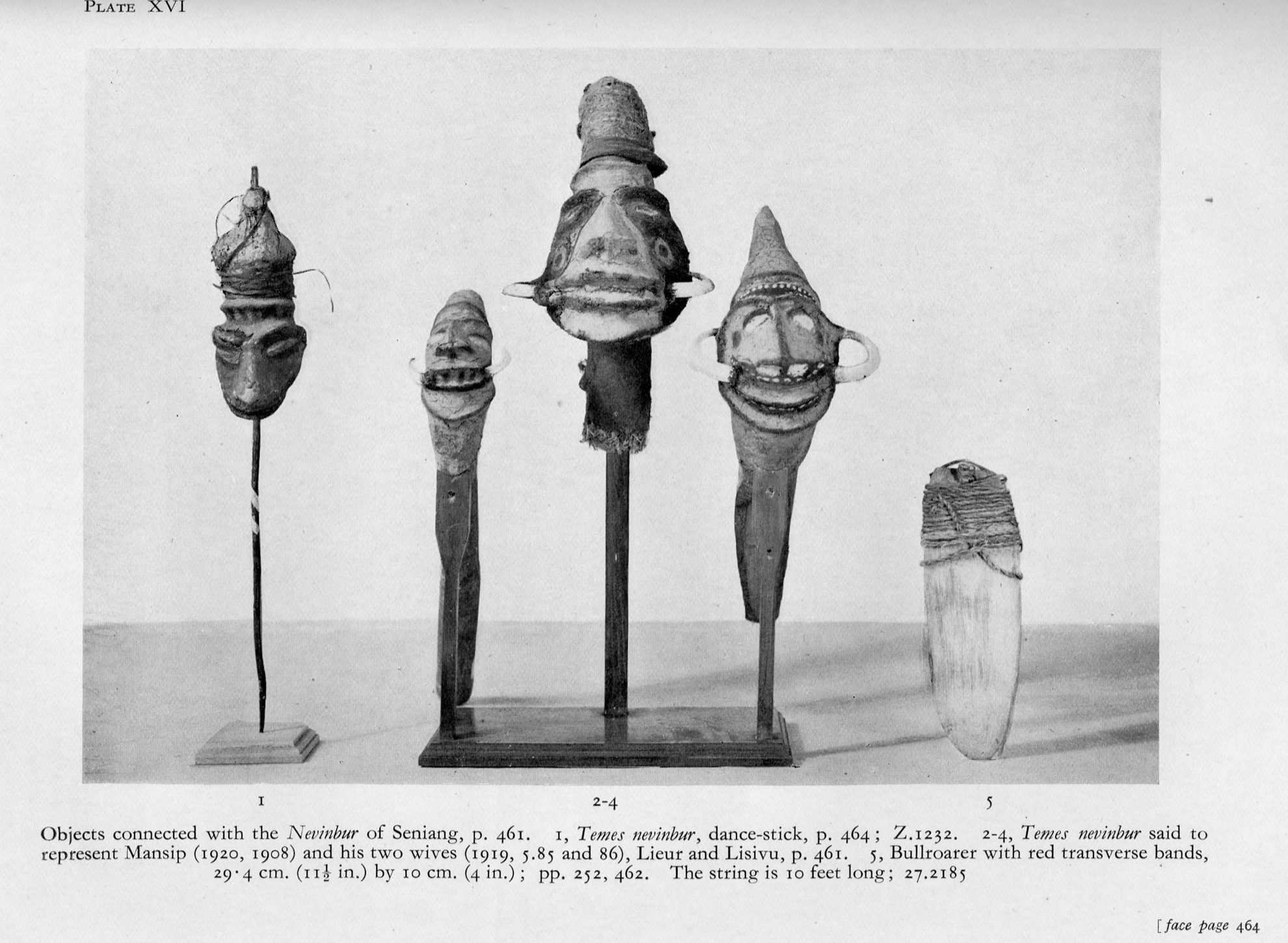
Its name, as Deacon set it down, was "woman-slit-my-ear" — the roar a wound a woman's ear was never meant to hear. This red-tailed blade on its cord belonged to the Nevinbur, a secret society of South West Bay, Malekula, whose men brought spirit-puppets to life behind the dancing-ground fence: the grandchildren of Mansip, son-in-law of the ogress Nevinbumbaau, raised and destroyed; Mansip and his two wives speared and burned. Screened from all of that theatre, women were left only the voice — and the name records what the voice cost them.
Nevinbumbaau is essentially connected with the bull-roarer (Pl. XVI, 5; c.f. f.n., p. 252), for she is the wife of Ambat Malondr, and the noise of this instrument is her voice crooning her child, Sasndaliep, to sleep. The whirring of the bull-roarer is the secret sound of this society, and is very ileo.
A. B. Deacon, Malekula: A Vanishing People in the New Hebrides (1934), p. 462
Particulars
- Object
- Wooden bull-roarer of the Nevinbur society, 29.4 by 10 cm, painted with red transverse bands, on a ten-foot string; MAA Cambridge 1927.2185 (Deacon).
- Function
- Swung inside the screened enclosure throughout the Nevinbur rites that admit new members, as the voice of Nevinbumbaau; at the coming of dawn or the morning star, all the roarers 'sing out' together.
Source
MAA Cambridge 1927.2185, bullroarer of the Nivivbur society, collected by A. B. Deacon at Seniang, South West Bay, Malekula; A. B. Deacon, Malekula: A Vanishing People in the New Hebrides, ed. C. H. Wedgwood (London: Routledge, 1934), pp. 252 n. 1, 461-467 and Pl. XVI, 5; John Layard, Stone Men of Malekula (London: Chatto & Windus, 1942), p. 494 n. 2