Atlas Essay —
Not Spirits, but Men
Women and children were told the roar was a monster that eats boys; the boys were shown men, and sworn to keep the lie
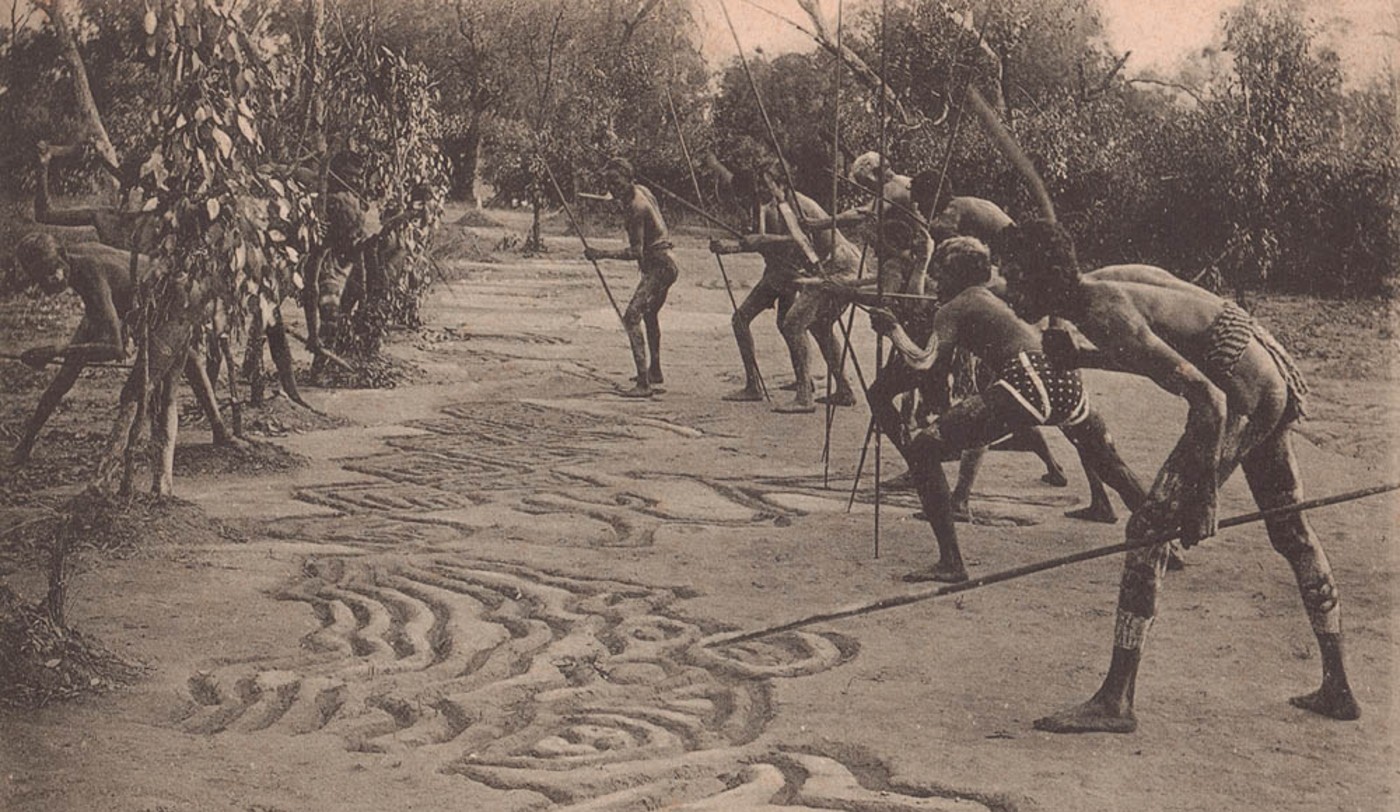
On Tami, a small island off the Huon Gulf of New Guinea, the men cut deep grooves into the trunks of trees and showed them to the women and children: the marks, they said, “made by the monster in tugging at the ropes which bound him to the trees” (Frazer 1913, p. 301). The monster was a dragon, it had come for the boys, and its roar filled the bush for as long as they were gone. In New South Wales, between the Hunter and Macleay rivers, the boys came home with their hair singed, “for the purpose of making the women believe that Goign has had them in the fire” (Mathews 1897, p. 334). On the Huon Gulf a boy who died under the knife had “slipped by mistake into the wrong stomach” of the monster that swallowed him (Frazer 1913, p. 252). In Tierra del Fuego the Selk’nam men walked out of their lodge with scratched faces and bleeding noses, to show the women what the spirits inside had done to them (Bridges 1948, p. 413). Each is a prop for one story, and the women of four continents were told it.
Across the bullroarer world the uninitiated are told one patterned lie: the roar is a being, nearly always a devourer that eats children or swallows boys, and the roarer carries that being’s own name. Initiation ends it with a double revelation: the spirits are men, and whoever tells will die.
In brief
- The lie comes with evidence: grooved trees on Tami; singed hair on the Macleay; firesticks thrown over the covered women of the Wiradjuri “to make them believe that Dhuramoolan had tried to burn them” (Harrison 1912, p. 18); a Yabim monster-house with painted eyes that growled with hidden roarers.
- It explains everything the women can see. The roar is the being’s voice, the empty sleeping place is its belly, the circumcision is its bite, and a boy who dies is one it “refused to bring up again” (Frazer 1913, p. 260).
- Of the thirty-two peoples on the chart, twenty-one say the being eats or swallows the boys, four that it kills and remakes them, and seven that it comes and carries them off.
- The roarer is called by the being’s name: Ngosa, balum, Sosom, Karwadi, Tundun, ngàkôlâ, Tembwe, imina na. “Here is Twanyirika,” an Arrernte elder tells the bleeding boy, and hands him the wood (Spencer & Gillen 1899, p. 249).
- The revelation is a face the boy knows. Don Talayesva saw his own father dancing as a kachina; a Selk’nam boy wrestled the monster Short to the ground and found a man of his father’s country under the mask.
- Death seals the secret in the same breath, and the boy goes home a teller. At the Kurnai rite of 1884 the new men “in their turn aided in mystifying the uninitiated” (Howitt 1904, p. 632).
All thirty-two bullroarer records on the chart below link to their record pages.

The lie comes with evidence
On the Huon Gulf the women were shown the monster’s house. When the Yabim boys were led away to be circumcised, their mothers and sisters watched from a distance, weeping and howling:
… for they are taught to believe that the lads, their sons and brothers, are about to be swallowed up by a monster called a balum or ghost, who will only release them from his belly on condition of receiving a sufficient number of roast pigs. How, then, can the poor women be sure that they will ever see their dear ones again?
J. G. Frazer, The Belief in Immortality, vol. I (1913), p. 251
In the bush the men had built a long hut to be the belly, and painted “a pair of great eyes” over its entrance. As the boys came near, it growled. “The growl is in fact no other than the humming note of bull-roarers swung by men, who are concealed within the edifice” (p. 251). Across the water on Tami the story was settled to a price:
Like their neighbours on the mainland of New Guinea, the Tami give out that the novices at initiation are swallowed by a monster or dragon, who only consents to disgorge his prey in consideration of a tribute of pigs, the rate of the tribute being one novice one pig. In the act of disgorging the lad the dragon bites him, and the bite is visible to all in the cut called circumcision.
J. G. Frazer, The Belief in Immortality, vol. I (1913), p. 301
The Kai, inland from Finsch Harbour, acted the swallowing out in front of the boys. The novices filed beneath a scaffold where a man stood and made a gesture of swallowing over each one; when a pig was offered as ransom he mimed retching and let a gulp of water fall on the boy; only then came the knife, which was the monster’s bite as it spewed him out (Frazer 1913, pp. 290–291). In the Kainantu hills the fathers threw ripe bananas into the water, which “persuades the spirit to vomit the boys and accept the bananas instead” (Berndt 1962, p. 95).
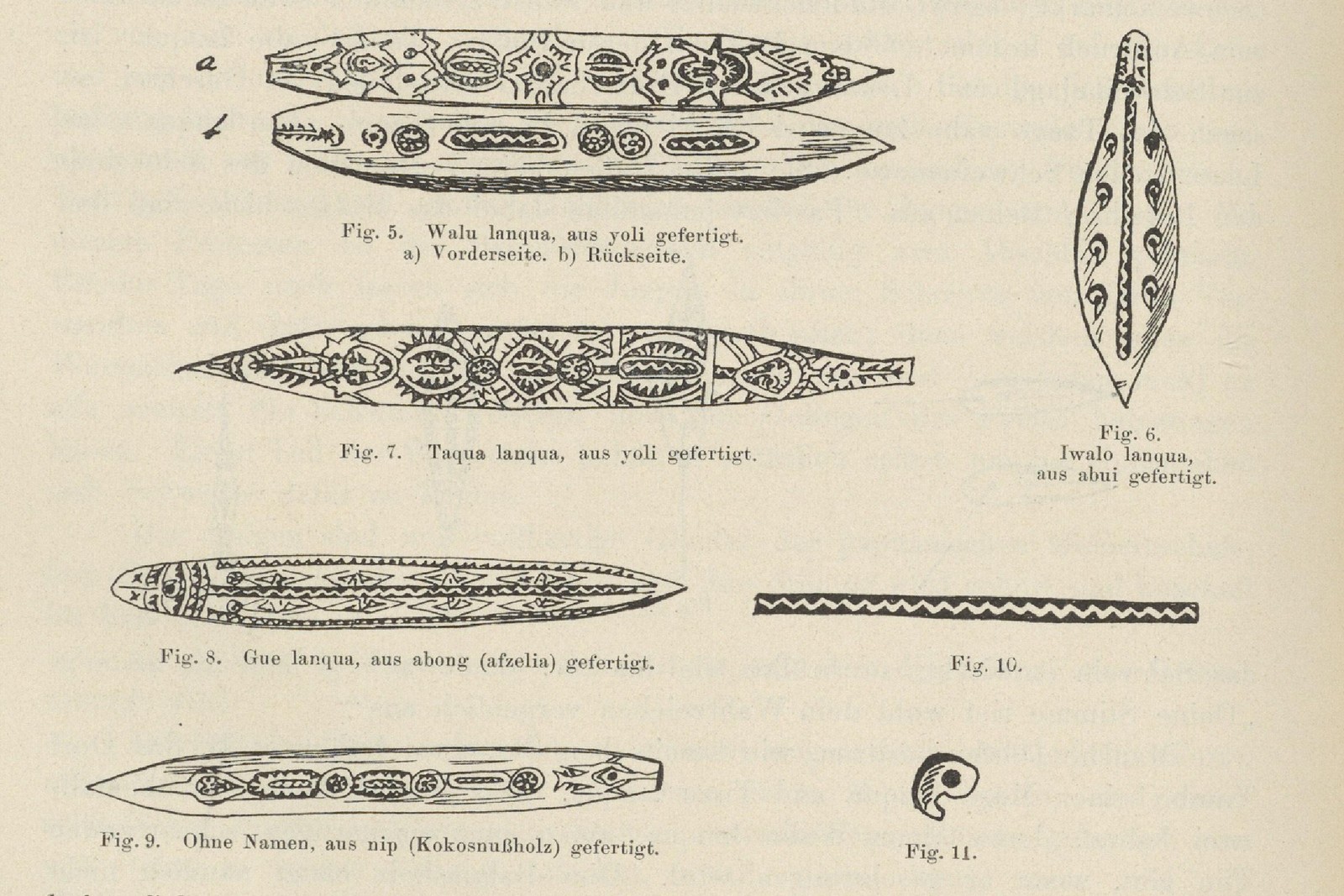
Australia staged it with fire and noise. Between the Hunter and the Macleay, as the boys were led off from the women, every armed man beat two boomerangs together over the roar, so that if a string snapped the women “would not hear it falling on the ground” (Mathews 1897, p. 328). In Wiradjuri country the women and children were huddled under blankets and bushes, and men came from the sacred ground swinging bull-roarers and threw lighted sticks over them “to make them believe that Dhuramoolan had tried to burn them”; later the boys too were covered up beside a roaring fire and told that Dhuramoolan was about to burn them (Harrison 1912, p. 18, quoting Frazer after Mathews). On the Murrumbidgee the men beat the ground with slabs of bark while the roarers sounded, and the covered women heard “the trampling of an evil spirit who has come to remove the boys” (Webster 1908, p. 99).
Where the being had teeth, the boys came home with its bite. Among the Buzi and Gbande of Liberia the chief Poro mask was “the great red-mouthed crocodile supposed to swallow the boys and leave the marks of his teeth on their bodies” (Harley 1941, p. 27). On the Chambri lakes of the Sepik the cutting itself is called the crocodiles eating the boys’ backs, and two of the scarifiers stay in the enclosure “whirling bull-roarers that contain the spirits of the initiate-eating crocodiles” (Gewertz 1982, pp. 292–293). Among the Orokaiva the children sat hooded in bark-cloth while the spirits of the dead roared round them:
Fathers and mothers cry out to the spirits to spare and not devour their children, while the spirits themselves utter a terrible chant or concerted cry, and gabble, ‘Kambo, kambo, kambo!’ which means ‘Bite, bite, bite!’
F. E. Williams, Orokaiva Society (1930), p. 183
And the story had a place ready for the boy who did not come home. Circumcision with a bamboo knife killed boys.
When a lad bleeds to death from the effect of the operation, he is secretly buried, and his sorrowful mother is told that the monster swallowed him and refused to bring him up again.
J. G. Frazer, The Belief in Immortality, vol. I (1913), p. 260, on the Bukaua and Yabim
The Yabim kept a finer version: the monster had a pig’s stomach as well as a human one, and the dead boy had “slipped by mistake into the wrong stomach and so perished miserably” (p. 252). In the Waria valley a Guhu-Samane boy killed in the ordeal was buried in silence, and his mother was told only that the poro had eaten him (Richert 1965). In south-western Angola a boy maimed in the circumcision camp had been swallowed by the roarer, Ehulumphuku lyamima, and a Humbi mother whose son had died there received his homecoming basket back with its bottom cut out (Estermann 1957). Every prop answers something the women could see or hear: the noise in the night, the empty sleeping place, the wound, and the boy who never came back. The devourer accounts for all four.
His sorrowful mother is told that the monster swallowed him and refused to bring him up again.— J. G. Frazer, The Belief in Immortality (1913), on the Huon Gulf
Four continents, one appetite
The men who watched these rites saw the pattern at the time. Baldwin Spencer, after years in the north and centre of Australia, wrote that “in every instance the women and children believe that the noise made by twirling the roarer is the voice of a great spirit that comes to carry off the boy,” and that the belief “was probably, at one time, universal in its distribution amongst Australian tribes” (Spencer 1914, p. 211). Hutton Webster found Queensland women who believed the sound was “the noise made by the wizards in swallowing the boys and bringing them up again as young men” (Webster 1908, p. 99). Edwin Loeb, comparing the secret societies of the world in 1929, wrote of south-eastern Australia that “there is an exoteric myth that the being who is connected with the bullroarer swallows the boys and disgorges them again” (Loeb 1929, p. 251).
Set the peoples side by side and the story has the same four parts everywhere: a being in the roar, a meal or a killing, a return, and a name.
| People | The being in the roar | What it does to the boys | What the roarer is called |
|---|---|---|---|
| Kai, Huon Gulf, Papua New Guinea | Ngosa, “Grandfather” | swallows them; bites them as he spews them out | Ngosa |
| Bukaua and Yabim, Huon Gulf, Papua New Guinea | the balum, a ghost-monster | swallows them; lets them out for a pig apiece | balum |
| Kamano, Eastern Highlands, Papua New Guinea | a spirit with “no belly but a large mouth” | swallows small boys; bananas make him vomit them | “bullroarer old man” |
| Ilahita Arapesh, Sepik, Papua New Guinea | Lefin, a dwarf with a huge mouth and great teeth | eats people | the voice of Lefin |
| Marind, south coast of New Guinea, Indonesia | Sosom, a giant | kills them and wakes them to life | Sosom |
| Murinbata, Port Keats, Australia | Karwadi, the Old Woman | swallows them alive and vomits them up | Karwadi |
| Hunter–Macleay tribes, New South Wales | Goign | will eat them; has them in the fire | gonnandhakeen, “excrement-eater” |
| Wiradjuri, New South Wales | Dhuramoolan | burns them to ashes and moulds them new | mundjeegong |
| Wonghi, New South Wales | Thuremlin | kills them, cuts them up, restores them, takes a tooth | — |
| Urabunna, Lake Eyre, South Australia | Witurna | carries them off and gives them new insides | chimbaliri; to the women, “debil debil” |
| Arrernte, Central Australia | Twanyirika | carries the boy off; enters his body | churinga: “Here is Twanyirika” |
| Kurnai, Gippsland, Victoria | Tundun, “grandfather” | comes down to make the boys men | Tundun |
| Fang, Gabon and Cameroon | the child-eater of the tales | eats the crying child | edžibŏ’ngo, “child-eater” |
| Dogon, Mali | the mother of the mask | drinks the blood of women and children | imina na, “mother of the mask” |
| Mano, Liberia | the great spirit of the Poro | eats the boys and keeps them in his belly | vu ni, a spirit voice |
| Banda, Central African Republic | Ngakola, a cannibal tyrant | eats them and vomits them up renewed | ngàkôlâ |
| Bembe, South Kivu, DR Congo | Tembwe, the leopard | swallows the boy at circumcision | Tembwe |
| Nyaneka (Humbi and Handa), south-western Angola | Ehulumphuku | swallows the boy maimed in camp | ehulumphuku |
| Bororo, Mato Grosso, Brazil | aige, a water-monster | kills the woman who sees it | aige |
Where the women hear only that a spirit comes and takes the boys, they are hearing the first half of the story. The Larrakia boys of Darwin, “like the women and children, have been taught to believe that the sound is the voice of a great old man who has come to take them away into the mangrove scrub” (Spencer 1914, p. 155). The Arrernte women heard Twanyirika “who has come to take the boy away”; the boy himself was told that Twanyirika entered his body and kept him in the bush until he was healed (Spencer & Gillen 1899, p. 246). The Urabunna told the women the rest: Witurna carried the boys into the bush, cut out all their insides and gave them new ones.
The same monster keeps the nursery. At the Cape a Xhosa nurse had a boy whirl the nodiwu outside the hut, and quieted a crying child “by pretending that a monster is coming to devour it” (Theal 1886, p. 223). On the Bandiagara cliffs of Mali, mothers told a crying child that the mother of the mask would eat it. Among the Fang of Gabon, Tessmann found the bull-roarer named child-eater, after the bogey of the bedtime tales, “an even more effective frightener for children” than a relative making noise outside the house (Tessmann 1913, p. 287, translated from the German). The Campa of the Peruvian Amazon whirled their roarer over small children and told them the jaguar was coming (Tessmann 1930, p. 100). The child who is frightened at four is the novice who is swallowed at twelve, by a being he has known by name all his life.
Twanyirika is in the wood
The lie has one device that makes it hold: the instrument carries the being’s own name. Ngosa is the Kai monster, the Kai roarer and the Kai word for grandfather. The Tami kani is the dead, the roarer and the dragon at once (Frazer 1913, p. 301). On the Marind coast the bullroarer and the giant are both Sosom, and in central Brazil the Bororo roarer is aige, after the water-monster whose voice it is. At Port Keats the roarer is Karwadi, the secret name of the Old Woman, and its sound is “the sign of her real presence” (Stanner 1963, p. 5). On the Katherine River the Djauan boy “is now shown the bull-roarer, or Kunapippi” (Spencer 1914, p. 162): the name of the great Mother’s cult is the name of the board in his hands.
Watch what the Arrernte elders do with the name. Under the noise of the roarers the boy is circumcised, and with the wound still bleeding one of his elder brothers presses the bull-roarers against it and tells him “that it was these and not Twanyirika which made the sound, that they were sacred Churinga and must never be shown or even mentioned to the women” (Spencer & Gillen 1899, p. 248). Then the oldest man brings out a bundle of wooden churinga:
“Here is Twanyirika, of which you have heard so much, they are Churinga, and will help to heal you quickly; guard them well and do not lose them, or you and your Mia, Ungaraitcha and Quitia (that is, blood and tribal mothers and sisters) will be killed.”
Spencer & Gillen, The Native Tribes of Central Australia (1899), p. 249

It was not Twanyirika, and here is Twanyirika. Both sentences are meant. The first takes the spirit out of the night and puts it in a man’s hand. The second puts it back, in wood. To the women the name means a being in the dark that takes boys; to the initiated it means the board, which is the being’s body. The one word carries both, so the lie never has to be retracted. The women are never told that Twanyirika does not exist. They are only kept from the board that is Twanyirika.
Africa says it as bluntly. Shown a bullroarer and asked what it was, a Lendu man of the Ituri forest in Congo answered “das ist Tore,” that is Tore, the forest being (Schmidt 1933, after Schebesta). The Banda roarer of Bangassou is ngàkôlâ, the name of the cannibal who swallowed the novices of his society whole. In Mali the Bwa priest of San carries the iron blade of Do to the bush altar, and Jean Capron wrote that it is “la divinité elle-même”, the divinity itself (Capron 1957, p. 86). Among the Kagoma of central Nigeria, whose Dodo was said to swallow a boy who died in the rite, the novice was asked whether he had seen the Dodo, and before he could answer a man blew into the voice-tube and said:
“I myself am the Dodo.” Then, handing the young man the tube, he says, “And henceforth you yourself are the Dodo too.”
C. K. Meek, The Northern Tribes of Nigeria (1925), vol. II, p. 21
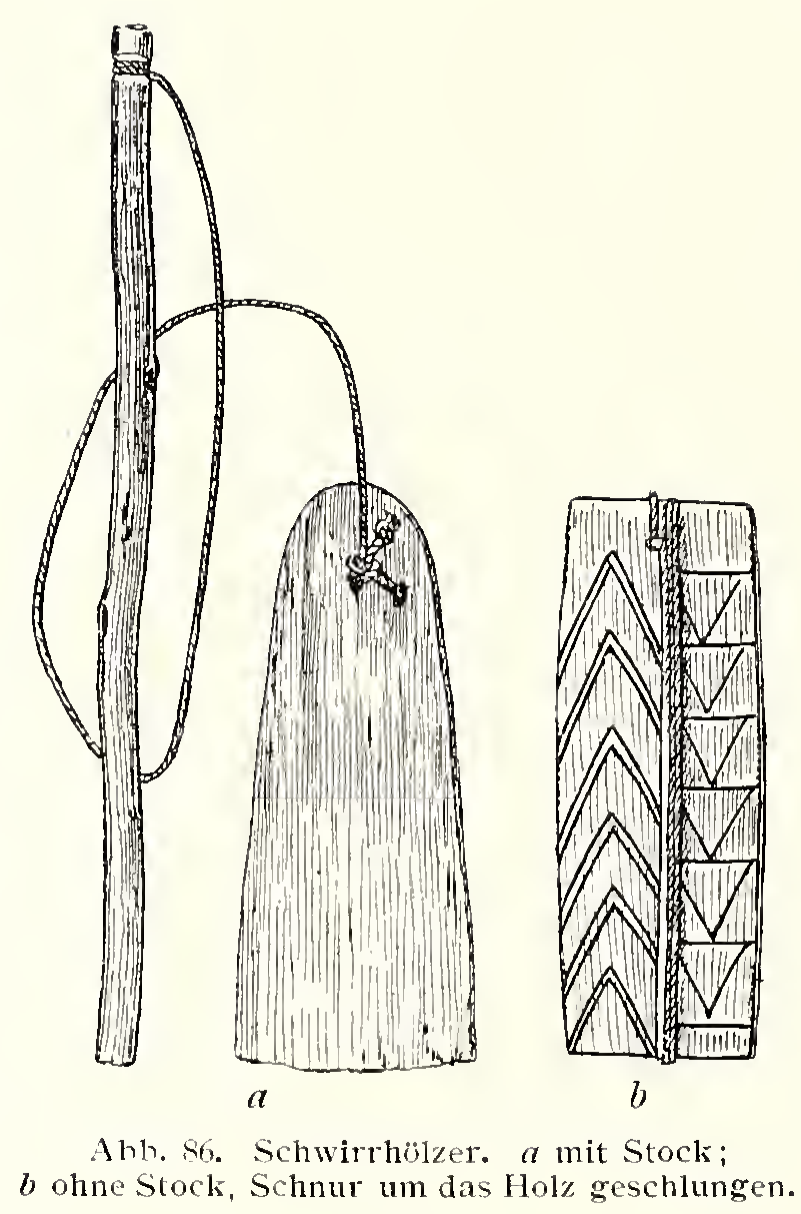
Not spirits, but men
The revelation is staged as a single sight, and the boys are kept in the dark for it. Between the Hunter and the Macleay the novices had travelled for days with their heads bowed and their eyes on the ground, while the guardians told one another they supposed Goign was killing all the women and children in the camp (Mathews 1897, p. 328). Then, very early one morning, a headman pretended to see a large brown squirrel go into a hole in a tree. A squirrel’s tail had been fastened beside the hole beforehand. A man began cutting steps up the trunk, others threw sticks at the tail, and two bull-roarers sounded close by:
Some of the men call out to those throwing the sticks, “We told you to beware of Goign — here he comes!” This is said to impress the boys with supernatural terror. The bull-roarers increase in loudness, and come quite near, and the guardians tell the novices to raise their heads and look. They then see two men swinging each a goonandhakeen (excrement-eater) on the cleared space beyond the line of fires. The boys are then cautioned by the old men that if ever they tell the women or uninitiated that they have seen this instrument the penalty will be death.
R. H. Mathews, “The Keeparra Ceremony of Initiation” (1897), p. 333
The same scene was played across the north. At Port Keats hidden men began to sound the boards, and as the roar came closer the older men cried “with shouts of well-simulated fear”: “Karwadi! Karwadi! The Old Woman is calling” (Stanner 1963, p. 8). Then the swingers sprang into view. At Port Essington the Iwaidja boy sat with his head bent so low he could not see, the painted old men crept up behind him whirling, and his guardian told him to look up: “As usual the lubras think it is the voice of a great spirit that takes the boys away, but the old men tell him that it is not so” (Spencer 1914, p. 119). In the Kainantu hills the fathers said it outright to their bleeding sons: “The spirit who lives in the water is, actually, the initiators” (Berndt 1962, p. 95). Among the Orokaiva the spirits who had roared “Bite, bite, bite!” all night went down to the river at dawn, bathed, “and return as mere human beings” (Williams 1930, p. 183).
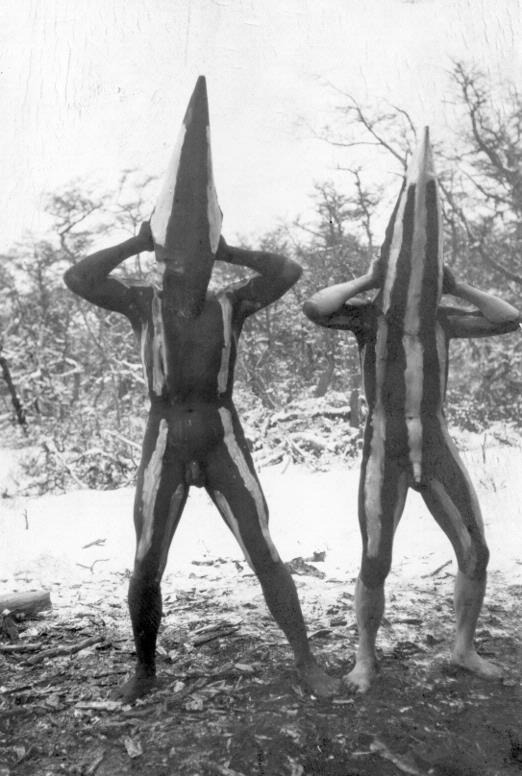
Where the roarer is no secret, the same revelation moves onto a mask. On the Hopi mesas of Arizona the bullroarer is an open rain instrument, and the kachinas who come to the children each year are the secret. Don Talayesva, born at Oraibi in 1890, had been whipped by the kachinas in the kiva at his initiation. The next night they came back to dance before the new initiates:
When the Katcinas entered the kiva without masks, I had a great surprise. They were not spirits, but human beings. I recognized nearly every one of them and felt very unhappy, because I had been told all my life that the Katcinas were gods. I was especially shocked and angry when I saw all my uncles, fathers, and clan brothers dancing as Katcinas. I felt the worst when I saw my own father—and whenever he glanced at me I turned my face away.
Don C. Talayesva, Sun Chief: The Autobiography of a Hopi Indian, ed. L. W. Simmons (1942), pp. 87–88
At the far end of the Americas the Selk’nam of Tierra del Fuego ran the lie with paint and masks. The women were told that the spirits of the Hain lodge hated them, and that Short, the grey monster of the rocks, “was said to be very dangerous to women and inclined to kill them” (Bridges 1948, p. 414). Lucas Bridges, who was initiated into the lodge, watched a boy named K-Wamen meet Short. The boy had already escaped Short in the forest and told his mother about it. Now he was brought into the lodge by his father, trembling, and the monster crawled up to him, sniffing:
When Short’s anger and disgust had grown almost to a frenzy, the terrified klokten was thrust into his embrace and urged by his father and friends to wrestle with the monster. This he did with all the strength of panic and the two of them struggled together, amidst the unrestrained laughter of the assembly … In these wrestling matches, Short always allowed the klokten to throw him in the end, so this fight ended in a victory for K-Wamen. But when he realized the identity of his tormentor, he attacked him again with such fury that he had to be dragged off, to the accompaniment of roars of laughter, in which Short joined heartily.
E. Lucas Bridges, Uttermost Part of the Earth (1948), pp. 420–421
“Whenever possible,” Bridges adds, “a relative of the novice was chosen for the part of Short.” Talayesva turned his face from his father; K-Wamen flew at a man from his father’s country. The great secret, in Bridges’s words, was that the monsters “were not supernatural beings, but merely characters in a masquerade” (p. 420), and the masquerade was played by the boy’s own kin.
They were not spirits, but human beings.— Don C. Talayesva, Sun Chief (1942), p. 88
Sealed by death
The second revelation comes in the same breath as the first. The Hunter–Macleay boys who looked up at the two swingers were warned that telling meant death, and the instruments were put into their hands to rub against their bodies. Spencer heard the same warning across the north: the youths are “everywhere and always, at the time of initiation, told that the noise is not the voice of a spirit but is made by the bull-roarer. They are also warned that on no account must they speak of it to the women and children” (Spencer 1914, p. 211). The Urabunna boy, given the plain stick he would carry until his wound healed, was told never to let a woman or child see it:
… or else he and his mother and sisters will tumble down as dead as stones.
Spencer & Gillen, The Northern Tribes of Central Australia (1904), p. 498
The penalty names the women he has just been lying to. The Arrernte churinga, guarded badly, would kill the boy’s mothers and sisters with him. The Kurnai elders ran the warning from boy to boy as the roarers closed round the kneeling novices: never tell your mother, never your sister, never anyone who is not initiated. And the Kurnai remembered what telling had once cost. Some children found a turndun, took it home and showed it to the women, “and immediately the earth crumbled away, and it was all water, and the Kurnai were drowned” (Fison & Howitt 1880, p. 269).
Outside Australia the sentence is the same. The Hopi head man told Talayesva’s class that “‘A long time ago,’ said he, ‘a child was whipped to death for telling the secret.’ I felt sure that I would never tell” (Talayesva 1942, p. 88). The Zuni novices whose floggers had lifted their masks were told that if they betrayed the secrets “they will be punished by death; their heads will be cut off with a stone knife; for so the Kokko has ordered” (Webster 1908, pp. 188–189). In the Poro of Liberia a man who betrayed the society met its mother in her mask; she struck his forehead with a small iron hook, and the executioner cut his throat (Harley 1941). The Selk’nam lodge was founded on the rule that “no woman was allowed to come near the Hain, under penalty of death” (Bridges 1948, p. 413). The death sentence is the last line of the revelation, spoken at the moment the boy stops being an audience for the lie and becomes one of its keepers.
The boys become the tellers
What the boy carries out of the bush is the story he must now tell. When A. W. Howitt reprinted A. L. P. Cameron’s account of the Wonghi Thurmulun, who took each youth away, killed him and restored him to life, he marked where the line fell: “The account of Thurmulun and his dealings with the novice is just what is told to the women and the children” (Howitt 1904, p. 589). The new man rejoins the camp as one of the people who tell it, and he takes to it quickly. At the Kurnai Jeraeil of 1884 the novices who had knelt in terror inside the circle of roaring men were handed the Tundun and told to sound it, which they did “with evident reluctance and apprehension.” Then they turned the roar on the women:
At the Jeraeil I am describing the novices thoroughly entered into the fun of frightening the women; and, having got over their awe of the bull-roarers, they made an outrageous noise with them. The moment the roaring and screeching sounds were heard there was a terrible clamour of cries and screams from the women and children, to the delight of the novices, who now in their turn aided in mystifying the uninitiated.
A. W. Howitt, The Native Tribes of South-East Australia (1904), p. 632
The boys had been tellers before they knew it. K-Wamen’s escapes from Short in the forest, Bridges noted, “no doubt, he had recounted to his credulous mother and other women, thus confirming their beliefs” (p. 420). Talayesva went home after the unmasking and asked his mother why the kachina had once given him yellow piki bread when he had watched her bake red. “She laughed and laughed, but finally told me that she had traded her red piki for yellow in order to keep me fooled” (1942, p. 88). The whole village had been in it.
So, often, had the women. On Tami, Frazer’s source wrote, the dragon was “an open secret to the married women, though they keep their knowledge to themselves, fearing to incur the penalty of death which is denounced upon all who betray the mystery” (Frazer 1913, p. 301). In 1984 the men of Ilahita stood up in church and confessed that the Tambaran was a hoax. The women, Donald Tuzin found, “had always assumed that the men were lying when they spoke of gigantic people-eating monsters,” and were furious anyway at having been duped (Tuzin 1997, pp. 161–162). Among the Bororo of Brazil an older woman, with the roarers storming through the village, calmly blocked her doorway with mats, told a nervous visitor it was “just a silly man’s game,” and still did not look. The lie does not need the women to believe it. It needs them to keep their side of it, and they do.
One lie, told around the world
That bullroarer cults deceive women has been known since the first reports, and two accounts have described how the deception is built. Michael Houseman and Carlo Severi described its abstract form, a rite played on two levels at once, one for those it deceives and one for those who deceive. Sam Gill read the Hopi unmasking as a disenchantment that leaves the child with a deeper faith. What the lie actually says, and that it says the same thing on four continents, is the finding set out here: a being in the roar; a being that eats, swallows or takes the boys; a name written into the wood that roars; a revelation staged as a sight of men; and a death sentence spoken in the same breath.
None of those parts is forced on a cult by the problem it solves. A cult could tell its women the noise is thunder, or a bird, and here and there one did; it could keep its secret with a law and no story at all. Over the great run of the bullroarer world it told the devourer, under its own name, and the boy who came back was the boy it had spat out. When the same plot, the same staging and the same penalty turn up in Gippsland, on the Huon Gulf, in the Poro bush of Liberia and among the Bororo of Brazil, they are one story that travelled with the instrument it explains.
The Greeks had it too. In the Orphic myth the Titans lured the child Dionysus with toys, the bullroarer among them, killed him and brought him back. Jane Harrison set that myth beside the Wiradjuri story of Dhuramoolan in 1912 and saw what the Titans were: “real men dressed up as bogies to perform initiation rites” (Themis, p. 17). The Wiradjuri half of that pairing is told in Dionysus in Australia; the initiation lodge as a swallowing womb in The House That Swallows Boys; the swallowing itself in Swallowed by the Monster and, for Africa, I Swallow Everything; the women’s side of the secret in Women and the Bullroarer.
Everywhere the lie ends where it began, with the name. The women hear the being called and run. The boys see two men swinging wood and are told the being was never there. Then an old man puts the wood in their hands and gives it back its name. “Here is Twanyirika, of which you have heard so much.” The monster that ate boys was men all along, and the men, from that day, are the monster.
Key sources
- R. H. Mathews, “The Keeparra Ceremony of Initiation,” Journal of the Anthropological Institute 26 (1897), pp. 320–340. The boomerangs beaten so the women would not hear a string break, and the guardians’ talk of Goign killing the women and children, p. 328; Goign “who would come and eat them,” p. 331; the squirrel, the raised heads and the death warning, p. 333; the singed hair, p. 334.
- Baldwin Spencer and F. J. Gillen, The Native Tribes of Central Australia (1899), pp. 246–249 (Twanyirika: the women’s belief, the bull-roarers pressed on the wound, “Here is Twanyirika”); The Northern Tribes of Central Australia (1904), pp. 257–258 (Urabunna Witurna) and p. 498 (“as dead as stones”).
- Baldwin Spencer, Native Tribes of the Northern Territory of Australia (1914): Iwaidja (“the Port Essington tribe”), p. 119; Larrakia, p. 155; Djauan, p. 162; Nullakun (Ngalakan) Mumanna, p. 176; the general statement on women, spirit and revelation, p. 211.
- A. W. Howitt, The Native Tribes of South-East Australia (1904), pp. 588–589 (Wonghi, after A. L. P. Cameron, JAI 14, 1885, pp. 357–358; “just what is told to the women and the children,” p. 589) and pp. 625–632 (the Kurnai Jeraeil). L. Fison and A. W. Howitt, Kamilaroi and Kurnai (1880), p. 269.
- W. E. H. Stanner, On Aboriginal Religion (Oceania Monograph 11, 1963; facsimile 1989), pp. 4–8 (Karwadi, the swallowing, “shouts of well-simulated fear”).
- J. G. Frazer, The Belief in Immortality and the Worship of the Dead, vol. I (1913), pp. 251–252, 260, 290–291, 301 (Kai, Bukaua, Yabim and Tami, after Keysser, Lehner, Zahn and Bamler in Neuhauss, Deutsch Neu-Guinea III, 1911).
- R. M. Berndt, Excess and Restraint (1962), p. 95 n. 5 (the Kamano bullroarer old man). Donald Tuzin, “Ritual Violence Among the Ilahita Arapesh” (1982) and The Cassowary’s Revenge (1997), pp. 161–162. Deborah Gewertz, “The Father Who Bore Me” (1982), pp. 292–293. Ernest Richert, “How the Guhu-Samane Cult of Poro Affects Translation,” The Bible Translator 16 (1965). F. E. Williams, Orokaiva Society (1930), p. 183. Rudolf Pöch, “Vierter Bericht,” Sitzungsberichte 115 (1906), p. 901.
- Günter Tessmann, Die Pangwe, vol. II (1913), pp. 287–288; Die Indianer Nordost-Perus (1930), pp. 99–100. G. M. Theal, Kaffir Folk-Lore, 2nd ed. (1886), p. 223. George W. Harley, Notes on the Poro in Liberia (1941), pp. 14–15, 27. C. K. Meek, The Northern Tribes of Nigeria (1925), vol. II, p. 21. Jean Capron, “Quelques notes sur la société du do,” Journal de la Société des Africanistes 27 (1957), p. 86. Carlos Estermann, Etnografia do Sudoeste de Angola, vol. II (1957), p. 75.
- Edwin M. Loeb, “Tribal Initiations and Secret Societies,” University of California Publications in American Archaeology and Ethnology 25(3) (1929), pp. 251–253, 271. Hutton Webster, Primitive Secret Societies (1908), pp. 99, 186–189.
- Don C. Talayesva, Sun Chief, ed. Leo W. Simmons (1942), pp. 87–88. E. Lucas Bridges, Uttermost Part of the Earth (1948), pp. 413–414, 420–421 (the Hain, Short and the initiation of K-Wamen). Martin Gusinde, Die Feuerland-Indianer, vol. I (1931).
- Michael Houseman and Carlo Severi, Naven or the Other Self (1998). Sam D. Gill, “Hopi Kachina Cult Initiation: The Shocking Beginning to the Hopi’s Religious Life,” Journal of the American Academy of Religion 45 (1977). Jane Ellen Harrison, Themis (1912), pp. 17–18 (the Wiradjuri firesticks, quoting Frazer after Mathews, JAI 25, 1896).
- As far as we know, the catalogue of what the lie says, and the finding that it names a devourer across four continents, are original to this page.