Atlas Essay —
I Swallow Everything
The Dogon cliffs · Forest Guinea · Nigeria · Cameroon and Gabon · the Kivu mountains · Angola and Namibia · the Cape
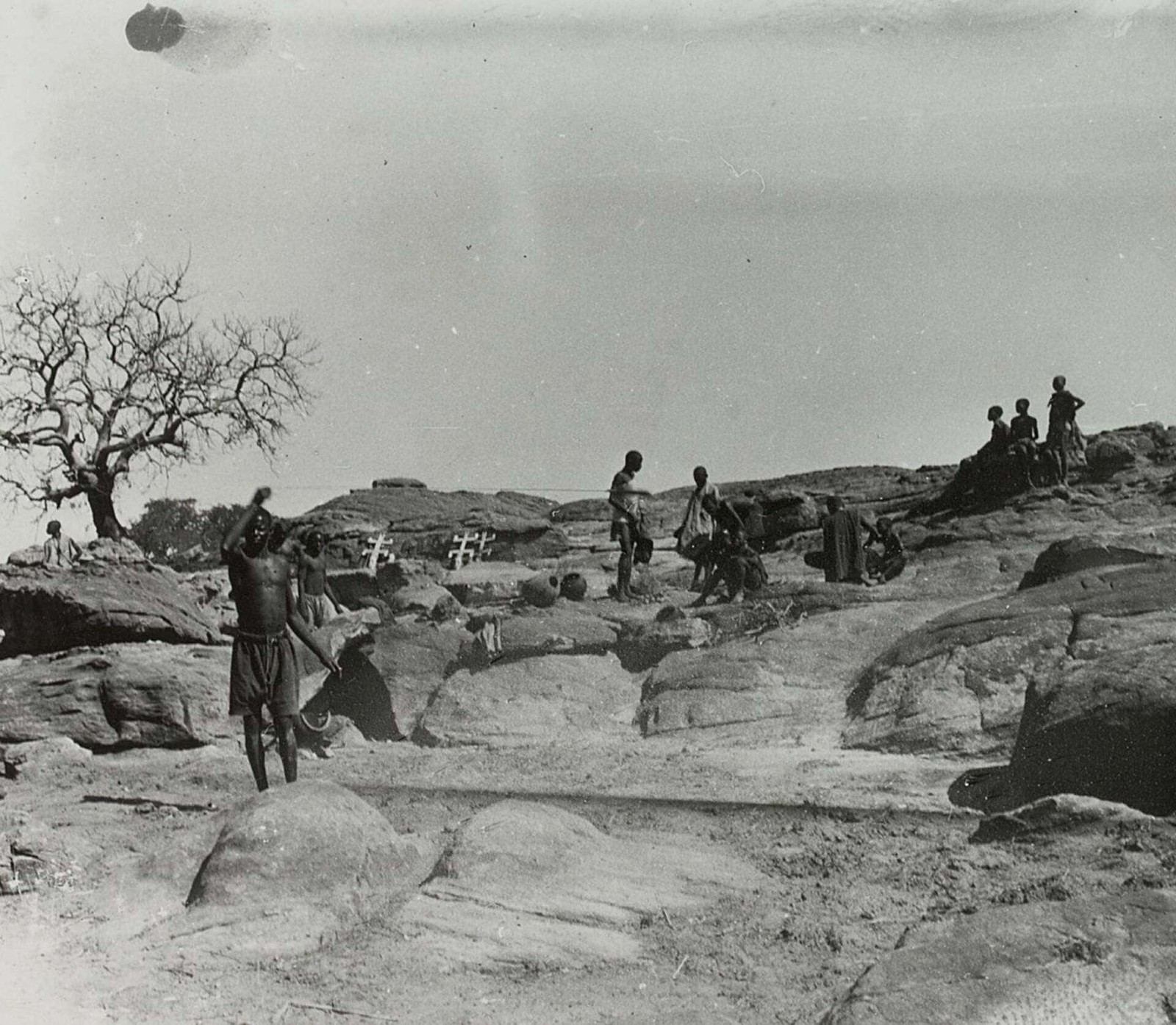
At midnight on the night of a Dogon funeral, every fire goes out. The mourners scatter into the lanes, the drums fall silent, and out of the dark comes the roar of the bullroarer, rising and falling, as the Great Mask is carried into the square. The Dogon knew what the roar was saying. It was saying it would eat them. “I swallow, I swallow, I swallow men, women, children,” the rhombes say. “I swallow everything.” Two thousand kilometres to the south-east a Fang child cried in the dark and a relative went out to whirl the child-eater. At the Cape a Xhosa nurse hushed a crying baby with a whirled slat and the news that a monster was coming to devour it. In the circumcision camps between them, the roar was the beast that swallowed the boys. Africa keeps more of these mouths than anywhere else on the atlas, and they all say the same thing.
Across Africa the bullroarer’s roar is not a herald but a mouth: the voice of a being that swallows, which eats the crying child at the hut door, swallows the boys at initiation, takes the boy who dies, and among the Dogon says in its own words that it swallows everyone.
In brief
- The Dogon rhombes speak in the first person: “I swallow everything,” because they witnessed the coming of death into the world (Dieterlen 1989, p. 34). The great rhombe is the “mother of the mask,” who “drinks the blood of women and children” and will eat a crying child (Leiris 1934, p. 4).
- The Fang name the bullroarer edžībŏngo, “child-eater” (Tessmann 1913, p. 287). The Xhosa nurse has a boy whirl the nodiwu outside the hut and tells the crying child “a monster is coming to devour it” (Theal 1886, p. 209).
- In the circumcision camps the roar is the swallower itself: the Kissi beast nyewonde fallen from the sky, the Kwanyama giant bird edila, the Nyaneka ehulumphuku, the Bembe leopard-god Tembwe, whose circumciser is “he who swallows what slumbers.”
- When a boy really dies, the mouth takes the blame: “the Dodo has swallowed him” (Meek 1925); “Langa had no meat, so he ate your son” (Frobenius 1925); the Kwanyama boy “remained in the monster’s stomach” (Loeb 1948).
- At the end the mouth is handed on. “I myself am the Dodo,” the Kagoma initiator says, and gives the novice the voice: “And henceforth you yourself are the Dodo too.”
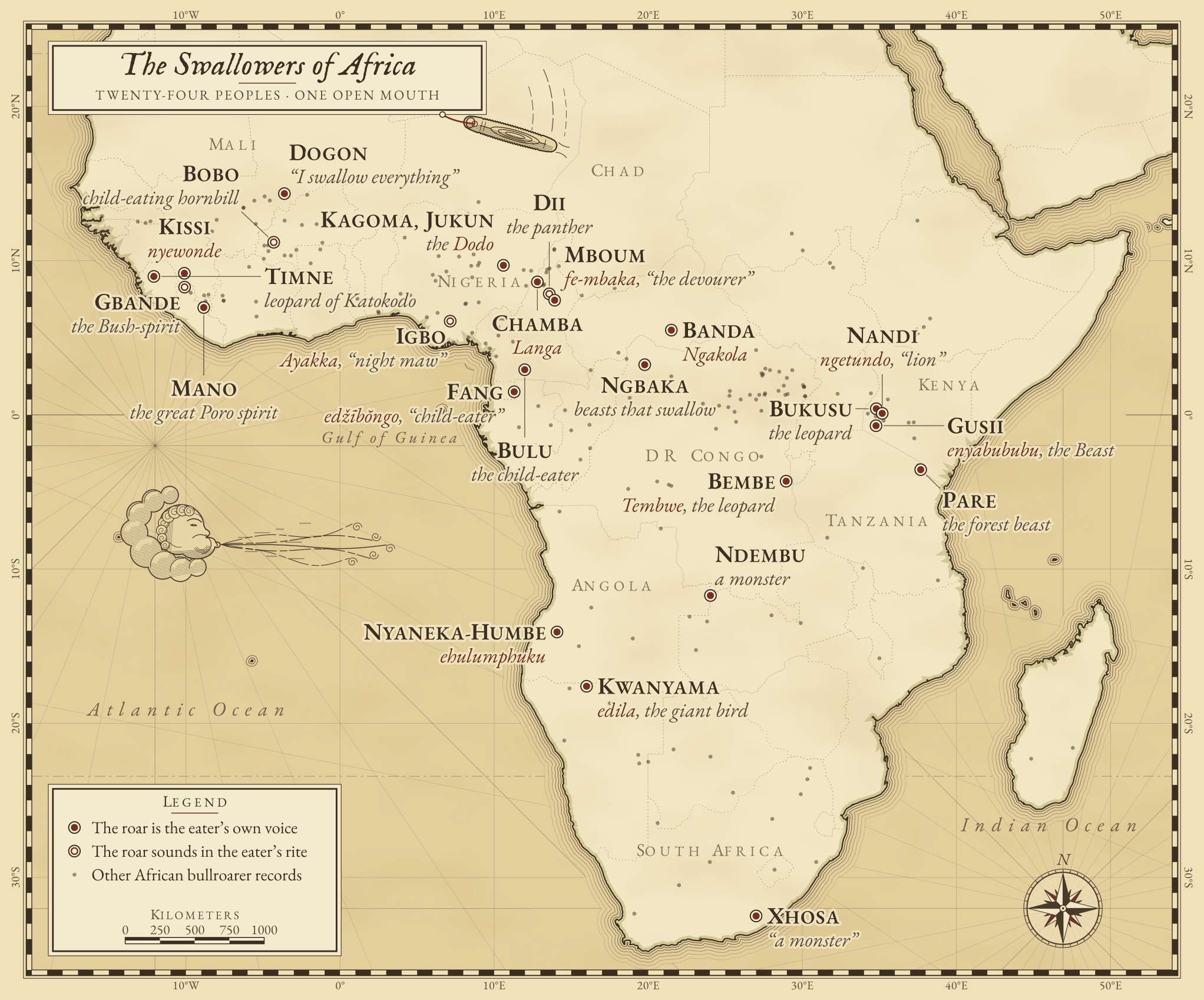
The Dogon rhombe says it swallows everything
The Dogon live along the Bandiagara escarpment in Mali, a wall of sandstone that runs for a hundred miles above the plain, with their villages stacked against the cliff and their masks kept in its caves. Their mask society, the Awa, owns the bullroarer, and its name is the name of the Great Mask itself: imina na. Once every sixty years, for the rite called the Sigui, young men go into long retreat, learn a secret language, carve three new rhombes, and make them roar at night through the whole of the festival. Germaine Dieterlen, who spent half a century among the Dogon, set down what those three blades are. Each, she wrote, is a tongue: the Fox’s, cut out when he tried to steal the souls of the first being; a catfish’s, the fish that stands for the human foetus; and the tongue of Dyongou Sérou, the first ancestor to die, who was raised again as a serpent and is carved, every sixty years, as the Great Mask. Then she gave the tongues their words.
For the Dogon, these bullroarers speak, and they say: “I swallow, I swallow, I swallow men, women, children, I swallow everything.” For they are the witnesses of the appearance of death on Earth — the death of the fish, the death of the Fox, who was at last condemned, the death of the first of the dead among men. Having struck the ancestor, death was bound to strike, one day or another, every living being. The bullroarer bears the same name as the Great Mask: it is, by itself, a mask. It is the speech, or what remains of it, of one who has died.
Germaine Dieterlen, “Mythologie, histoire et masques,” Journal des Africanistes 59 (1989), p. 34, translated from the French. The original: « J’avale, j’avale, j’avale les hommes, les femmes, les enfants, j’avale tout. »
This is the plainest statement anywhere in the world’s ethnography of what a bullroarer is. It is not a messenger announcing a monster in the bush. It is a mouth, and it speaks as one. It does not say he is coming; it says I swallow. And its appetite has no edge: men, women, children, everything. Death entered the world through the first ancestor, and the roar is the voice of a dead man telling the living that what took him will take them all.
Dieterlen goes on to describe the moment when that voice is heard. At midnight on a funeral, “all the fires are put out,” the mourners scatter into the surrounding lanes, “all the drums fall silent, and now the repeated roaring of the bullroarer sounds, from low to high and back again,” as the Great Mask is carried, upright on a man’s shoulder, into the square. It circles an altar to ask for the soul once refused it for its impurity; at the dead man’s terrace a relative ties a live chicken to its tip, the soul granted at last; and the roar goes with it to the cave, translating the Mask’s speech of thanks. Every funeral is the first death again, and every funeral the swallower speaks.
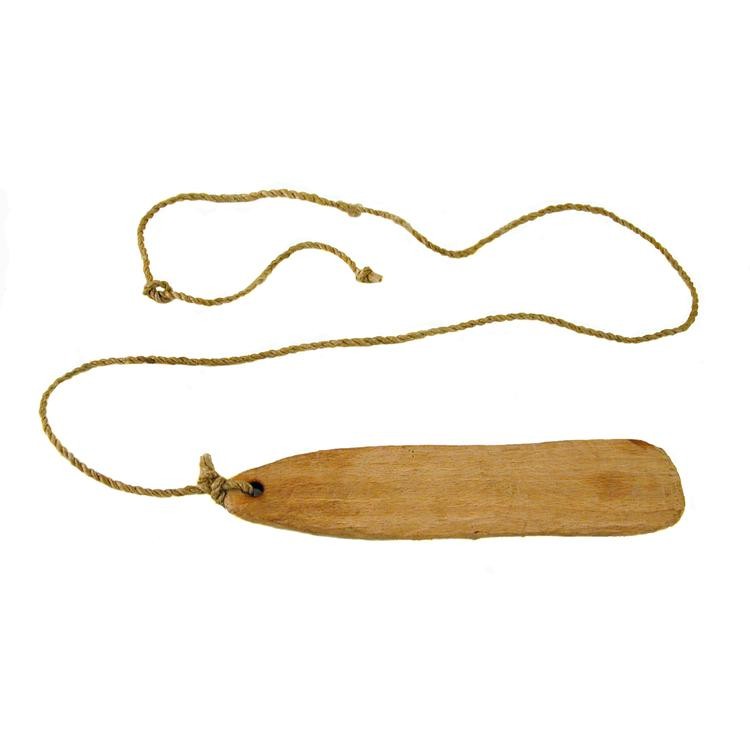
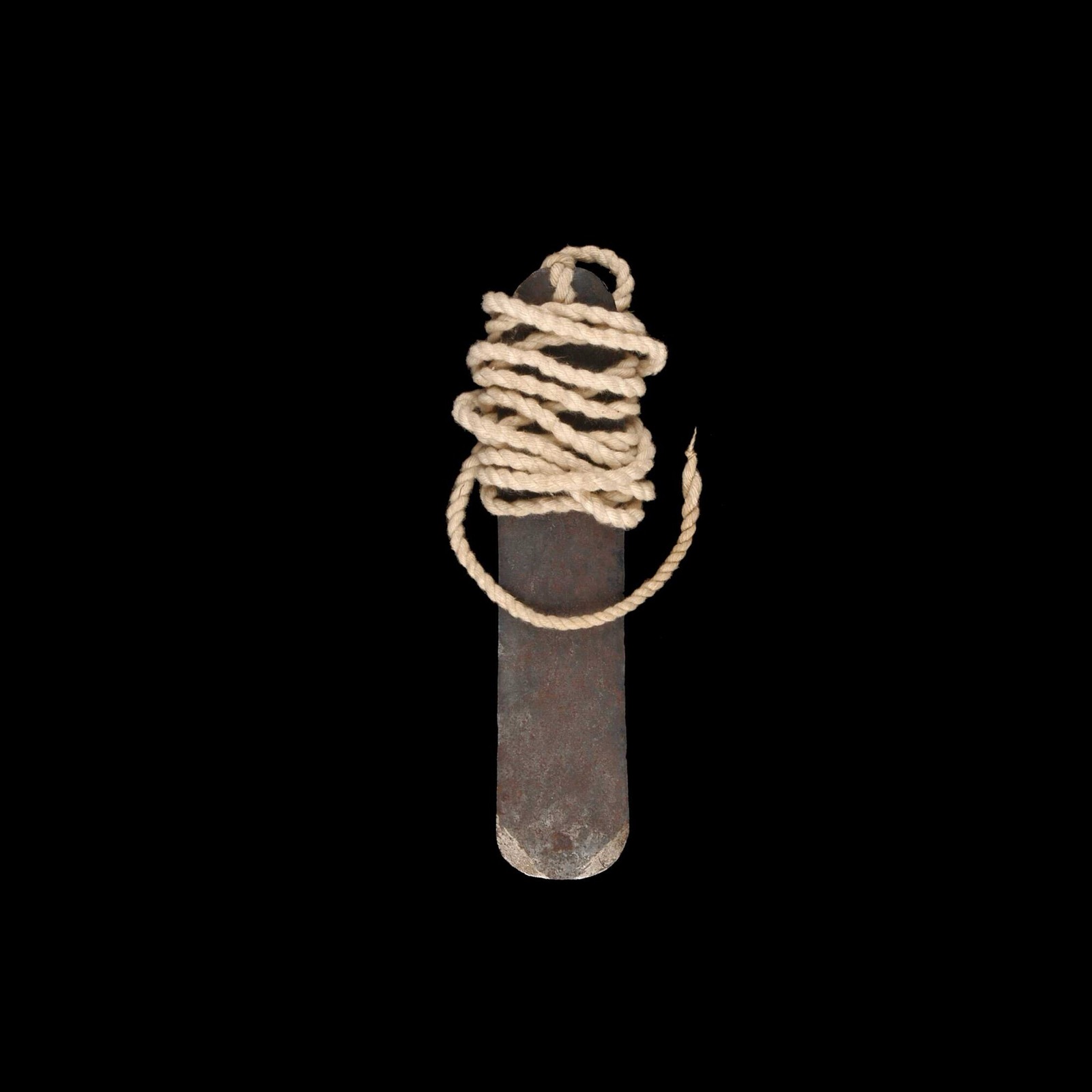
Fifty-five years before Dieterlen, the young Michel Leiris had heard the same appetite from the men of Sanga, aimed at the nearest mouths to hand. In 1934 he published the rules of the Dogon rhombe: never to be seen by women or children, carved only by full initiates, hidden in the mask caves with its cord wound round the blade, spun outside the village on the night a man died. The largest of them had a name of her own.
According to Ambara Sodamma, of Sanga Ogoldognou, “the mother of the mask is the mother because she is the largest, the one who receives the sacrifices and drinks the blood of women and children.” She is made into a bogey for the children: to those who cry, they say that she will eat them.
Michel Leiris, “Rhombes dogon et dogon pignari,” Bulletin du Musée d’Ethnographie du Trocadéro 7 (1934), p. 4, translated from the French
Ambara had the story of how she came to be kept outside the village, too. A woman found the first red fibre costume of the masks in the bush; her husband took it, and with it the first “mother of the mask”; and he decided to leave the rhombe out in the bush, in the cave at the edge of the village, after he noticed that she “drank the blood of women and children.” The rhombe is housed where it is because of what it eats. While the mother of the mask turned, women and children had to stay in their houses, and the children ran to the old men, and the old men spoke to her in the secret tongue and told her to go away and leave the children alone.
J’avale, j’avale, j’avale les hommes, les femmes, les enfants, j’avale tout.— the Dogon rhombes, in Germaine Dieterlen, Journal des Africanistes 59 (1989), p. 34: “I swallow, I swallow, I swallow men, women, children, I swallow everything.”
The child-eater stands outside the hut
The smallest mouth the roar threatens is the crying child’s, and the threat is made in the same way from one end of Africa to the other: someone goes out into the dark and whirls the slat, and someone inside says that the noise has come to eat.
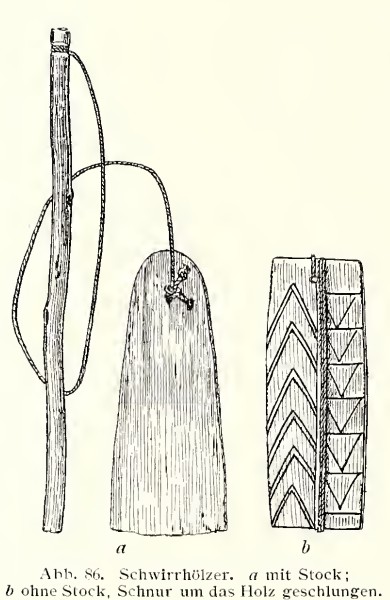
The Fang live in the forests of southern Cameroon, Rio Muni and northern Gabon. Günter Tessmann lived among them from 1907 to 1909 and wrote up their whole life in the two volumes of Die Pangwe. He put the bullroarer in the chapter on bringing up children, among the things used to frighten the little ones, and he gave its name.
The threats used with smaller children up to six or seven years old are limited to harmless frightening-devices, known by the name kōkŏ-bŏṅgo, “things to frighten children.” The method is that in the evening or at night a relative makes some noise or other in front of the house. The little one who is naughty or crying is then warned by the people about the bad man out there. … An even more effective frightening-device for children is the uncanny tone of the bullroarer (edžībŏngo = child-eater), which men and older boys often use to frighten the younger ones.
Günter Tessmann, Die Pangwe, vol. II (1913), p. 287, translated from the German
Edžībŏngo was not only the name of the slat. It was the name of the devouring bogey of the Fang tales, the Edschibongo whose stories mothers told their own children. The instrument and the monster are one word, as they are on the Huon Gulf of New Guinea, where balum names both the bullroarer and the beast that swallows the boys. In a footnote Tessmann adds the second Fang name, kōkō-boṅgo, “the bad man for children,” and says that “the bullroarer in particular is called this” (vol. II, p. 335, n. 1). Among the Fang the voice in the dark does not stand for the eater of children. It is called the eater of children.
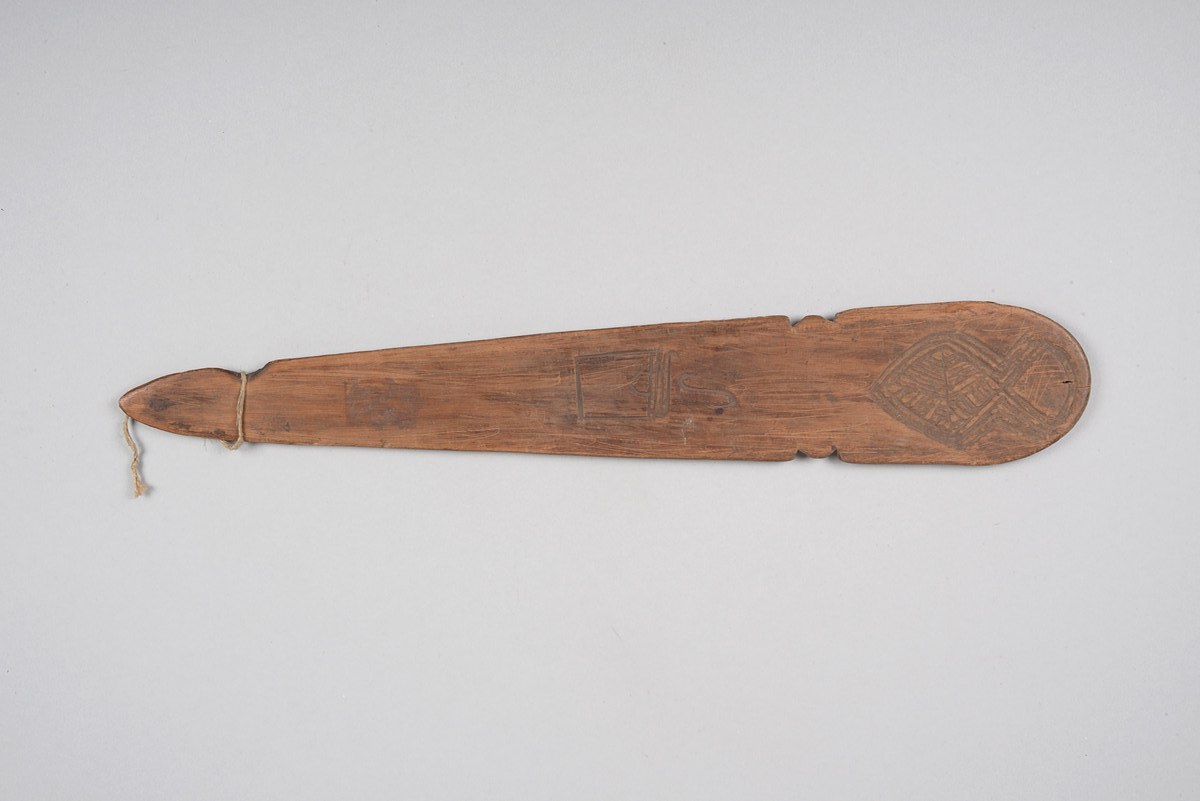
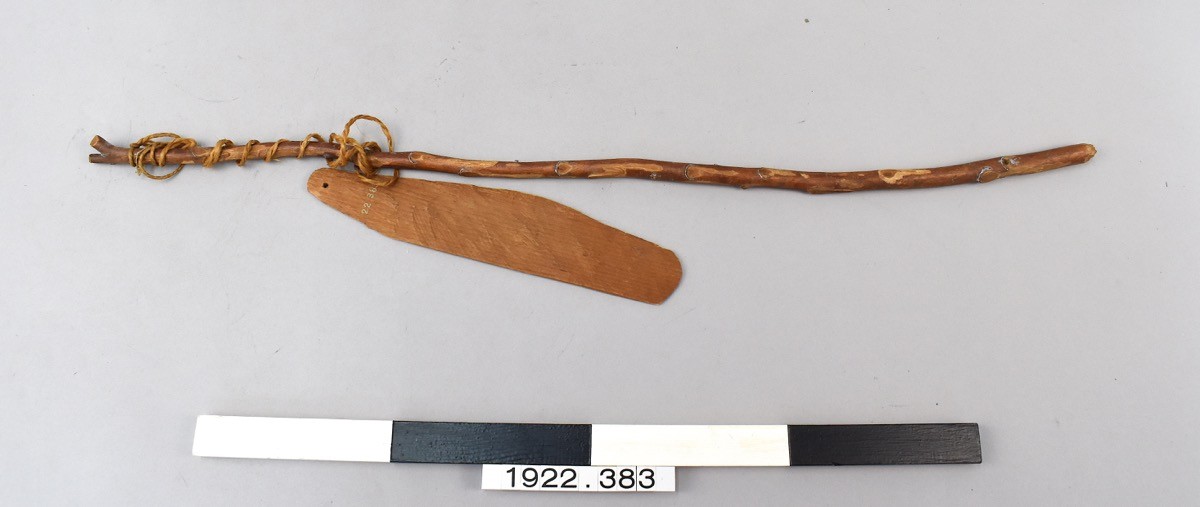
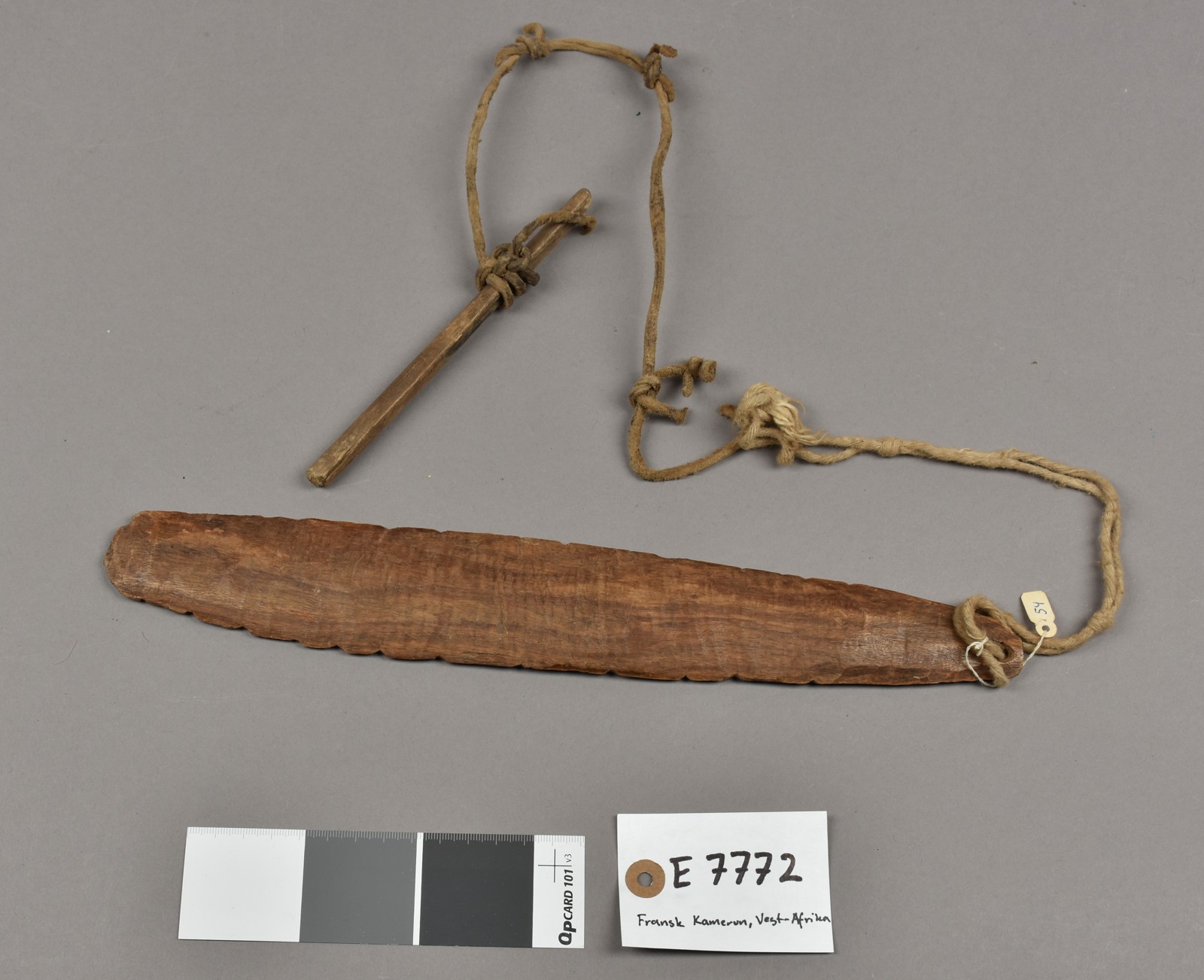
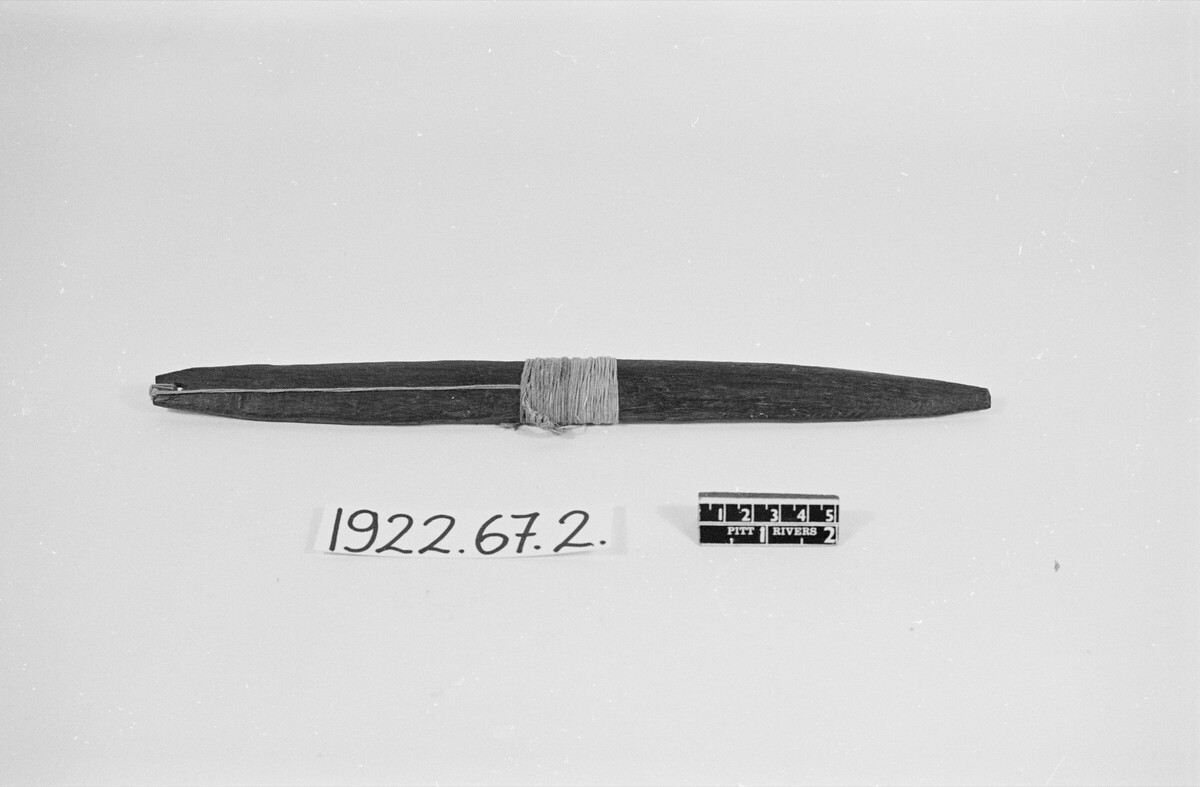
Four thousand kilometres to the south-east, the same scene plays at the door of a Xhosa hut. George McCall Theal, collecting Kaffir Folk-Lore in the Eastern Cape, described the nodiwu as a slat six or eight inches long, bevelled on its edges, whirled on a thong tied to a little wooden handle, and audible a long way off. Then he told what it was for.
Besides the use which it is put to by the lads, when a little child is crying inside a hut its mother or nurse will sometimes get a boy to make a noise with a nodiwu outside, and then induce the child to be still by pretending that a monster is coming to devour it.
George McCall Theal, Kaffir Folk-Lore, 2nd ed. (1886), p. 209
Set Theal’s page beside Tessmann’s and Leiris’s and the three are one paragraph. A child cries inside. Someone goes out into the dark. The slat roars, and the people inside name the roar as a mouth: the bad man, the monster, the mother of the mask who will eat the child that cries. Forest, savanna cliff and Cape veld are thousands of kilometres apart, and the scene crossed them whole: the child, the dark, the roar, and the mouth.
It would be easy to file this as nursery play and move on. The Dogon forbid it. At Sanga the mother of the mask who will eat the crying child is the same blade that roars at midnight over the dead, that no woman or child may see, that receives the sacrifices of the mask society. The bogey at the hut door is not a cult instrument that has decayed into a toy; it is the cult’s own mouth turned toward the youngest listener. The child hears early what the boy will hear at initiation and the mourner at the grave. A Fang boy learns the child-eater from the outside of the house, and later, holding the cord himself, from the inside. The voice that teaches him fear first is the voice he will one day lend.
The beast that eats the sons
At initiation the mouth opens wide. Across the circumcision belt of Africa, when the boys are taken out to the camp, what the women and children at home hear is the roar of the thing that is eating them.
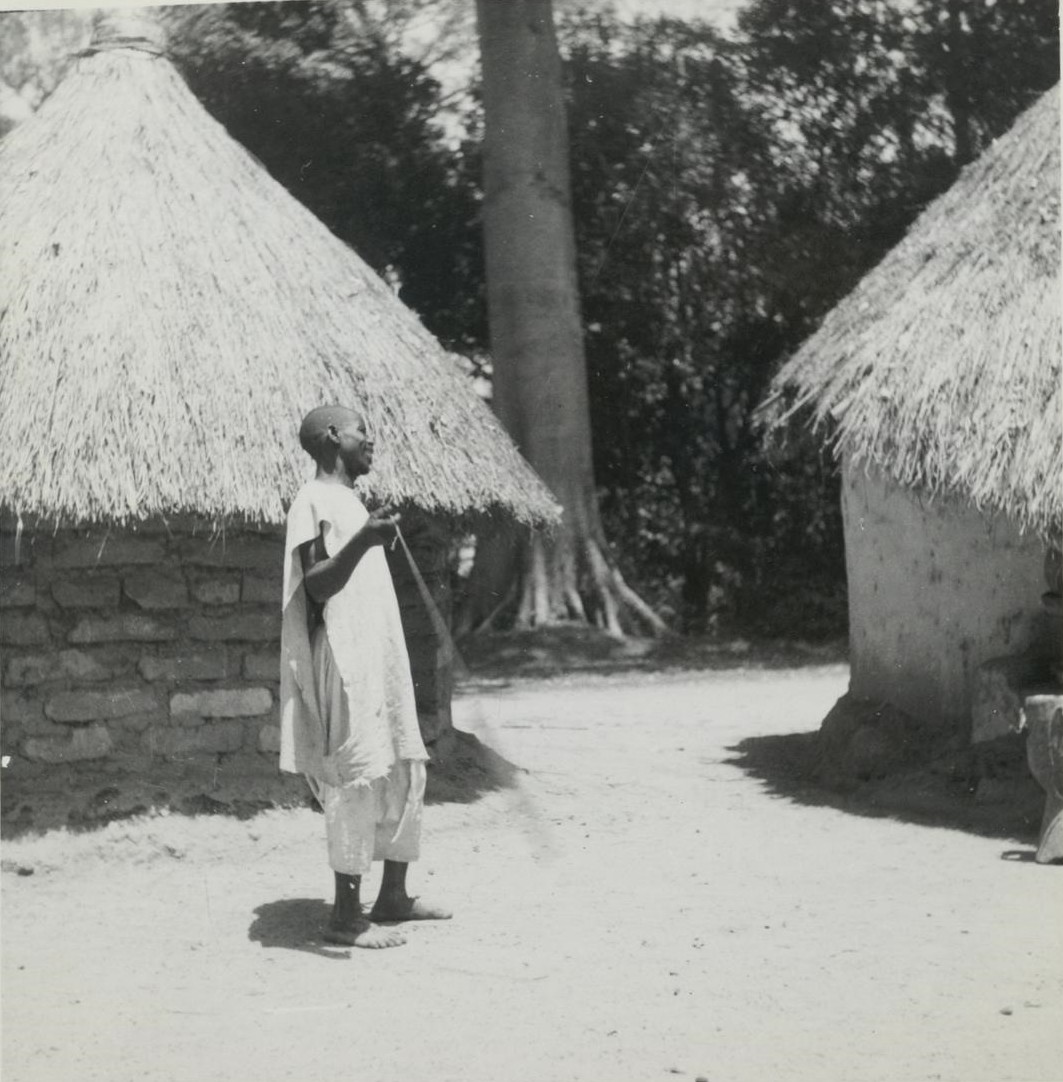
In Forest Guinea, in the hills around Kissidougou, the Kissi turned their bullroarers morning and evening through the whole seclusion of the young men. André Schaeffner, who studied Kissi music in the 1930s and 1940s and photographed a man turning the rhombe between thatched houses at the village of Kenéma Pombo in 1947, recorded what the women were told.
… the drone they hear is the roar of a great ferocious beast (nyewonde), fallen from the sky, which devours their children in the sacred forest. If one of them happens to see the bullroarer, or to meet the man carrying it, or simply to learn what object makes the noise, she is in danger of death. … As for the initiates, they are told that the roar of the bullroarer is the very voice of the ancestors.
André Schaeffner, Les Kissi: Une société noire et ses instruments de musique (1951), p. 75, translated from the French
One sound, two truths, and the second does not cancel the first. To the women the roar is a beast from the sky with its jaws in their sons; to the sons it is their ancestors speaking. Both are the voice of the same thing. The ancestors are the dead, and the dead are the ones who eat. The boy passes into the beast and comes out among the ancestors, and the mouth that took him is the mouth he joins.
Far to the south, on the border of Angola and Namibia, the Kwanyama made the beast a bird. Edwin Loeb, working among them in the 1940s, found the bullroarer to be the only secret of their circumcision camp, and the whole rite turned on its voice.
The only esoteric feature of the ceremony seems to be the use of the bull-roarer (edila). The boys were not told the nature of this instrument, but both they and their mothers at home believed that its humming sound was the voice of a giant bird called edila which swallowed the candidates. If a youth survived, it was because he had succeeded in passing through the anus of the creature. If, however, he succumbed to the circumcision, it was because he remained in the monster’s stomach.
Edwin M. Loeb, “Transition Rites of the Kuanyama Ambo,” African Studies 7(1) (1948), p. 27
The bullroarer has the bird’s name: edila is the Kwanyama word for the great bird itself. The boys came out of the camp singing about it, and their song is the swallowed boy’s own account of the inside of the swallower:
It threw me up, and when I came down I fell into its mouth. Then I came out of its anus.— the Kwanyama boys’ song of the edila, in Loeb 1948, p. 27
Next door, among the Nyaneka-Humbe herders of south-western Angola, the camp bullroarer was the ehulumphuku, and Nyaneka songs heard it howling across the plain by the lagoon of Pundo like a wild animal in the bush. Carlos Estermann, who spent his life among them, recorded how the people spoke when a boy came home from the camp crippled by the knife:
Of one who had been left maimed by the operation — rare cases of it are cited — they would say: Ehulumphuku lyamima, “the bogey (that bullroarer) swallowed him.”
Carlos Estermann, Etnografia do Sudoeste de Angola, vol. II (1957), p. 75, translated from the Portuguese
The sentence has three words and no gap in it. The bullroarer, the bogey and the swallowing are one act. Among the Humbe the boys who came home whole were met by their mothers dancing the motions of childbirth: out of the swallower, born again.
In Kenya the Gusii gave the beast a name that is its own noise. It is enyabububu, the thing that goes bububu, and it swallows initiates; its wooden voice, twirled on a cord over the healing boys, is eng’iti enene, the Big Beast of Outside, and swinging it is called ogosicha, “taming the Beast” (Mayer 1953, p. 20). In the mountains above Lake Tanganyika the Bembe beast is a leopard, and it is a god. The Bembe bullroarer is Tembwe, white on one face and red on the other, whose roar is the voice of the leopard and drives the women out of the circle it draws in the air. Tembwe rules the circumcision, which the Bembe call ’Ètomba, “the corpse,” and at the moment of the cut the man with the knife becomes the swallower:
The circumciser, ngaliba or wondolomina (literally “he who swallows what slumbers”), who with his bloody adze “kills” and “swallows” the circumcised boy, is explicitly identified at that moment with Tembwe himself, with the leopard who thereby proclaims himself, decisively, the hero, indeed the “god” of culture, since he literally creates man.
Pol Pierre Gossiaux, Le Bwamè du Léopard des Babembe (Kivu-Congo), Tembwe section (pp. 89–96), translated from the French
“Whoever would surpass Tembwe,” the god-bullroarer proclaims at his dreaded appearances, “will die crushed in the bush.” The leopard that roars is the leopard that swallows is the man with the adze, and what comes out of the swallowing is a man, m’tu, made by the god.
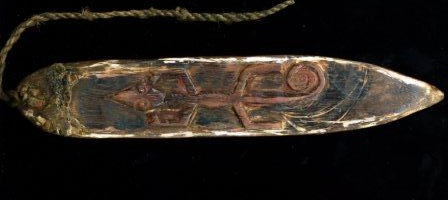
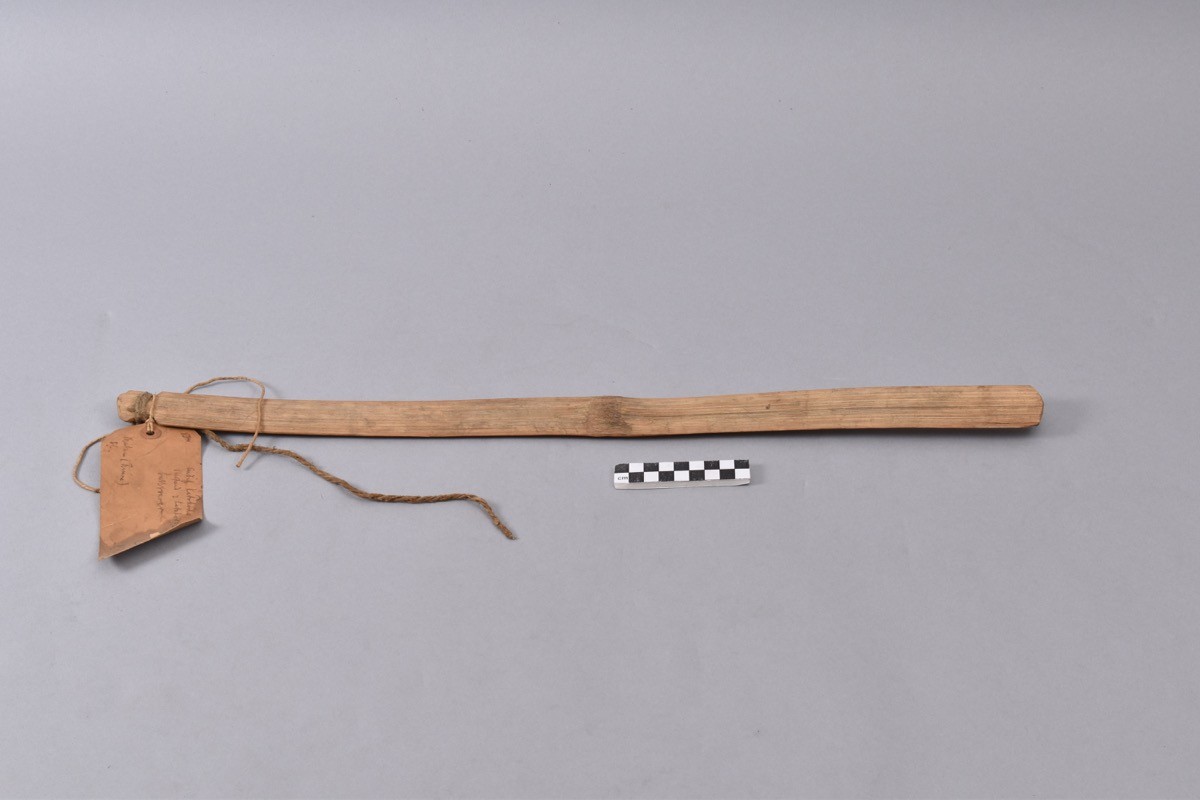
The leopard swallows on the Atlantic coast too. Among the Timne of Sierra Leone, N. W. Thomas collected a cane bullroarer in 1914 whose luggage tag gives its Timne name, which Thomas glossed “leopard of Katokodo.” Two years later he published what the leopard did. The spirit of the Katokodo society was played by a masked man who spoke through a calabash and “carries a bull-roarer (ɔsip Katokodo, the leopard of Katokodo); he is said to swallow non-members” (Thomas 1916, p. 150). Here the swallow is turned inside out: the society is the belly, and only those outside it are in danger of being eaten. A little to the east, in the Liberian Poro, the Mano said of the boys in the bush school, once their scars had healed, “the great spirit had eaten them, but they were to remain in his belly until his time came when he would give them re-birth as men” (Harley 1941, p. 15), and the bullroarer was one of that spirit’s voices in the night. The Gbande Bush-spirit had a crocodile’s jaw, its teeth reddened with kola paste so that they seemed still wet with the blood of the boys it had swallowed; drums, flutes and bullroarers announced it (Spannaus 1936). In the Ubangi country of the Central African Republic the Banda bullroarer bore the very name of the swallower, ngàkôlâ: Ngakola, the hairy cannibal hero who told the men to send him people, that he would eat them and vomit them up renewed.
| People | Where | The swallower | The bullroarer is |
|---|---|---|---|
| Dogon | Mali | death itself, through the first dead ancestor | imina na, speaking: “I swallow everything” |
| Fang | Cameroon, Gabon | Edschibongo, the bogey of the tales | edžībŏngo, “child-eater” |
| Xhosa | South Africa | “a monster” | nodiwu, sounded outside the hut |
| Kissi | Guinea | nyewonde, a beast fallen from the sky | its roar, devouring the sons |
| Kwanyama | Angola, Namibia | the giant bird edila | edila, the bird’s own name |
| Nyaneka-Humbe | Angola | the bogey ehulumphuku | ehulumphuku, which “swallowed him” |
| Gusii | Kenya | enyabububu, the Beast | the Big Beast of Outside |
| Bembe | DR Congo | the leopard-god Tembwe | Tembwe himself |
| Timne | Sierra Leone | the Katokodo spirit | “the leopard of Katokodo” |
| Banda | Central African Republic | Ngakola | ngàkôlâ, the swallower’s name |
Read down the last column. Again and again the instrument does not carry the name of a herald or a messenger. It carries the name of the eater: the child-eater, the bird, the bogey, the leopard, Ngakola. In Africa the roar is the swallower’s body speaking.
Sort the map by language and the mouth stops looking like anyone’s local custom. Of its twenty-four peoples, ten speak Bantu languages: the Fang and Bulu, the Bembe, the Bukusu, Gusii and Pare, the Ndembu, the Nyaneka-Humbe and Kwanyama, and the Xhosa. The other fourteen do not. The Bobo, Mano and Gbande speak Mande languages, and the Dogon a family of their own; linguists place both at the oldest fork of the Niger-Congo tree or outside it altogether. The Timne and Kissi speak Mel languages of the Atlantic coast. The Igbo, the Kagoma and the Jukun speak Benue-Congo languages of Nigeria, the stay-at-home cousins of Bantu; the Chamba, Dii and Mboum speak Adamawa languages of the Cameroon hills; the Banda and Ngbaka, languages of the Ubangi country. And the Nandi of the Kenya highlands, who call the bullroarer the lion, are Southern Nilotes, speakers of a Nilo-Saharan language with no kinship to any of the rest. Bantu is a young branch near the tip of the Niger-Congo tree; Mande and Atlantic stand near its root, many thousands of years away. A custom carried by the Bantu expansion would have stayed inside Bantu. This one runs from the Mande country to the Cape and across the border between the continent’s great language families, and only a trait that was already old when those families parted can do that. The swallowing roar is not a Bantu habit or the property of any one people. It is one of the deepest layers of African ritual.
The mother is told her son was eaten
Circumcision in the bush killed boys. Every camp knew it, and every camp had to tell a mother. The swallower told her. Its mouth was the explanation the rite gave for a real death, and the answer is the same from Nigeria to Namibia.
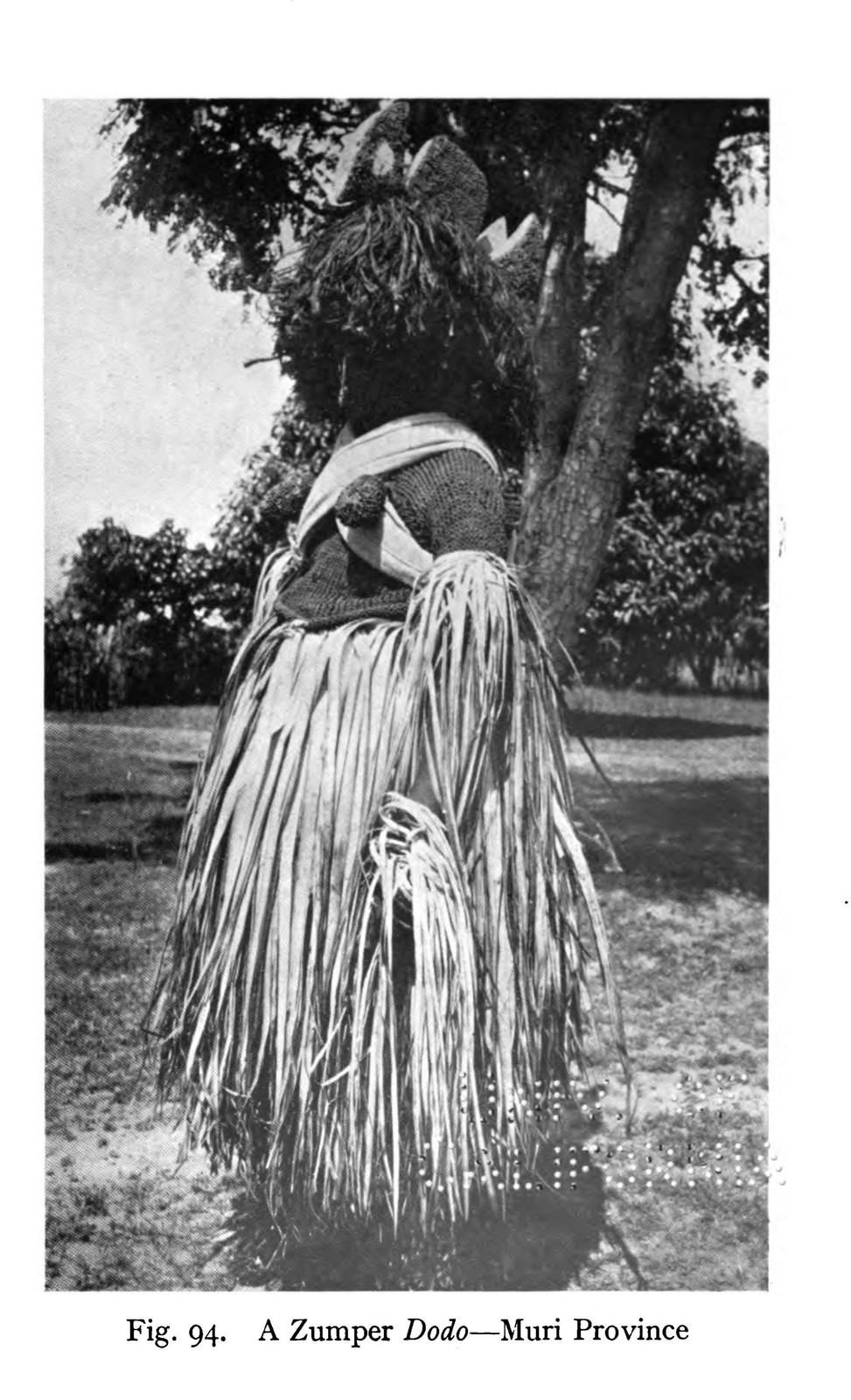
On the Jos Plateau and the Benue country of central Nigeria the being behind the rite was the Dodo, the masked spirit of a village’s dead founder. C. K. Meek, the government anthropologist of the Northern Provinces, wrote that among many tribes the Dodo was seldom seen except at circumcision, when the boys were brought before him.
The uninitiated believe that the circumcision is performed by the Dodo himself; and if any boy dies during the rites his mother is told that the Dodo has swallowed him!
C. K. Meek, The Northern Tribes of Nigeria (1925), vol. II, p. 20
Among the Kagoma, Meek goes on, the Dodo’s cry was made by blowing through a tube tipped with spider’s web, and “the bullroarer is also used for this purpose” (p. 21). The voice the women heard over the camp was the voice of the one who had swallowed the boy who did not come back.
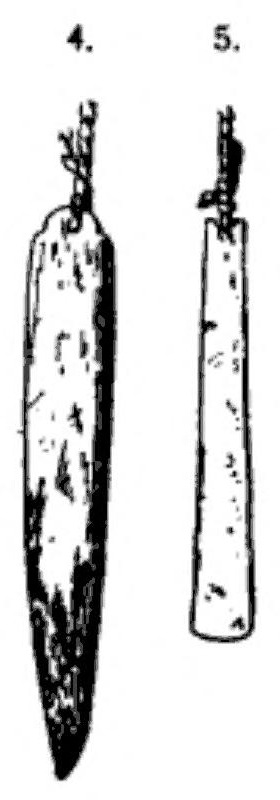
East of the Benue, in the Adamawa hills of Cameroon, the Chamba called their bullroarers langa, and Leo Frobenius heard how a death in the camp was given to a mother on the day the boys came home. The king had just greeted the circumcised and told them they were no longer children; that evening the bullroarers sounded again, and women, children and the uncircumcised fled.
But if a boy has died in the bush, it is told to the mother on this day, and here in these words: langa bobyokse fuaja, that is, “Langa had no meat, so he ate your son.” That mother then falls into grief and lamentation, while the others are merry.
Leo Frobenius, Dichten und Denken im Sudan (1925), p. 14, translated from the German
Langa, the women were told when they asked, was an ancestor who came to drink beer and eat. That is the whole theology in a sentence: the dead are hungry, the roar is their hunger, and the rite feeds them. Most years they are fed meat. One year a mother’s son is the meat.
The Kwanyama gave the news without words. The boy who died at circumcision “remained in the monster’s stomach,” Loeb wrote; “the body was then secretly buried in the bush, and the mother, upon receiving her son’s food basket back unemptied, knew that he was dead, but dared not mourn openly” (1948, p. 27). Among the Humbe a mother sent her son a new basket for his homecoming, and if he had died in the camp a guard cut out its bottom and sent it back (Estermann 1957, p. 74). In the Adamawa hills the Dii made their bullroarers roar like the panther that lived out where the boys had gone, so that, as one of Tomás Drønen’s informants put it, the women would be aware of nothing, not even which boys were injured or died (Drønen 2009, p. 127).
This is where the mouth earns its terror. It is not a story told only to frighten. It is the rite’s account of its own dead, and every mother who received an empty basket or a cut one learned that the voice over the camp had meant exactly what it said. The swallower is believed because it sometimes keeps what it swallows.
The novice is given the mouth
Every one of these rites ends the same way for the boys who live: they are shown the voice, and the voice becomes theirs. In Africa the moment of revelation says it outright. Meek recorded it among the Kagoma, whose Dodo cried through a tube and a bullroarer:
Each youth is then asked if he has seen the Dodo, and, before he can reply, a member of the cult blows on the tube and says, “I myself am the Dodo.” Then, handing the young man the tube, he says, “And henceforth you yourself are the Dodo too.”
C. K. Meek, The Northern Tribes of Nigeria (1925), vol. II, p. 21
The novice brought before the Dodo is given the Dodo’s voice to hold. He has stood before the mouth, and now he is the mouth. The Bembe say the same of the man with the adze, who is Tembwe at the instant he “kills” and “swallows” the boy. Among the Igbo of south-eastern Nigeria, boys of about ten entered the night society of the Ayakka by chewing a goat’s tooth as “the teeth of the ju-ju”, and only in a later grade were shown that a man could make the spirit’s voice with a tube in his own mouth. The initiate first gets the teeth, then the voice.
This is why the mouth must be total, and why the Dogon say everything. A swallower who ate only boys would be an ordeal. A swallower who eats the crying child, the boy in the camp, the man who dies, and at last men, women and children without exception is death itself, and the men who hold its voice hold death’s office. The ancestors are the ones the mouth has already eaten, and they speak from inside it.
The mouth roars on every continent
Africa does not hold this mouth alone. On the Huon Gulf of New Guinea, the Bukaua and Yabim used one word, balum, for the bullroarer, the monster that swallowed the boys at circumcision, and the souls of the dead, and pigs were given to make it vomit the boys back. When a boy died, the answer to his mother was the African answer to the letter:
When a lad bleeds to death from the effect of the operation, he is secretly buried, and his sorrowful mother is told that the monster swallowed him and refused to bring him up again.
J. G. Frazer, The Belief in Immortality and the Worship of the Dead, vol. I (1913), on the Bukaua and Yabim, after Lehner
In northern Australia the swallower is a mother, and her voice is the bullroarer as plainly as the Dogon rhombe’s is death’s. The Dalabon of southern Arnhem Land told Kenneth Maddock of Lumaluma, a serpent who was mother to all Aboriginal people and lived in the salt water. The men given to her in the Gunabibi, the great ceremony also called Kunapipi, she swallowed, and she vomited back only their bones. So a father and son stopped feeding her and put bullroarers in her place, and when she next spoke a left-handed night bird caught her voice by swinging one. “She used to swallow people and spew out their bones,” Maddock wrote. “The bull-roarer is Lumaluma” (1978, p. 104). In every Gunabibi since, the novices are swallowed by her. North of the Dalabon, the Yolngu python Yurlunggur swallowed the two Wawilak sisters, and his roar is the serpent crying in hunger: the men told the women any woman who came near would be swallowed whole, and at initiation they became Yurlunggur, swallowed the boys into forbidden ground and gave them back weeks later as men (Warner 1937). At Port Keats the Murinbata novices are told the Mother will “swallow them alive, then vomit them up,” and the hidden bullroarers are “the voice of the Mother” (Stanner). The swallowing Mothers of Sahul, the Ice Age continent that joined Australia to New Guinea, are gathered in The Mother of All.
Across the Pacific the mouth is still open. Among the Marind-anim of south New Guinea the bullroarer is sosom, the name of the giant who “devours all the neophytes” and disgorges them again (van Baal 1966, p. 480): the African habit of naming the instrument for the eater, carried to its end. On the Northwest Coast of North America the Kwakwaka’wakw whirled bullroarers on the rooftops as the voice of the spirit come to take another novice (Boas 1897, p. 611), and the novice was swallowed by He-Who-First-Ate-Man, a being covered in mouths, and came back a Hamatsa dancer. In the Northwest Amazon the Tatuyo anaconda swallowed the initiates and was made to vomit up their bones, and the sacred instruments are cut from the palm that grew from its ashes; Stephen Hugh-Jones describes the novices of the whole region as “killed and swallowed and reborn by being vomited up again.” Bones vomited by Lumaluma, bones vomited by the anaconda, the Kwanyama boy kept in the bird’s stomach: the mouth that keeps what it swallows is the same mouth on three continents. These rites are set side by side in Swallowed by a Monster and The House That Swallows Boys.
Greece did the eating another way. In the Orphic myth the Titans lured the infant Zagreus with toys, and among them was the rhombos, the whirled bullroarer (Clement of Alexandria, Protrepticus 2); then they tore the child apart, cooked him and ate him, and he was born again. Jane Harrison set the Wiradjuri boys of south-eastern Australia, “burnt to ashes and remodelled” at initiation, beside Zagreus and wrote that the one account might have been written of the other (Themis, 1912).
The Huon monster swallows the boys and keeps the dead one; the Dodo swallows the boy who dies; the Kwanyama bird keeps him in its stomach; Langa eats him for want of meat; Lumaluma gives back only bones. The rite, its voice, its excuse and its mouth have the same shape on both sides of the Indian Ocean and beyond. Edwin Loeb, who had surveyed tribal initiations across the world in 1929 before he went to the Kwanyama, drew the conclusion himself: among “primitive black-skinned people and the less-civilized American Indians, as well as the natives of West Ceram, these puberty rites take such similar forms that they must belong to a very early stratum of human culture” (Loeb 1948, p. 23). The swallowing roar is one of the oldest things people carried, and Africa, where it is densest, is where it speaks plainest.
The roar is the mouth of death
Put every African case side by side and the instrument is never neutral, never merely loud, never a signal standing for something elsewhere. It is a mouth. It is named for the eater, the child-eater of the Fang and the bird of the Kwanyama and the Ngakola of the Banda. It is heard as the eater’s roar, the beast from the sky over the Kissi forest, the leopard over the Bembe circle. It takes the blame for the eater’s meal when a boy dies in the camp. And when the boy who survives is shown the secret, he is handed the eater’s voice and told that he is the Dodo now.
The nursery shows the mouth at its smallest and the funeral at its largest, and they are the same mouth. At the hut door it threatens one crying child. In the camp it swallows a generation of sons and gives them back as men. At midnight, with the fires out and the drums still, it says what it was always saying. Death struck the first ancestor, and it will strike everyone; the roar is the voice of the dead man who learned that first, and it speaks for the thing that took him. I swallow, I swallow, I swallow men, women, children. I swallow everything. Across Africa the bullroarer’s roar is not a herald but a mouth: the voice of a being that swallows, which eats the crying child at the hut door, swallows the boys at initiation, takes the boy who dies, and among the Dogon says in its own words that it swallows everyone.
Key sources
- Germaine Dieterlen, “Mythologie, histoire et masques,” Journal des Africanistes 59 (1989): 7–38, at pp. 33–35: the three rhombes as tongues; « J’avale, j’avale, j’avale les hommes, les femmes, les enfants, j’avale tout »; the witnesses to the coming of death; the midnight funeral (p. 34).
- Michel Leiris, “Rhombes dogon et dogon pignari,” Bulletin du Musée d’Ethnographie du Trocadéro 7 (1934): 3–10: the mother of the mask who “boit le sang des femmes et des enfants,” and the crying child she will eat (p. 4).
- Günter Tessmann, Die Pangwe, vol. II (Berlin, 1913), p. 287 and Abb. 86 (edžībŏngo = Kinderfresser), p. 335 n. 1 (kōkō-boṅgo).
- George McCall Theal, Kaffir Folk-Lore, 2nd ed. (London, 1886), p. 209: the nodiwu and the monster coming to devour the child.
- André Schaeffner, Les Kissi: Une société noire et ses instruments de musique (Paris, 1951), pp. 74–76: nyewonde, the beast fallen from the sky (p. 75).
- Edwin M. Loeb, “Transition Rites of the Kuanyama Ambo (A Preliminary Study), Part I,” African Studies 7(1) (1948): 16–28: the “very early stratum” (p. 23); the edila and the boys’ song (p. 27).
- Carlos Estermann, Etnografia do Sudoeste de Angola, vol. II (Lisbon, 1957), pp. 71, 74–76: the howling ehulumphuku; the cut basket; Ehulumphuku lyamima (p. 75).
- Philip Mayer, “Gusii Initiation Ceremonies,” Journal of the Royal Anthropological Institute 83 (1953): 9–36, at p. 20.
- Pol Pierre Gossiaux, Le Bwamè du Léopard des Babembe (Kivu-Congo), pp. 10, 33, 89–96: Tembwe, the circumciser wondolomina, “celui qui avale ce qui somnole.”
- N. W. Thomas, Anthropological Report on Sierra Leone, Part I (London, 1916), pp. 149–151: the Katokodo krifi who “is said to swallow non-members.”
- George W. Harley, Notes on the Poro in Liberia, Papers of the Peabody Museum 19(2) (1941), pp. 14–15; Günther Spannaus, Masken- und Stelzentänze (Gbande, Nordliberia) (1936), pp. 1–2.
- C. K. Meek, The Northern Tribes of Nigeria (London, 1925), vol. II, pp. 20–21: the Dodo who swallows the boy who dies; “I myself am the Dodo.”
- Leo Frobenius, Dichten und Denken im Sudan (Jena, 1925), pp. 13–15: langa bobyokse fuaja (p. 14).
- Tomás Sundnes Drønen, Communication and Conversion in Northern Cameroon (Leiden, 2009), pp. 127–128: the Dii panther-rhombe.
- G. T. Basden, Among the Ibos of Nigeria (London, 1921), ch. XXII; M. D. W. Jeffreys, “The Bull-Roarer among the Ibo,” African Studies 8(1) (1949): 23–34.
- Susanne Fürniss, “Les instruments de musique de Centrafrique au musée de l’Homme,” Journal des Africanistes 63(2) (1993), pp. 92–93, 116 (the Banda ngàkôlâ); A.-M. Vergiat, Les rites secrets des primitifs de l’Oubangui (Paris, 1936).
- J. G. Frazer, The Belief in Immortality and the Worship of the Dead, vol. I (London, 1913), pp. 260–261, after S. Lehner, “Bukaua,” in R. Neuhauss, Deutsch Neu-Guinea III (1911).
- Kenneth Maddock, “Communication and Change in Mythology,” in N. Peterson (ed.), Tribes and Boundaries in Australia (Canberra, 1976), p. 166: the Dalabon Lumaluma, the vomited bones, the bullroarers put in her place; Maddock, “Introduction” and “Metaphysics in a Mythical View of the World,” in I. R. Buchler and K. Maddock (eds), The Rainbow Serpent (The Hague, 1978), pp. 11–12, 104: “The bull-roarer is Lumaluma.”
- W. Lloyd Warner, A Black Civilization (New York, 1937): Yurlunggur, the Wawilak sisters and the Yolngu initiation; W. E. H. Stanner, On Aboriginal Religion (1959–63): the Murinbata Mother.
- J. van Baal, Dema: Description and Analysis of Marind-anim Culture (The Hague, 1966), p. 480; Franz Boas, The Social Organization and the Secret Societies of the Kwakiutl Indians (Washington, 1897), p. 611; Stephen Hugh-Jones, The Palm and the Pleiades (Cambridge, 1979).
- Clement of Alexandria, Protrepticus 2 (the toys of Zagreus); Jane Ellen Harrison, Themis (Cambridge, 1912): the Wiradjuri boys “burnt to ashes and remodelled.”
- Language classifications follow Glottolog 5.3 (H. Hammarström, R. Forkel, M. Haspelmath and S. Bank, glottolog.org).
- For the swallowing initiation in Australia, New Guinea, Greece and the Americas, see the atlas essays Swallowed by a Monster, The House That Swallows Boys and The Mother of All. As far as we know, gathering the African bullroarer’s swallowers together as one voice that names itself the eater is original to this page.