No. SA-Z1953-001
Bororo - São Lourenço and Eastern Brazil
Eastern Brazil · South America
Restricted
aige
Source term: Schwirrgerät / Schwirrholz / bullroarer
aidye (also aidge; later aige) — von den Steinen's spelling of the Bororo name for the funeral bull-roarer.
Etymology. aige names both the bullroarer and the fabulous water monster whose voice it is; the being is linked to the dead.
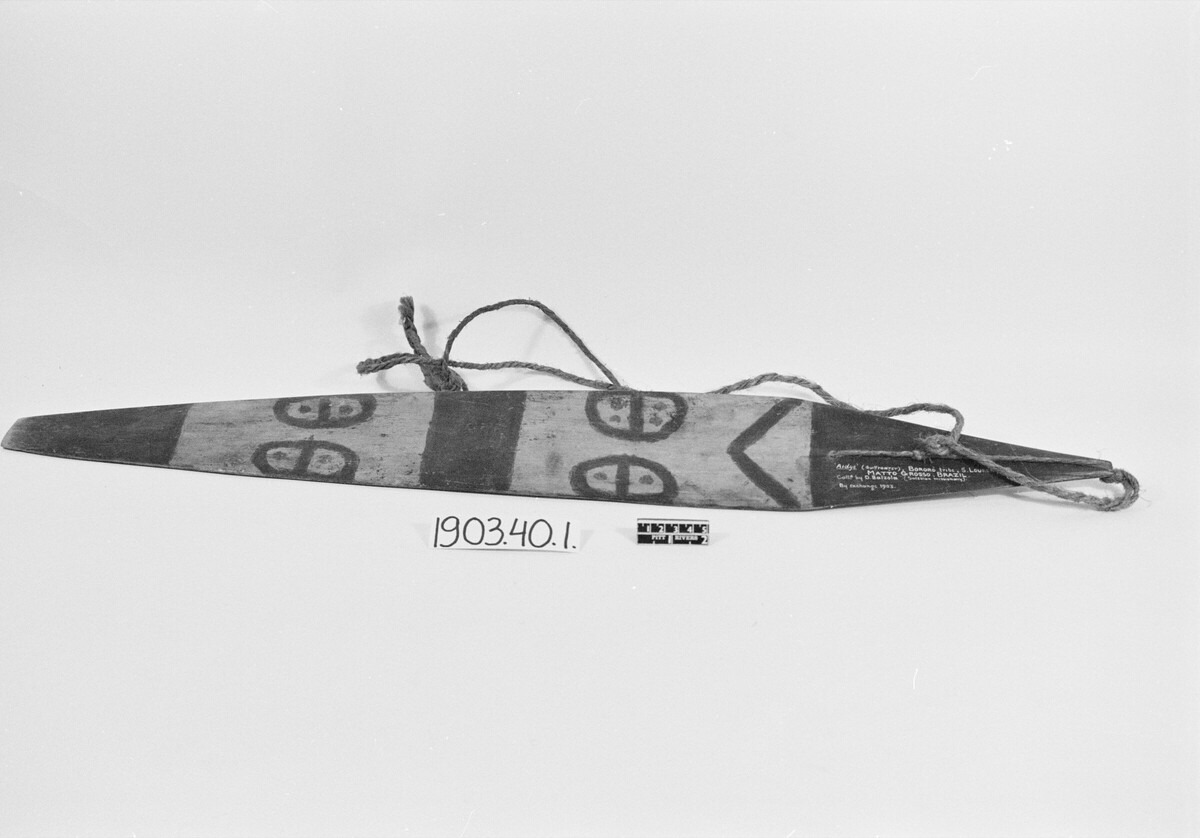
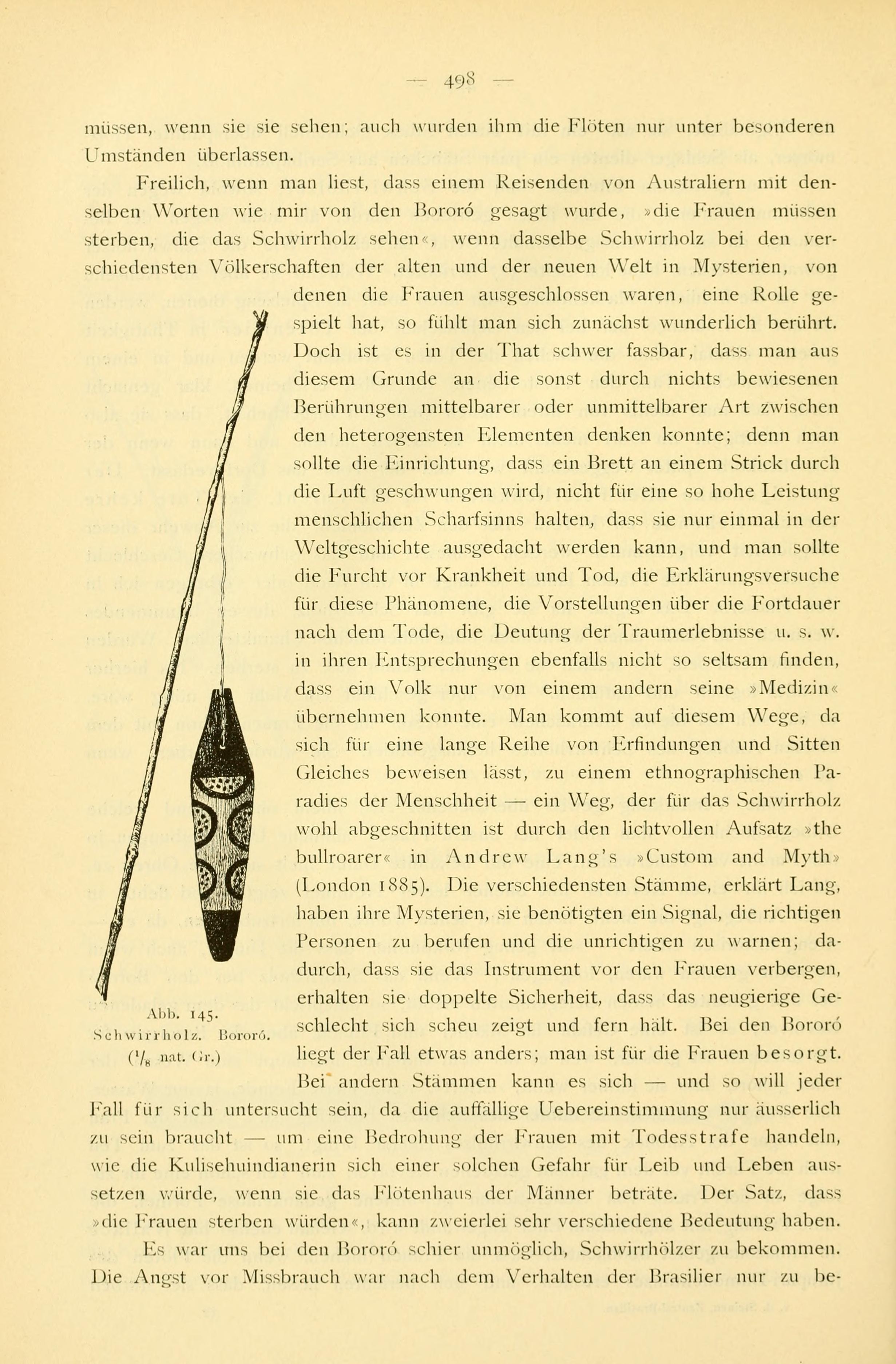
Among the Bororo of eastern Brazil, the bullroarer is the voice of the aige, a fabulous water-monster that lives on the bottom of a lagoon and shares its name with the instrument. It sounds only at funerals: as the dead person's belongings are burned and the basket of cleaned bones is carried out of the village, men whirl lance-shaped wooden boards on long poles, and when the buzzing begins the women run away into the forest or hide in the huts, for to even glimpse the aige would mean death. In the myth a man of the Páiwoe clan finds a tiny curious creature, keeps it in a pot of water, and feeds it until it outgrows every vessel, becomes monstrous, and is given over to the Aróroe, who carry it to a swamp-ringed lake and devise the songs and ornaments in its honor. At the climax of the funeral-initiation, naked young men smeared head to foot in clay crawl on all fours as the beast, and the little board that "is" the aige is shown to the uninitiated boys for the very first time, amid shouts, shoving, and thrown mud.
Während sie aber am Kulisehu nur für die fröhlichen Maskentänze oder auch sonst als Spielzeug dienen, werden sie am S. Lourenço nur bei den Gebräuchen der Totenfeier in Thätigkeit gesetzt... Die Frauen laufen so lange in den Wald oder verbergen sich in den Häusern. Das Signal für sie gibt das Schwirrholz... Sie würden sterben, wenn sie es sähen.
But whereas on the Kulisehu they serve only for the merry mask-dances or otherwise as a toy, on the S. Lourenço they are set in action only at the observances of the funeral feast... For so long the women run off into the forest or hide themselves in the houses. The bull-roarer gives the signal for them... They would die if they saw it.
von den Steinen 1894:497
Particulars
- Object
- Large lanceolate wooden aidye, truncated at both ends, pierced for a robust cord and decorated in black on both faces; PRM 1903.40.1 measures 883 × 116 mm.
- Function
- Funeral bullroarers; women flee or hide; bope and aroe dead-soul complex; aige monster; boys shown instrument during funeral-initiation
Source
Karl von den Steinen, Unter den Naturvölkern Zentral-Brasiliens (Berlin, 1894), pp. 496-500 (fig. 145, pl. 19) and 505-508; A. Colbacchini and C. Albisetti, Os Boróros Orientais (1942), pp. 52, 162-163 and 255; Giglioli 1899, p. 24; Pitt Rivers Museum, Oxford, 1903.40.1; Otto Zerries, 'The Bull-roarer among South American Indians,' Revista do Museu Paulista n.s. 7 (1953)