No. LOEB1929-029
Kwakiutl winter-ceremony bullroarer
Canada · Vancouver Island · British Columbia coast · North America · Northwest Coast
Restricted
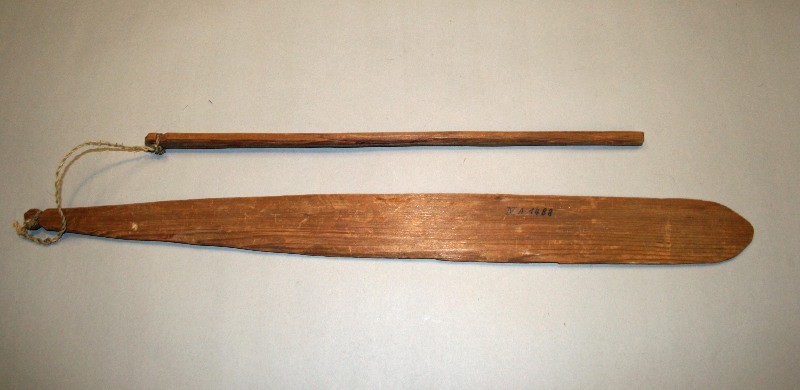
x·îndayu
Source term: bullroarer
During the Kwakiutl winter ceremony, men secretly climbed onto the roofs of the village houses and whirled their sticks. The sound was the voice of Hai'aLilaqas or Wīnā'lag·ilîs, the spirit come to carry off another novice; the noise was made four times, each stretch about ten minutes, before the people sang their secret songs inside the houses. Edwin Loeb singled out the Kwakiutl as the only Northwest Coast tribe to make ceremonial use of the bullroarer, sounding it secretly to announce the being who possesses and abducts the initiate. The novice taken in this way was held to have been seized by a cannibal ghost and, under its influence, to have tasted human flesh; his return required a death-and-resurrection rite to drive the spirit out. The usual way of voicing the abducting spirit among the Kwakiutl was to blow through tubes of kelp; the bullroarer was its secret voice. The roarer's Kwak'wala name, x·îndayu, comes from the verb to buzz or whirr; Franz Boas called it the whirring stick.
When the noise stops, a ha'mats'a is heard to shout in the bush, and on the next morning a blanket is found in front of one of the houses.
Franz Boas, The Social Organization and the Secret Societies of the Kwakiutl Indians (Report of the U.S. National Museum for 1895, 1897), p. 610
Particulars
- Function
- Whirled in secret from the roofs as the voice of the spirit taking a hamatsa novice.
Sources
- Loeb, Tribal Initiations and Secret Societies, University of California Publications in American Archaeology and Ethnology 25(3) (1929):249–288, pp. 273–274 View · archived
- Franz Boas, The Social Organization and the Secret Societies of the Kwakiutl Indians, Report of the U.S. National Museum for 1895 (1897), p. 610