Atlas Essay —
Dionysus in Australia
The Wiradjuri of New South Wales, Australia · the Orphic mysteries of Greece
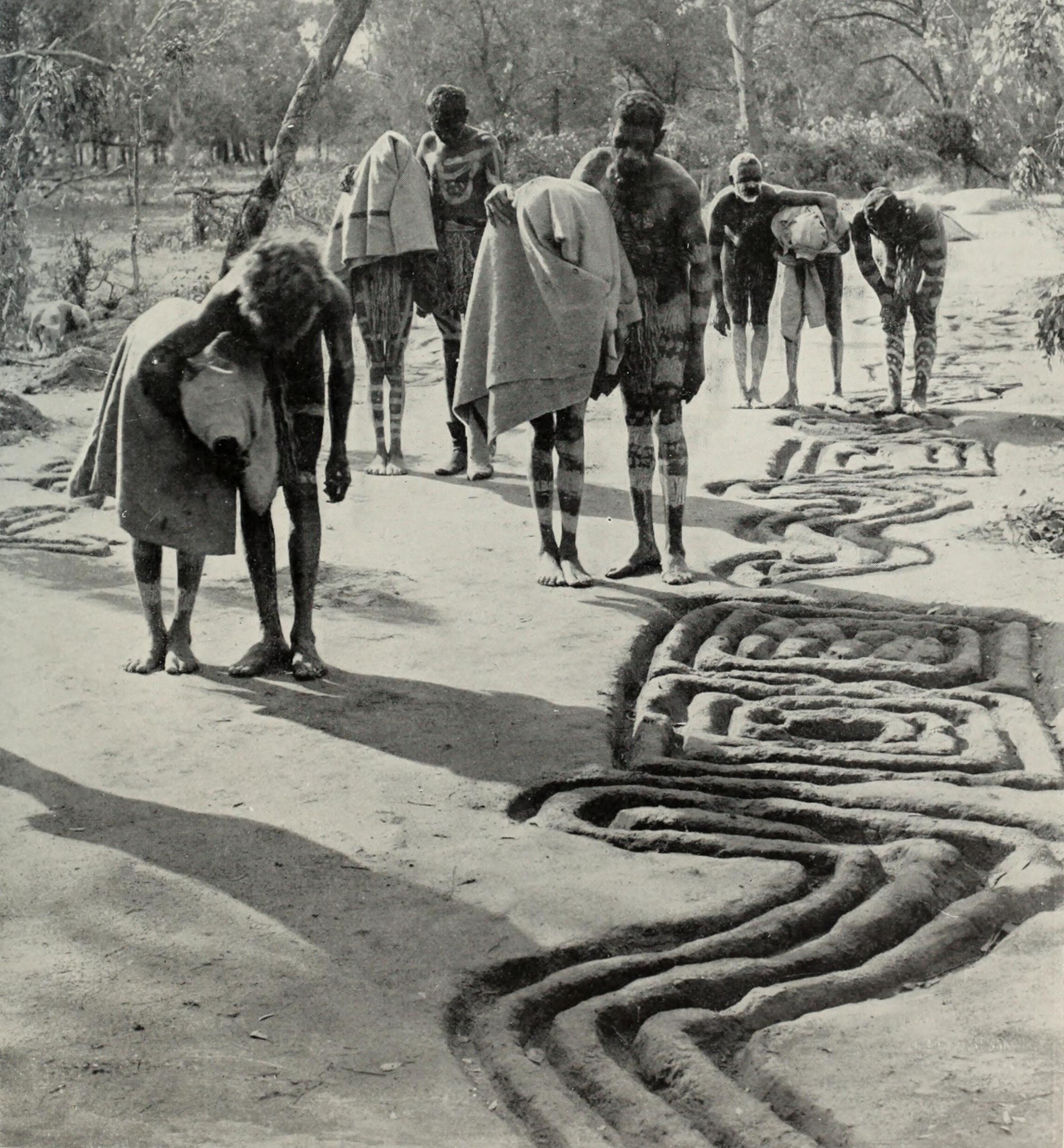
In the autumn of 1893, on Bulgeraga Creek by the Macquarie River in inland New South Wales, south-eastern Australia, the headman sang out “Lie down! here he comes!” The women and children threw themselves on the ground and were covered with blankets and bushes. Bullroarers roared from the scrub, men beat the earth with strips of bark, and burning sticks fell around the covered women. When the blankets came off the boys were gone, and the women were told who had taken them. Dhuramoolan, whose voice was thunder, would kill the boys, cut them up, burn them to ashes, form the ashes into human shape and bring them back new, each with a tooth missing. Long before, and half a world away, Greek initiates were told the same thing about a child god. The Titans lured him with toys, among them a bullroarer, tore him apart, cooked his limbs, and he came back to life.
The story Wiradjuri men in south-eastern Australia told their women is strikingly close to the Orphic myth of Zagreus, the child Dionysus: the same steps, in the same order, on the Macquarie and in the Greek mysteries.
In brief
- On the Macquarie in 1893 an old doctor told R. H. Mathews that Dhuramoolan “killed the boys, cut them up, and burnt them to ashes, that then he formed the ashes into human shape, and restored them to life, new beings, but each with a tooth missing” (Mathews 1896, p. 297). Their Wonghi neighbours said the same of Thuremlin, who “kills him, and in some instances cuts him up, after which he restores him to life and knocks out a tooth” (Cameron 1885, p. 358).
- The Orphic poem quoted by Clement of Alexandria runs the same course: the Titans lure the infant Dionysus with toys, the rhombos among them, tear him limb from limb, boil and roast the pieces, and the child is restored.
- Both stories hide an eating under the remaking. Dhuramoolan “feasted” on the boys and bit their faces off; the Titans cooked the child. In both a high god destroys the eaters, and something lasting is made from what is left of them: the bullroarer in Australia, the human race in Greece.
- The killers in Greece were “white-clay-men,” their faces plastered with gypsum, and Athenian initiates were daubed with clay. On the Macquarie the boys came back held up on their guardians’ shoulders, arms outstretched and eyes closed, and their sisters squirted pipe-clay into their faces.
- The tooth was the mark of the eater’s own mouth, “a visible sign that they had been initiated by Dhuramoolan.” At the end of the rite the boys were shown the bullroarer, told “There he is! that is Dhuramoolan,” and the instruments were split in pieces or burnt.
- Jane Harrison set the two accounts side by side in 1912 and wrote that mutato nomine, with the name changed, the Wiradjuri account “might have been written of Zagreus.”
Wiradjuri“Lie down! here he comes!” The women go under blankets; bullroarers sound; each boy is led away by the elbow.
OrphicThe Titans “lured him with childish toys”: cones, the rhombos, limb-bending dolls, golden apples.
Wiradjuri“and burnt them to ashes”
Orphic“piercing them with spits, they ‘held them over Hephaestus’”
Wiradjuri“formed the ashes into human shape, and restored them to life, new beings”
Orphicthe heart set in “a figure of gypsum”; from the Titans’ ashes “sprang the human race”
Wiradjuri“but each with a tooth missing”; pipe-clay squirted into the boys’ faces
Orphicthe killers “whitened with mystic gypsum”; the initiates scoured “with the loam and the bran”
WiradjuriBaiamai “destroyed Dhuramoolan, but put his voice into all the trees”
OrphicZeus “plagues the Titans with thunder”
The Wiradjuri account (Mathews 1896, pp. 297–311) and the Orphic one (Clement of Alexandria, Exhortation to the Greeks 2.17–18, with the later witnesses Harrison gathers in Themis, pp. 14–17), step by step. The steps are followed in the sections below.
The old man’s story
The Wiradjuri held the inland of New South Wales, from about the Murray north almost to the Barwon, where their country met the Kamilaroi. In March 1893 the remnants of five tribes answered the summons of the headman of the Macquarie River people and began to gather on Bulgeraga Creek, an anabranch of the Macquarie, for a Burbung, the initiation of boys. They came from the Macquarie, the Castlereagh, the Bogan, the Barwon and Cobar, and each camped on the side of the ground that faced its own country. The last ceremonies ended early in July. R. H. Mathews, a surveyor who had made the initiations of New South Wales his study, heard of it too late, waited out a flood, and travelled 427 miles by rail, coach and horseback to reach the camp. There the headman, known to the settlers as Big Jimmy, walked him over the ground, and at night an old man “who appeared to be a doctor or wizard (wooringimba)” told him the story on which the whole rite rested.
A long time ago there was a gigantic and powerful being, something between a blackfellow and a spirit, called Dhuramoolan, who was one of Baiamai’s people. His voice was awe-inspiring and resembled the rumbling of distant thunder. At a certain age the boys of the tribes were handed over to Dhuramoolan, in order that he might take them away into the bush, and instruct them in all the laws, traditions and customs of the community, to qualify them to sit in the councils, and discharge all the duties and obligations devolving upon them as tribesmen.
When he brought them back to the camp, it was always observed that each boy had lost one of his upper incisor teeth, as a visible sign that they had been initiated by Dhuramoolan. He pretended to Baiamai that he always killed the boys, cut them up, and burnt them to ashes, that then he formed the ashes into human shape, and restored them to life, new beings, but each with a tooth missing.
The wooringimba of Bulgeraga Creek, in R. H. Mathews, “The Būrbung of the Wiradthuri Tribes” (1896), p. 297
Every step of that sentence is his: the killing, the cutting up, the burning to ash, the forming of the ash into a man, the return to life, the missing tooth. Mathews printed it as he heard it, with a footnote that other tribes told the middle differently: “Dhuramoolan swallowed the boy, and after a time vomited him up again a young man, possessing all the tribal knowledge, but minus a tooth” (p. 297, n. 2). The swallowing is another form of the same death (see Swallowed and Reborn and The House That Swallows Boys). On the Macquarie the death came by fire.
The Wonghibon speakers from the Bogan and Cobar were at the same Burbung, and a generation earlier A. L. P. Cameron had heard their version. At the Wonghi initiation, while the women and children lay covered with boughs, each youth was met by “a Being, who, so far as I can understand, is believed to be something between a blackfellow and a spirit. This Being, called Thuremlin, it is said, takes the youth to a distance, kills him, and in some instances cuts him up, after which he restores him to life and knocks out a tooth” (Cameron 1885, p. 358). Two peoples, two collectors, the same order of events, ending in the same mark.
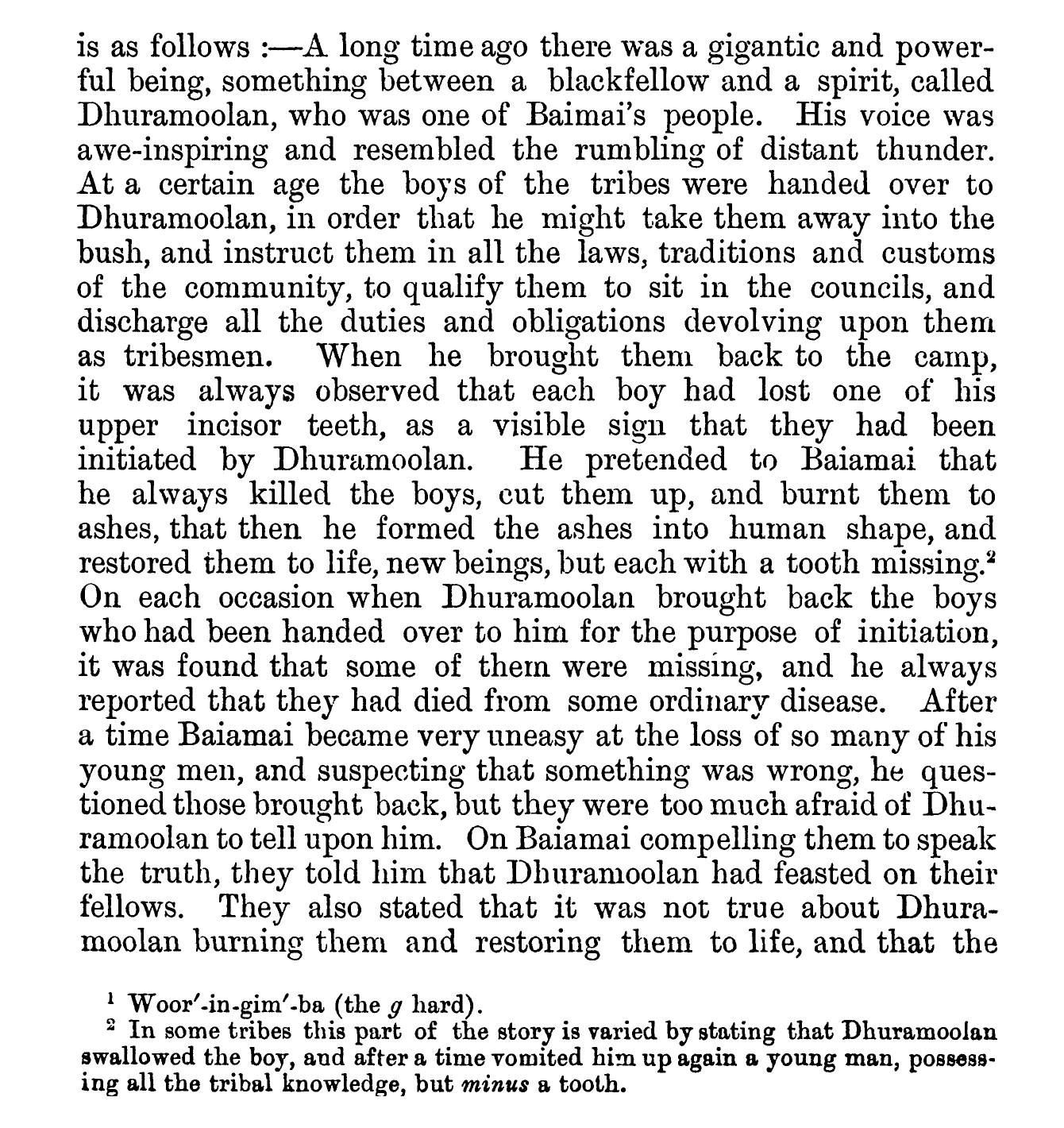
Then the story turns. Dhuramoolan’s account was a lie, and Baiamai, the All-Father, found it out. Boys went missing from every initiation, and Dhuramoolan reported that they had died of “some ordinary disease.” Baiamai questioned the ones who came back, and they told him “that Dhuramoolan had feasted on their fellows,” that the burning and restoring were not true, and that he knocked the teeth out with his own lower incisors: “At this part of the performance he sometimes bit the entire face off the boy and devoured him” (pp. 297–298). Baiamai destroyed him and put his voice into the trees, made the first bullroarer, and handed the initiations to his chief men. Then he gave the order that made the lie into the rite:
Baiamai thought it would be better not to communicate Dhuramoolan’s imposition to the women and uninitiated, but to continue to make them believe that he came and took the boys away and burnt and resurrected them as heretofore. He then instituted the ceremonies of the Burbung as it is at present practised, and commanded them to teach it to their sons in order that it might be perpetuated among all the tribes.
Mathews (1896), p. 298
So the Wiradjuri story is two stories, one inside the other. The outer one, kept for the women, is a death by fire and a remaking from ash. The inner one, kept for the men, is an eater, a high god who destroyed him, and a voice that survived in wood. The Greek myth of Zagreus has both, in the same order.
The toys of Dionysus
Clement of Alexandria, writing about AD 200 to shame the Greeks out of their mysteries, retold the secret story of the infant Dionysus, Zagreus in the Orphic poems, and quoted the Orphic verses as he went. Jane Harrison, the Cambridge classicist, translated him in Themis:
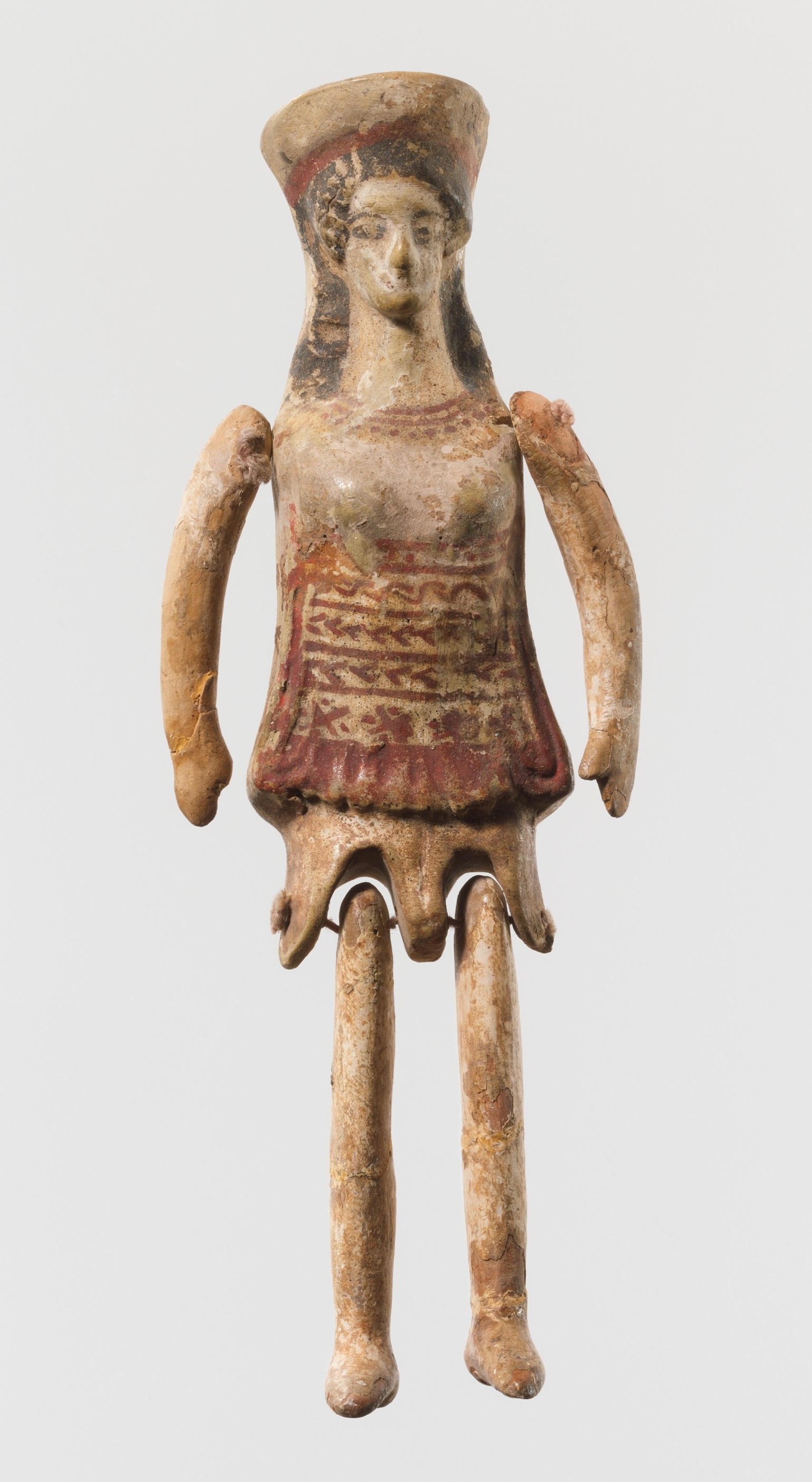
The mysteries of Dionysos are wholly inhuman, for while he was still a child and the Kouretes were dancing round him their armed dance the Titans came stealthily upon him and lured him with childish toys and tore him limb from limb while he was yet a babe. Thus does the Thracian Orpheus, the poet of the Rite recount.
The cones, the rhombos and the limb-bending toys,
Clement, Exhortation to the Greeks 2.17, translated in Harrison, Themis (1912), p. 14
And the fair gold apples of the Hesperides.
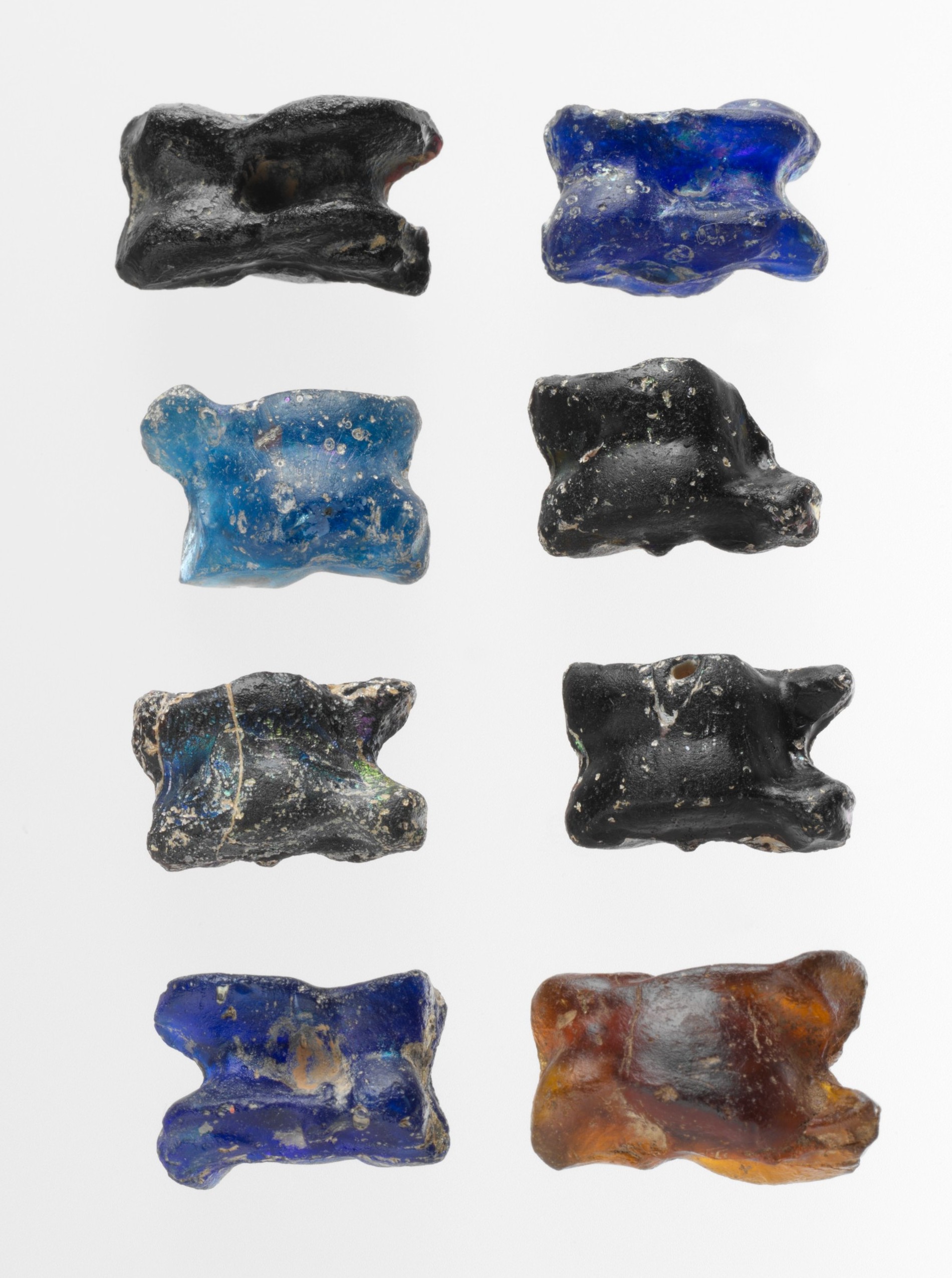
The rhombos is the Greek bullroarer, a slat of wood on a cord whirled in the rites to roar. A papyrus from Gurob in Egypt, written in the third century BC, already lists it among the god’s toys in the mystery basket (The Gurob Papyrus). Clement adds the rest of the set the initiates kept as tokens, “the knuckle-bone, the ball, the spinning-top, apples, wheel, mirror, fleece,” and then tells what the Titans did:
Now Athena made off with the heart of Dionysus, and received the name Pallas from its palpitating. But the Titans, they who tore him to pieces, placed a caldron upon a tripod, and casting the limbs of Dionysus into it first boiled them down; then, piercing them with spits, they “held them over Hephaestus.” Later on Zeus appeared; perhaps, since he was a god, because he smelt the steam of the flesh that was cooking, which your gods admit they “receive as their portion.” He plagues the Titans with thunder, and entrusts the limbs of Dionysus to his son Apollo for burial.
Clement, Exhortation to the Greeks 2.18, translated by G. W. Butterworth (1919), pp. 37–39
Later writers fill in the parts Clement leaves out, and Harrison gathered them on a single page. The Titans who stole the child “were painted over with white clay, gypsum.” The child came back: “Some said the child’s heart was saved and then put back into a figure made of gypsum. In some versions the wicked giants or white-clay-men are struck with lightning by Zeus and burnt to ashes and from these ashes sprang the human race” (Themis, p. 15). The Greek titanos is gypsum, white earth. Harrison read the giants’ name as what they wore: the Titans were the white-clay men.
Mutato nomine
Harrison had long suspected that a rite of initiation lay under the Zagreus myth, “because of the white-clay-men.” What she could not see was why the child was killed and brought back. Then James Frazer sent her a paper containing his summary of Mathews’s Burbung, and she saw it. She reprinted Frazer’s summary in Themis, and under it she wrote:
Harrison chose the Wiradjuri, she said, “out of countless other instances, because in it we have the definite statement that the boys were burnt to ashes and Zagreus-like remodelled again in human shape” (p. 18). Her reading of the Greek followed in two sentences. “Every single element, however seemingly preposterous, in both the ritual and myth of Zagreus can be explained I believe by the analogy of primitive rites of tribal initiation” (p. 16). And: “The Titans then, the white-clay-men, are real men dressed up as bogies to perform initiation rites” (p. 17).
Harrison wrote that the two accounts were alike. They are closer than alike. They run in the same order, with the same unlikely details in the same places: a death by cutting and then by fire, a body brought back to human shape from what the fire left, killers disguised in white, a voice like thunder, a whirled board, and a high god who learns what the killers did and destroys them.
Lure: here he comes
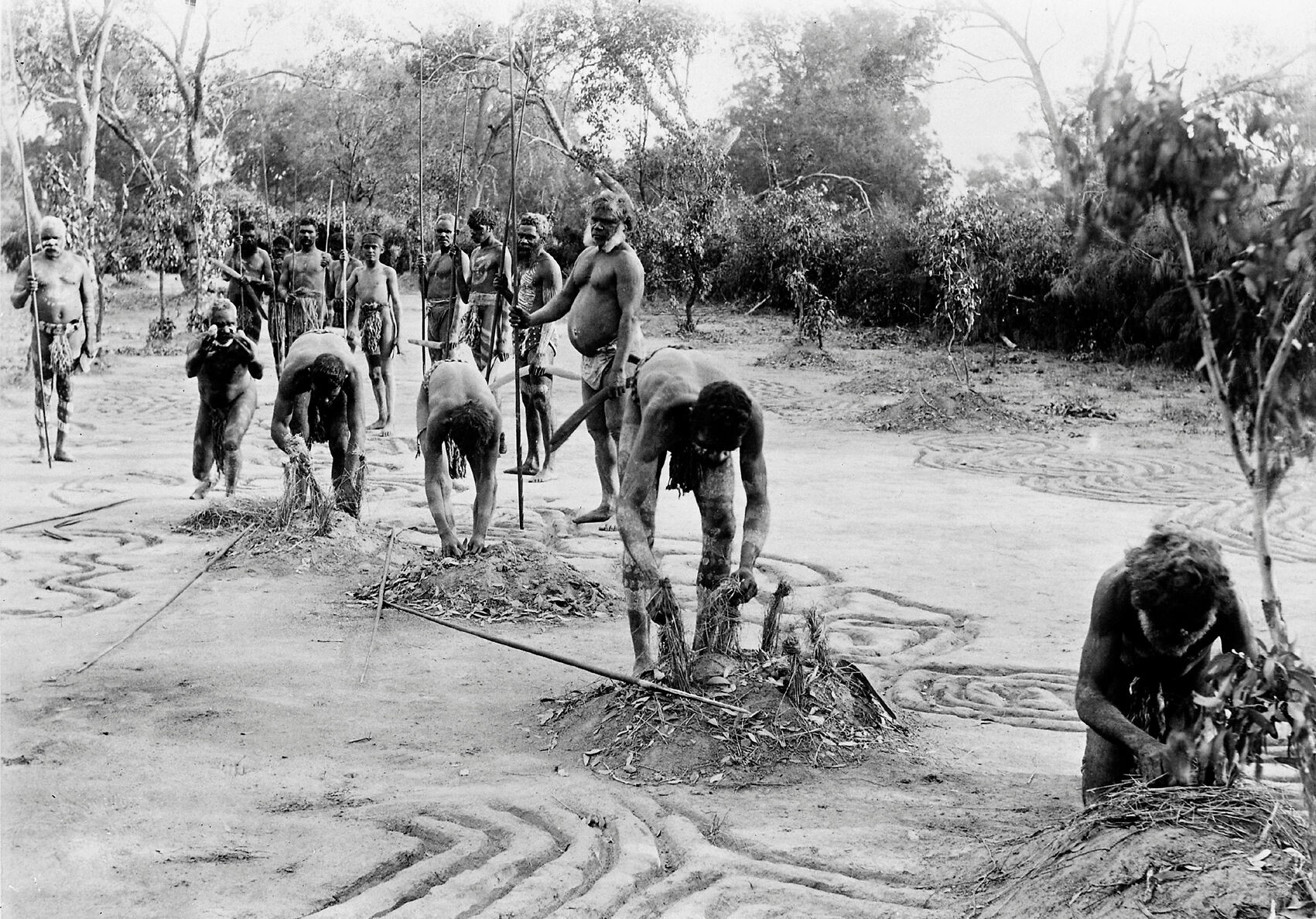
Mathews walked the ground with the men who had run it and wrote down the morning the boys were taken. Before daylight the whole camp gathered inside the cleared circle, each tribe on the side nearest its own country, with small fires against the cold. The novices sat naked on sheets of bark, eyes on the ground. Each boy’s sister and her husband, his guardian, painted him all over with red ochre and grease, “making a few marks of pipe-clay on the chest,” and dressed him in a man’s girdle and kilts for the first time.
When all was ready the headman sang out “Lie down! here he comes!” (meaning Dhuramoolan). The women and children then lay down, and were securely covered up with blankets and bushes, and a few of the men were appointed to watch them. A blanket was also thrown over the head of each of the novices in such a way that he could only see the ground at his feet.
Immediately this was done a number of men approached from the direction of the sacred ground, some sounding bull-roarers, others with strips of bark about 2 feet 6 inches long and 4 or 5 inches wide … in each hand, with which they beat the ground alternately at each step. They tramped round and round inside the circle three or four times, beating the ground, some men outside sounding bull-roarers, and together making a terrific din. … While this frightsome row was going on the guardians caught each his novice above the elbow, and led him noiselessly away along the pathway towards the sacred ground.
Mathews (1896), p. 308
The Greek scene has the same parts. The child is with men who dance an armed dance around him, the Kouretes beating their shields, and under the din the Titans come “stealthily” and take him. The din is the cover and the Titans are the takers. On the Macquarie the din was made by the same men who led the boys away: Kouretes and Titans in one body. The Greeks gave those dancers a trade as well: some, Strabo reports, made the Kouretes one with the Kabeiroi, children of Hephaestus, and with the Idaean Daktyls, “the first to discover and to work iron” (10.3.7, 10.3.21–22), the smith’s own people of The God the Smith Made. Harrison read the Greek dancers that way too, as the initiated young men of a tribe, who “steal them away from their mothers, conceal them, make away with them by some pretended death and finally bring them back as new-born, grown youths” (Themis, p. 20).
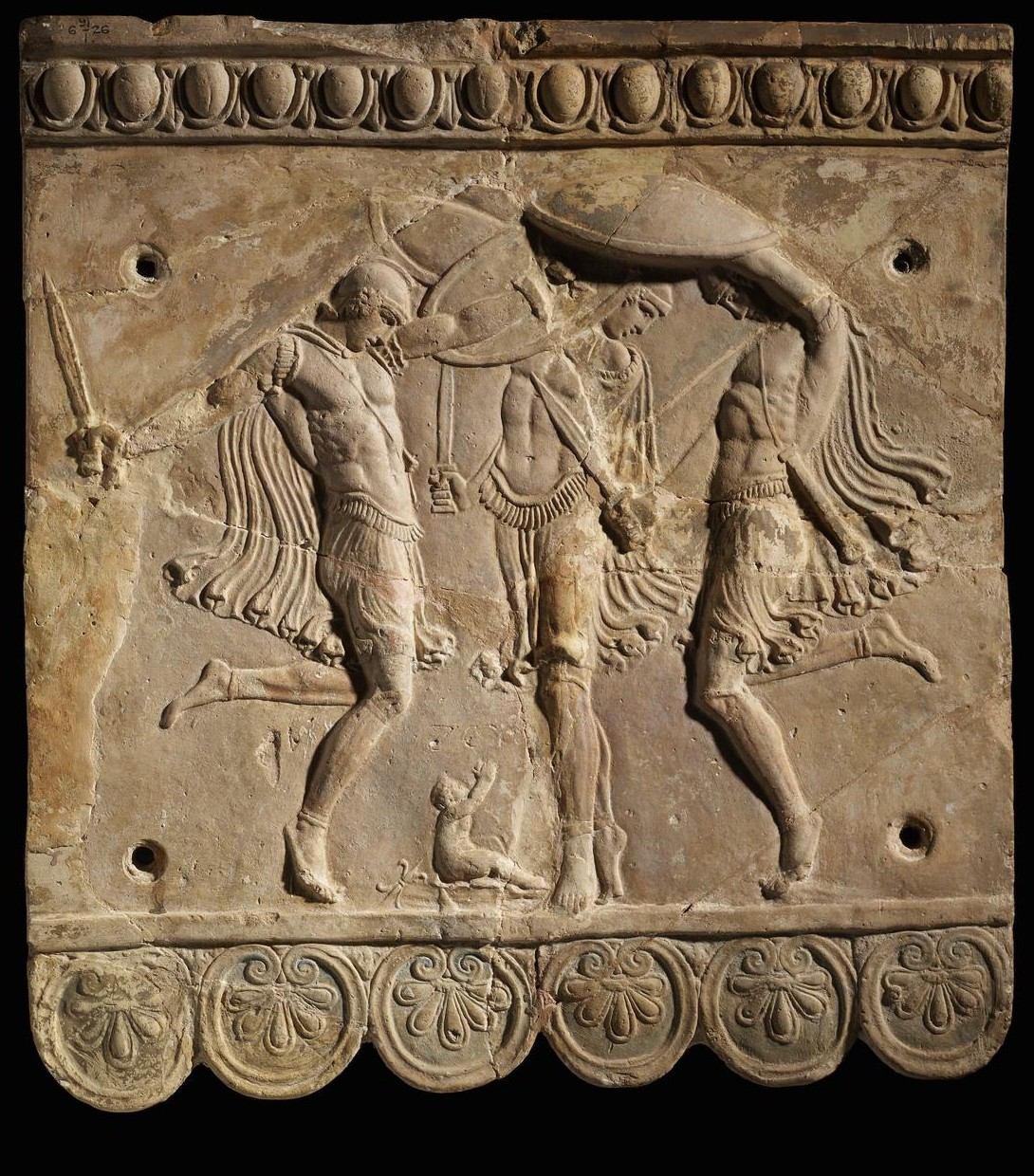
And the Greek lure is the Australian voice. In the Orphic verses the god is drawn to his death by a rhombos put into his hands. On the Macquarie the boys go to their death at the sound of the bullroarer, and the board is put into their hands only at the end, after the fire, when the headman points at the men whirling it and says who they are. The same object passes into the boy’s hands in both rites. Greece kept the moment of handing it over and turned it into a lure; the Wiradjuri kept it as the last revelation. Either way the god who takes the child and the toy the child is given are the same piece of wood. One of the names of the Wiradjuri bullroarer, Mathews says, was simply dhuramoolan (p. 298).
Kill and cut up
“He always killed the boys, cut them up”; the Titans “tore him limb from limb.” Neither story stops at death. It has to be death in pieces. Harrison saw why: “So vital, so crucial is the change that the savage exhausts his imagination and his ingenuity in his emphasis of death and new birth. It is not enough to be killed, you must be torn to pieces or burnt to ashes” (Themis, p. 19). The Wiradjuri story and the Orphic one each do both, the cutting first and then the fire.
Both cuttings also hide the same thing. Under the outer Wiradjuri story is a meal: Dhuramoolan “feasted on their fellows” and devoured the boys whose faces he bit off. Under the Greek one is a meal too. The Titans did not only tear the child; they boiled the pieces and roasted them on spits, and in Clement’s telling it was the steam of the cooking flesh that brought Zeus. Firmicus Maternus, telling the same story in Latin, says it outright: the Titans cut the boy’s limbs into pieces, cooked them in different ways and ate them (On the Error of Profane Religions 6). The story the uninitiated hear is of a death that remakes. The story under it is of an eater, and in both the eater is found out by what he took: the boys who never came home, the smell of the meat.
Burnt to ashes
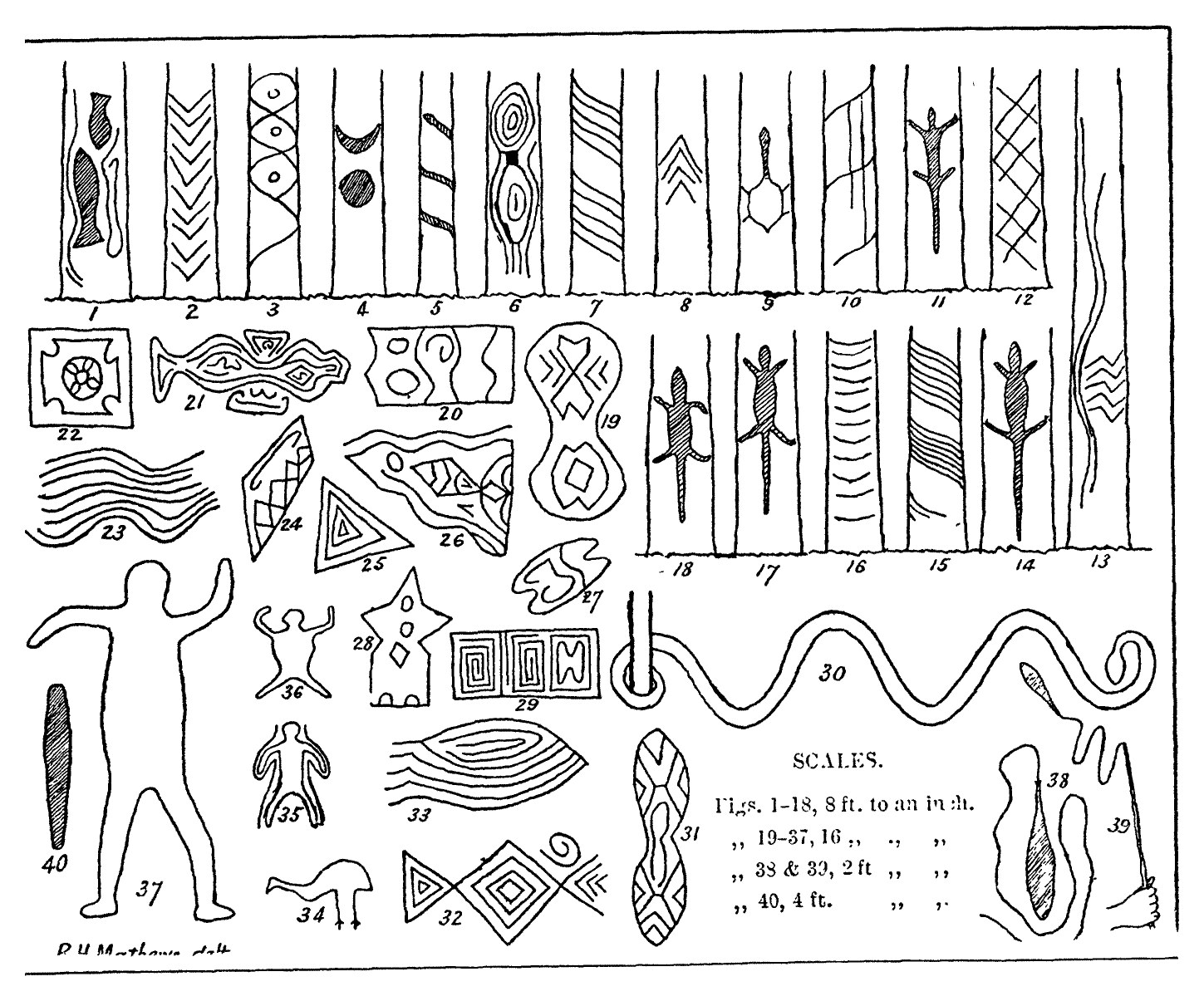
The Burbung was staged as a burning from its first morning to its last night. When the boys were led away, men snatched burning sticks from the fires and threw them among the covered women “to make them believe Dhuramoolan had tried to burn them.” When the blankets came off, “they looked up, half terrified, and seeing the burning sticks lying near them, were told that Dhuramoolan had done this to try and burn them when he was taking the boys away” (p. 308). Out in the bush, on the nights the boys camped with the old men, men slipped away into the scrub to swing bullroarers while others rushed around the camp rattling boomerangs and yelling “Go away! Go away!” “pretending that they were beating off Dhuramoolan, who was trying to come and burn the boys” (p. 309).
The last day brought the fire to the boys themselves:
On the afternoon of the last day of this period, the heads of the boys were again covered with blankets, as at the first. A fire was lighted about 50 yards off, and when the crackling of the wood and roaring of the flame became audible, several old men suddenly commenced to sound bull-roarers, whilst others beat the ground with pieces of bark in each hand, similar to those used at the circle. The old men told the boys they were going to be burnt by Dhuramoolan.
Mathews (1896), p. 311
The roar of the flame and the roar of the board were made to sound together, and the boys under their blankets could not tell one from the other. That night and the next morning their female relatives met them at a fallen log, and green bushes were burnt beneath it, and “a great smoke was made, which ascended up around the boys” (p. 312). The Burbung ended in that smoke.
Zagreus went into the fire as limbs on spits, “held over Hephaestus,” the fire god. Then the fire turned on his killers: Zeus struck the Titans with lightning and “burnt them to ashes.” The thunder is in both stories. Dhuramoolan’s voice “resembled the rumbling of distant thunder,” and his voice is the bullroarer. In the Cretan mysteries of Zagreus, Harrison found, the initiate “heard mimic thunder” (Themis, p. 62), and she set that rite beside the Wiradjuri rite of adolescence.
Remade in human shape
“He formed the ashes into human shape, and restored them to life, new beings.” The Greek witnesses give the same remaking twice. In the first the child himself is moulded. Firmicus Maternus, a Latin Christian of the fourth century, tells it as history: after the Titans had killed the boy, his father “made an image of him out of gypsum by the modeller’s art, and placed the boy’s heart … in that part of the figure where the lines of the breast had been shaped” (On the Error of Profane Religions 6, quoted in Themis, p. 15, n. 3). The heart Athena saved goes into a white figure in the shape of a child, and the child lives again. Harrison put it as the myth’s third element: “sometimes the child reappears as a white-clay-man himself, his heart being put into a figure of gypsum” (p. 15).
In the second, the ash is moulded into people. The Titans who ate the child were burnt to ashes by the thunderbolt, “and from these ashes sprang the human race.” The Neoplatonist Olympiodorus drew the lesson in the sixth century: we are made of the Titans’ soot, and since they had eaten the god, there is something of Dionysus in us. The Wiradjuri boy, too, is made from ash, and comes out a man.
The Wiradjuri did not leave the remaking as a story. They showed it to the women. On the Friday after the boys were taken, men came back to the new camp and announced “that Dhuramoolan would show them the boys that night” (p. 309). A horseshoe of boughs was built, with a low platform of bark at the back, and the boys’ female relatives lit a fire outside it and waited.
About 9 o’clock at night the guardians with their novices, followed by a number of the men, emerged from a thick scrub facing the open end of the yard and about 50 or 60 yards distant. Behind these a couple of men were loudly sounding bull-roarers to make the women and novices believe that Dhuramoolan was present. … The guardians sat down on the platform, and the boys got on top of their shoulders, their legs hanging down in front, and were held in the hands of the guardians. The novices now extended their arms horizontally, and kept their eyes closed. At a signal from the men the sisters of the boys entered the yard, and walking up close to them squirted pipe-clay out of their mouths into their faces.
Mathews (1896), p. 310
That is the formed figure, shown. The boys are held up on the platform by firelight, arms stiff and straight out, eyes shut, still as something made, and whitened. What the women see is the thing Dhuramoolan was said to have made out of ash: a human shape, carried in from the bush to the sound of his voice, not yet awake. The Greek child came back as a figure of gypsum. The Wiradjuri boys came back as figures of pipe-clay.
The white-clay men and the missing tooth
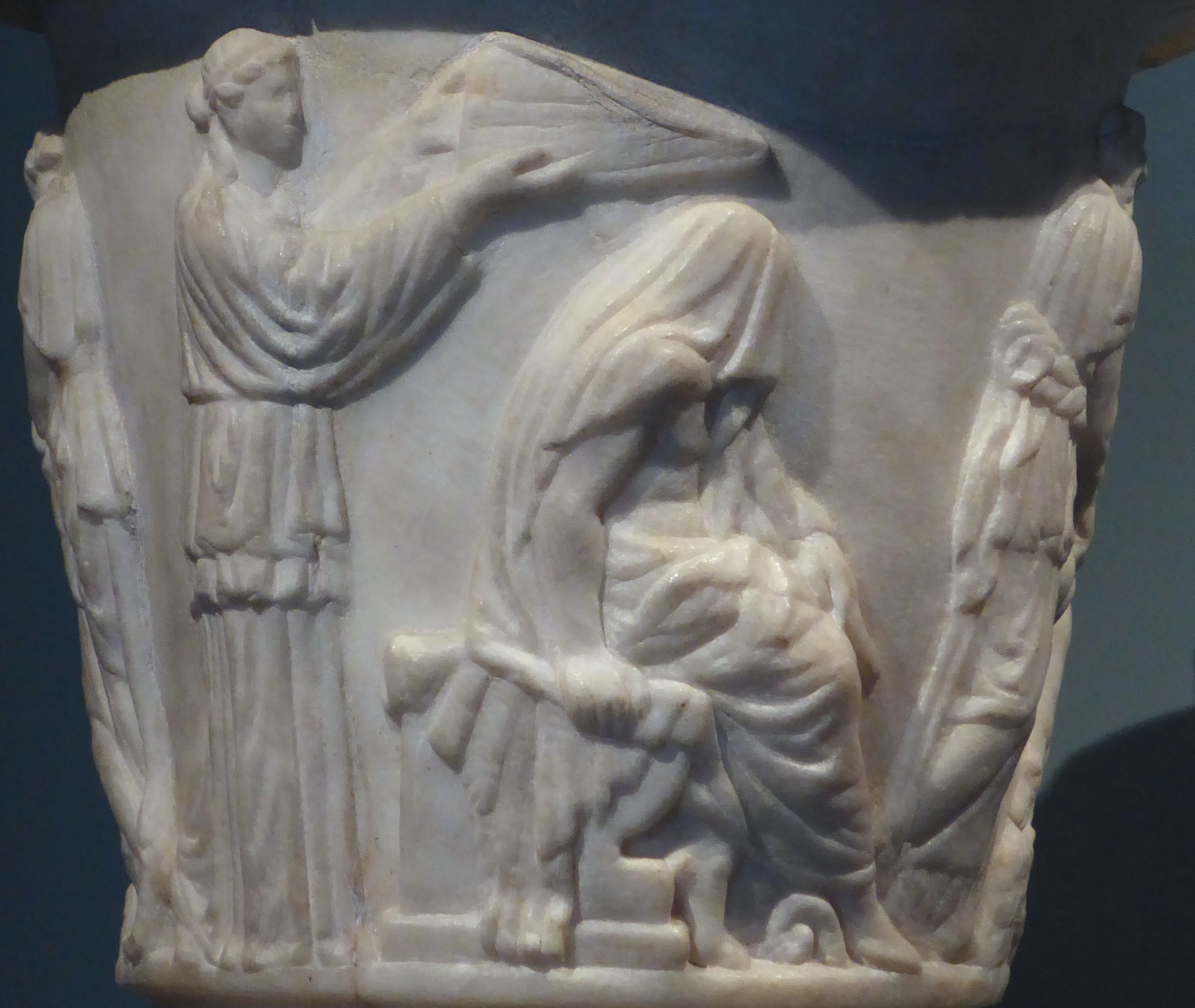
White runs through both rites, on the killers and on the killed. The Titans whitened themselves to kill. The lexicographer Harpocration, explaining a word Demosthenes used of the Athenian mysteries, says the initiators were “imitating what some tell in myth, that the Titans maltreated Dionysus after plastering themselves with gypsum so as not to be recognised. That custom lapsed, and later they daubed themselves with clay, for custom’s sake” (quoted in Themis, p. 17, n. 2). The epic poet Nonnus has the Titans “whitened with mystic gypsum.” And Demosthenes, mocking his rival Aeschines for the cult work he did as a boy for his mother’s Sabazios mysteries in Athens, gives the novice’s side of it:
At night it was your duty to mix the libations, to clothe the catechumens in fawn-skins, to wash their bodies, to scour them with the loam and the bran, and, when their lustration was duly performed, to set them on their legs, and give out the hymn: Here I leave my sins behind, Here the better way I find.
Demosthenes, On the Crown 259, translated by C. A. and J. H. Vince (1926)
Daubed with clay, then raised to their feet, the initiates sing that they have escaped the bad and found the better. In Harrison’s summary of the rites of rebirth, the pretended killing of the child is followed by “painting him with clay and bringing him back to life again as a young man” (Themis, pp. 18–19). On the Macquarie the same order holds: the boys are taken away under the roar, burnt in story, and brought back with clay on their faces. The men who came for them in the dark are the bogies of the women’s story. Harrison’s sentence fits them without a word changed: real men dressed up as bogies to perform initiation rites.
The clay washes off. The tooth does not. “Each boy had lost one of his upper incisor teeth, as a visible sign that they had been initiated by Dhuramoolan” (p. 297). It is the one part of the women’s story that was true on every man in the camp: the boy went away whole and came back with a gap. In the men’s story the gap has a cause. Dhuramoolan pulled the teeth with his own lower incisors, and that was the moment he bit the faces off. The mark every initiated man carried was the print of the eater’s mouth, the place where the eating stopped (The Initiates Used to Die follows this mark through Australia, New Guinea and West Africa).
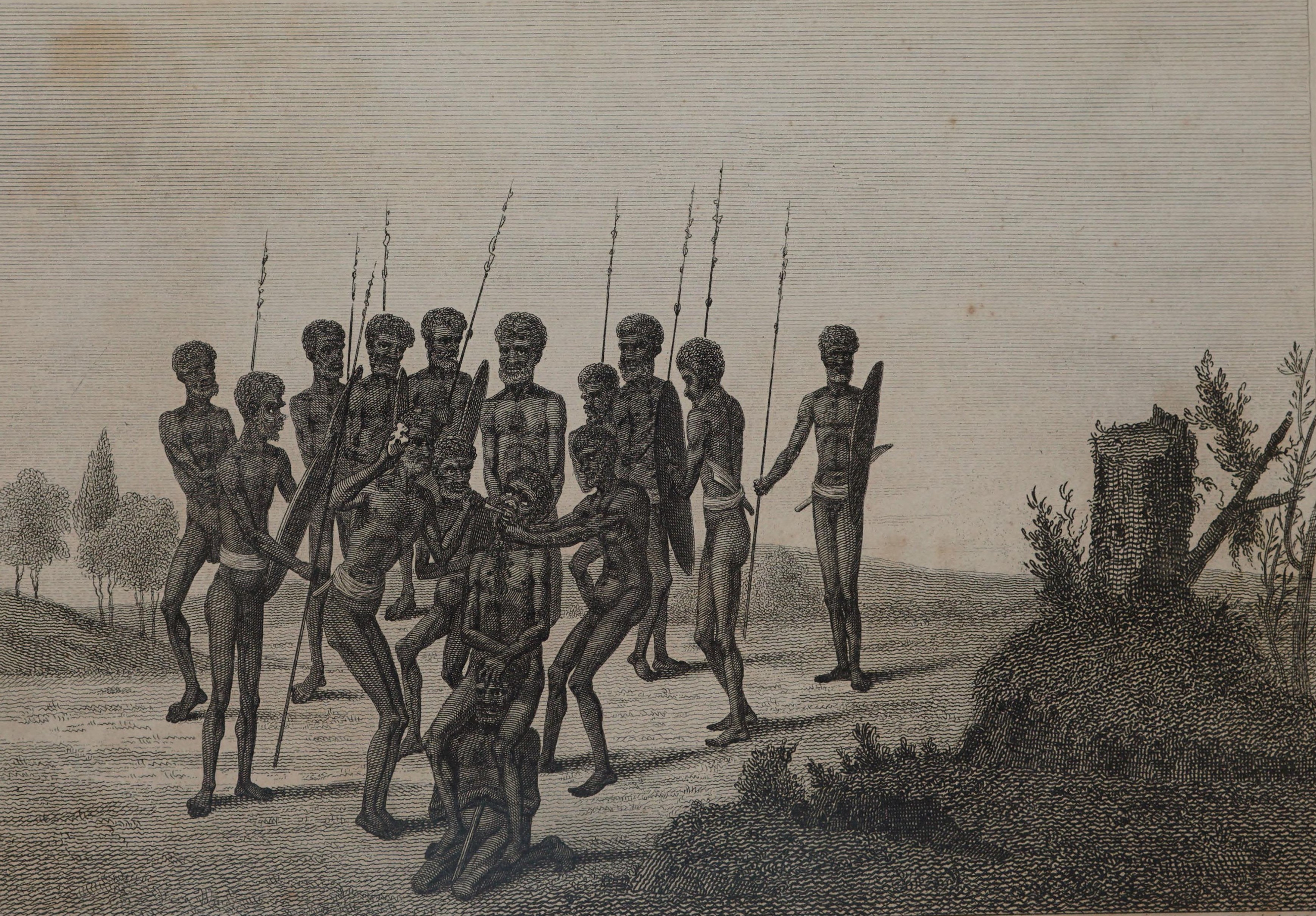
By 1893 the old men no longer knocked the tooth out at the Macquarie; Mathews notes that it was done in the bush “before the knocking out of a front tooth fell into disuse” (p. 310). The story kept the mark after the rite let it go. The boys still came back with new names, “known only to themselves and the initiated men of the tribe” (p. 310), and the Wonghi gave each one “a new designation … indicating the change from youth to manhood” at the moment the tooth came out (Cameron 1885, p. 357).
The Greek mark is carried by everyone. In the Orphic account humans are made of the Titans’ ash, so the eaters’ stain is in every body. The initiate washes it with clay and bran and sings that he has left the bad behind. The Wiradjuri man carries the eater’s bite in his mouth for life. In both rites the newly made person is marked by what ate him.
There he is
The last step belongs to the high god. Baiamai learned what Dhuramoolan had done and “became very angry and destroyed Dhuramoolan, but put his voice into all the trees of the forest and told it to remain in these trees for ever. He then split one of the trees, and made a bull-roarer (mudthega) which he fastened to a string and swung round, and it had Dhuramoolan’s voice” (p. 298). Zeus smelled the cooking, struck the Titans with thunder and burnt them to ashes, and men came out of the ash. In each story the high god destroys the eaters and something that lasts is made out of their remains: the voice in the wood, the race of men. Both outlast the god’s anger. The voice is still in every tree, and the people are still made of Titan.
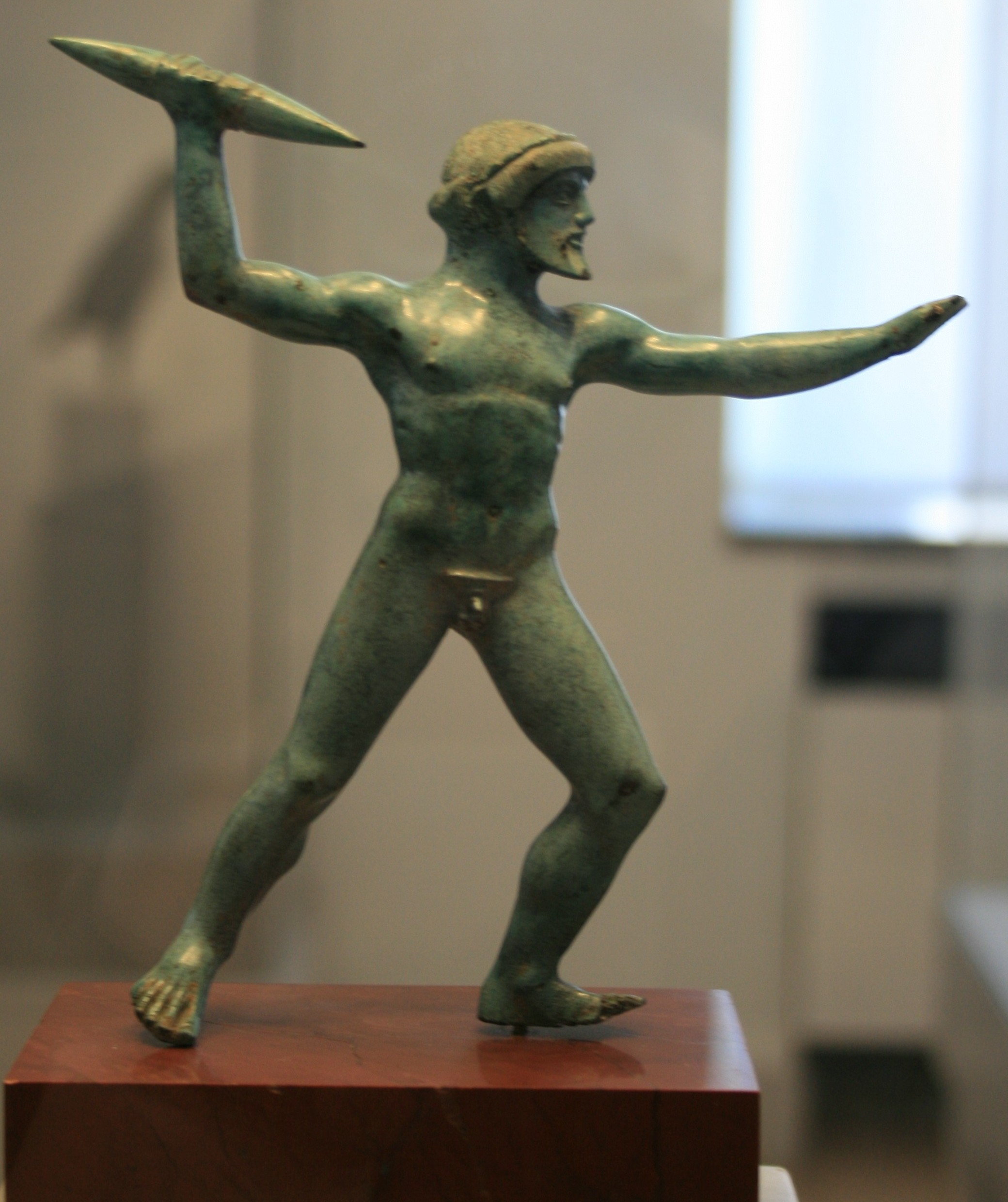
And the voice is what the boys meet at the end. After the last fire on the last afternoon, with the old men roaring the bullroarers and telling the boys they were about to burn:
When it was thought that the novices had been sufficiently impressed, at a given signal the guardians lifted the blankets off their heads, and the principal headman, pointing to the men with the bull-roarers, said, “There he is! that is Dhuramoolan,” and proceeded to explain to the boys how the noise was made at the circle the morning they were taken away, and at all other places where they had heard it, by sounding bull-roarers and beating the ground with pieces of bark, similar to those now before them.
The story of Dhuramoolan, and the origin of the mudhega was then detailed to them, and they were told that they must hand down this custom to the boys of the tribe. … The bull-roarers were then handed to the novices and they were invited to examine and whirl them round, to make themselves fully acquainted with their form and use.
Mathews (1896), p. 311
Harrison saw that this is a mystery in the Greek sense. “When the boy is actually initiated the central mystery takes the form of a revelation (ἀποκάλυψις) of the Bull-Roarer, the boy sees and handles it, and learns to twirl it; it is not, he finds, the voice of Dhuramoolan the Sky-God, it is a Bull-Roarer” (Themis, p. 63). The child Dionysus was handed the rhombos and died. The Wiradjuri boy died in story and was handed the mudthega. He walks out of the rite holding the god who took him.
Then the god is cut up and burnt. “An hour or two after this, the bull-roarers were destroyed by splitting them in pieces, and driving them into the ground out of sight. Sometimes, instead of doing this, they are burnt” (p. 311). The mudthega, whose other name was dhuramoolan, goes through the death the boys were promised. It is split to pieces like Zagreus, or burned like the Titans, and put out of sight in the earth the way Apollo buried the god’s limbs on Parnassus. Next Burbung the old men would split a fresh tree, because the voice was in all of them.
Change the name
Set the two accounts side by side, as Harrison did, and only the names differ. A child is taken from the women under a roar made by men. He is killed and cut in pieces. The pieces go into the fire. Something is moulded from what the fire leaves, and a person comes back, whitened, and marked by the eaters. Under that story, kept from the women, is another: the killers ate their victims, the high god found them out and destroyed them, and from what was left of them came the thing that lasts, a voice in the wood or a people made of ash. The instrument that carries the voice is the bullroarer, and in both rites it ends in the initiate’s hands.
Stories do not fall into that order twice by accident. Plenty of peoples kill their boys in story; few burn them to ash and mould them again, and fewer still keep an eater under the remaking and a high god who undoes him. The Wiradjuri and the Orphic poets share all of it, down to the pairing of the women’s version and the men’s, and the Wonghi beside the Wiradjuri tell it again in their own words. Fire, clay, thunder, the whirled board, the mark: these are the working parts of one rite, and the rite is older than either telling of it. To the north the Euahlayi say Byamee’s first initiator, sent to knock out the front tooth, “began to eat the boys’ faces,” and was replaced by a voice in wood (Parker 1905, p. 67). Greece kept its piece of the rite in the mysteries, and Clement wrote it down to mock it.
Harrison found the equation by accident, in a paper Frazer sent her, and wrote it in a single Latin phrase. The phrase holds. Change the name of Dhuramoolan to the Titans, of Baiamai to Zeus, of the mudthega to the rhombos, and the old man’s story at Bulgeraga Creek is the secret of the Greek mysteries: boys burnt to ashes, remade in human shape, and sent home to their mothers new, each with a tooth missing.
Key sources
- R. H. Mathews, “The Būrbung of the Wiradthuri Tribes,” Journal of the Anthropological Institute 25 (1896), pp. 295–318: the gathering at Bulgeraga Creek, March to July 1893 (p. 296); the wooringimba’s story of Dhuramoolan and the swallowing variant (p. 297 and n. 2); Baiamai, the voice in the trees, the mudthega called dhuramoolan (p. 298); the serpent wahwee on the ground (p. 301); “Lie down! here he comes!” and the burning sticks (p. 308); “Go away!” and the showing of the boys (p. 309); the pipe-clay, the new names, the tooth (p. 310); “There he is! that is Dhuramoolan,” and the splitting and burning of the bullroarers (p. 311); the smoke (p. 312); Plate XXVI (p. 315).
- A. L. P. Cameron, “Notes on Some Tribes of New South Wales,” Journal of the Anthropological Institute 14 (1885), pp. 344–370: the Wonghi tooth and new designation (p. 357); Thuremlin kills, cuts up and restores the youth (p. 358).
- Jane Ellen Harrison, Themis: A Study of the Social Origins of Greek Religion (Cambridge, 1912): Clement’s Orphic toy list (p. 14); the white-clay-men, the gypsum figure, the Titans’ ashes and the three cardinal elements, with Firmicus Maternus (p. 15 and n. 3); “Every single element” (p. 16); Harpocration and Nonnus on the gypsum, “real men dressed up as bogies” (p. 17 and n. 2); Frazer’s summary of Mathews and “mutato nomine” (p. 18); “torn to pieces or burnt to ashes” (p. 19); the Kouretes as initiators (p. 20); the Thunder-Rites and the revelation of the Bull-Roarer (pp. 61–63).
- Clement of Alexandria, The Exhortation to the Greeks 2.17–18, translated by G. W. Butterworth (Loeb, 1919), pp. 37–39.
- Demosthenes, On the Crown 259, translated by C. A. Vince and J. H. Vince (Loeb, 1926).
- Firmicus Maternus, De errore profanarum religionum 6, ed. K. Ziegler (1907): the Titans cook and eat the limbs; the father’s gypsum image with the heart.
- K. Langloh Parker, The Euahlayi Tribe (London, 1905), p. 67: Byamee’s stone initiator who ate the boys’ faces.
- Olympiodorus, Commentary on the Phaedo 1.3, on the human race made from the Titans’ soot.
- J. G. Frazer, On Some Ceremonies of the Central Australian Tribes (Melbourne, 1901), the summary of Mathews that Harrison reprinted.