No. SUBSAH-010
Humbi Handa lumpoku circumcision-school bullroarer
South-western Angola · Huila · Southern Africa
Restricted
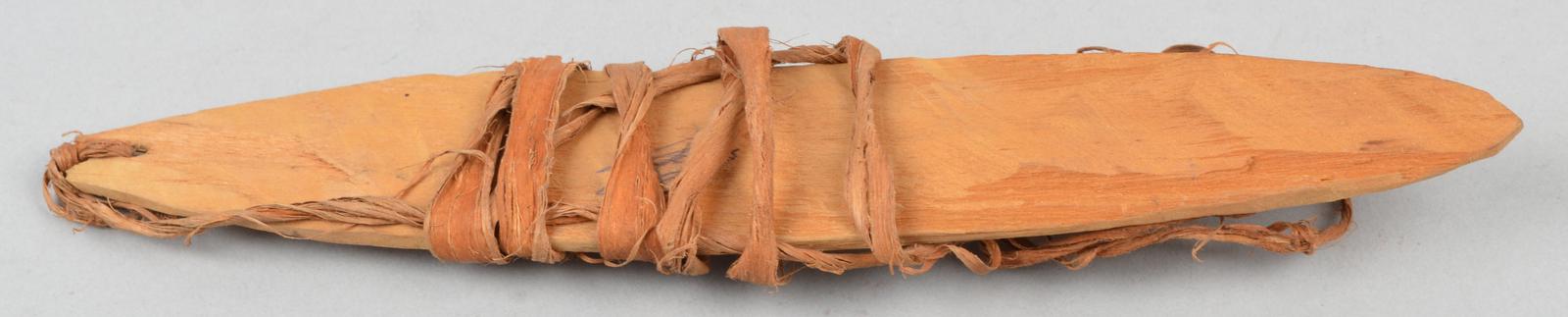
lumpoku
Source term: bullroarer
lumpoku — Humbi/Handa name for the bullroarer, used in boys' circumcision schools. Among the Nyaneka proper the same instrument is ehulumphuku, which Estermann glosses «o pau-espantalho» ('the scarecrow stick'); the 1896 Portuguese-Olunyaneka dictionary lists it under Papão, 'bogeyman'.
Among the Humbi and Handa cattle-herders of south-western Angola, the lumpoku sounded in the boys' ekwendje circumcision camps. Its rising and falling roar frightened the uninitiated, who took it for the voice of an all-powerful Being; among the Humbi, its buzz was the voices of the ancestors. Nyaneka songs heard the ehulumphuku howling across the plains by the lagoon of Pundo. If the operation left a boy maimed, people said Ehulumphuku lyamima: the bullroarer had swallowed him. Among the Humbi, a mother sent her absent son a new basket for his homecoming. If he had died in camp, a guard cut out its bottom and returned it; she understood without explanation. For boys who came home, the mothers danced and mimed childbirth. Their return from the forest to family life was a second birth.
É pois uma espécie de réu-réu, destinado a produzir ruído, e aqui comparado a um animal selvagem, soltando seus uivos em pleno mato.
It is, then, a kind of bullroarer (réu-réu), made to produce noise, and here likened to a wild animal letting out its howls in the open bush.
Carlos Estermann, Etnografia do Sudoeste de Angola, vol. II, Grupo étnico Nhaneca-Humbe (Lisbon, 1957), p. 71
Particulars
- Object
- A flat wooden slat about 20 cm by 4 cm with a hole at one end and a two-metre string; Kubik describes one whirled in the ekwendje circumcision camp at Kamuvia in 1965.
- Function
- Whirled in the ekwendje circumcision camps to frighten the uninitiated boys.
Source
Gerhard Kubik, “Musical Bows in South-Western Angola, 1965,” African Music 5(4) (1975): 98–104, p. 99; Gerhard Kubik, Humbi-Handa, Angola, recordings booklet (1965 fieldwork); Carlos Estermann, Etnografia do Sudoeste de Angola, vol. II (Lisbon, 1957), pp. 71, 74–76; Etnografiska museet, Stockholm, 1953.34.0100 (Gustaf Bolinder, 1951)