No. TESSMANN1930-001
Campa meromero jaguar bullroarer
Peru · Perené-Tambo drainages, Selva Central montaña (Tessmann's Kampa area) · South America · Upper Amazon
Play / practical
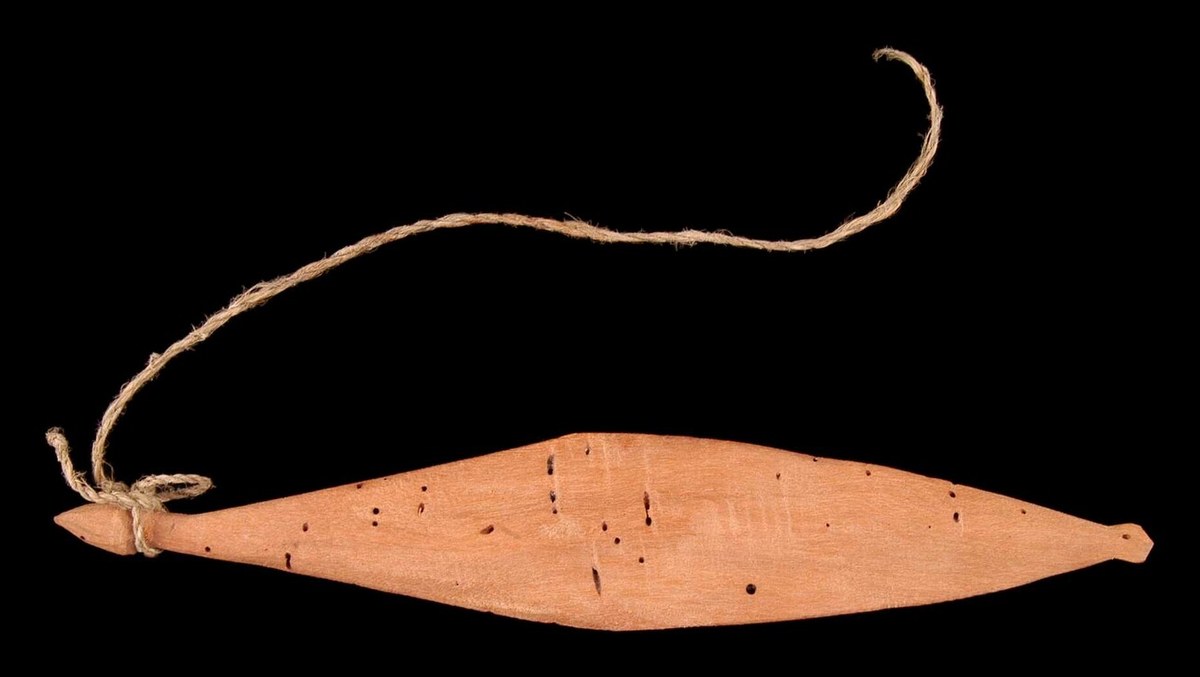
mēromēro
Source term: Schwirrholz
mēromēro: the Campa (Asháninka) name for the bullroarer, from Tessmann's list of their games; his German Schwirrholz is literally 'whirring wood'.
Among the Campa — the Asháninka of Peru's Selva Central — the bullroarer lived in the nursery, on both sides of the line between delight and dread. As mēromēro it was a plaything, alongside balls plaited from maize husks; it was also the bogey, whirled to frighten the smallest children. Bigger children, the ethnographer Günter Tessmann adds, graduate to stinging nettles and the rod, their shirts stripped off first.
Sind die Kinder klein, so werden sie mit dem Schwirrholz (das auch Spielzeug ist) erschreckt. Dabei sagt man ihnen, der Jaguar käme.
When the children are small they are frightened with the bullroarer (which is also a toy). As it sounds they are told the jaguar is coming.
Tessmann, Die Indianer Nordost-Perus (1930), pp. 99-100
Particulars
- Function
- Small children are frightened with the bullroarer — told the jaguar is coming as it sounds — and it is also a toy, listed among Campa games as mēromēro.
Sources
- Günter Tessmann, Die Indianer Nordost-Perus: Grundlegende Forschungen für eine systematische Kulturkunde (Hamburg: Friederichsen, de Gruyter, 1930), p. 92, pp. 99-100 View
- Handbook of South American Indians, vol. 3 (1948), pp. 546, 548, digesting Tessmann
- Otto Zerries, 'The Bull-roarer among South American Indians,' Revista do Museu Paulista n.s. 7 (1953), pp. 287, 296
- Karl Gustav Izikowitz, Musical and Other Sound Instruments of the South American Indians (1935), pp. 212-213