No. SA-Z1953-016
Baniwa bullroarer and Botuto/Jurupari context
Brazil; Colombia; Venezuela · Northwestern Brazil · Rio Negro · South America
Function not recorded
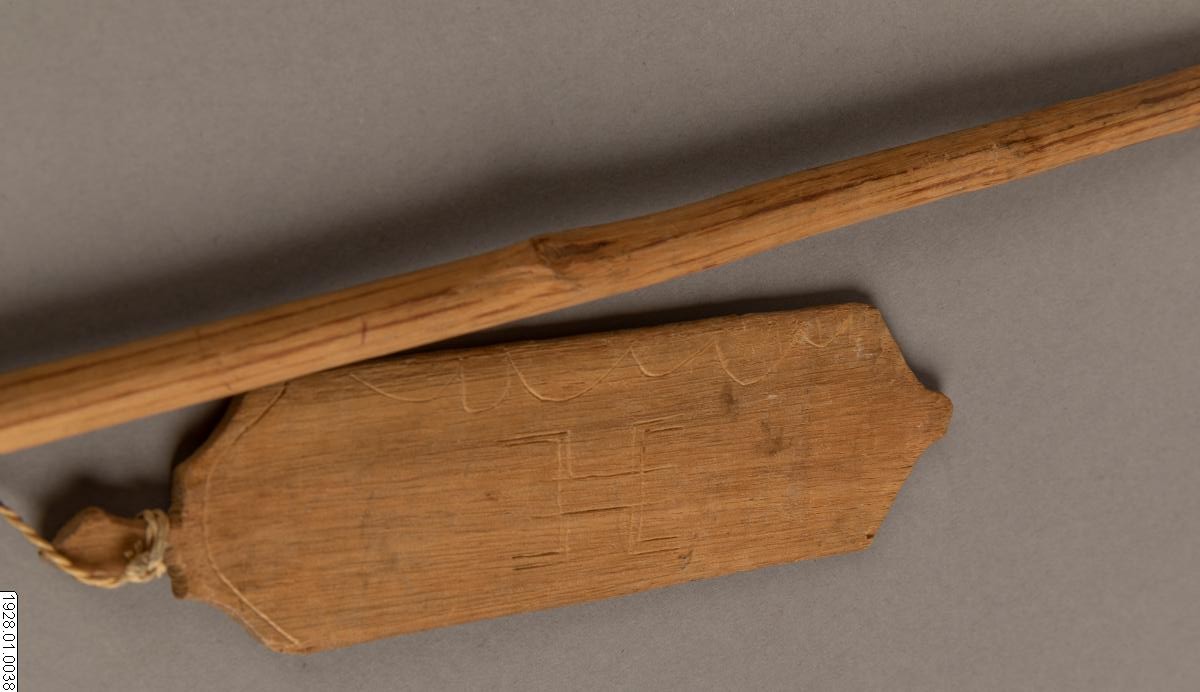
Source term: Schwirrgerät / Schwirrholz / bullroarer
Schwirrgerät / Schwirrholz (German): bullroarer. Jurupari / Yuruparí (regional vernacular) = Kuwai (Baniwa): the male-initiation cult whose sacred voice is carried by paxiuba-palm flutes and trumpets, forbidden to the sight of women. Botuto: a large earthenware ritual trumpet of the Orinoco (a distinct instrument, not a bullroarer).
The Baniwa had the bullroarer; what they swung it for is lost. The upper Rio Negro is the heartland of the Kuwai or Jurupari (Yuruparí) cult, in which a sacred voice is barred from women and revealed only to initiated men, and there the voice belongs above all to the great paxiuba-palm flutes and trumpets, said to be the body of a slain creator-child. The whirled slat was no stranger to that ensemble: across the Vaupés the Tukanoan Desana swung a bull-roarer they called the horsefly as one of the voices of the Sun Father beside the yuruparí flutes. Among the Arawakan Baniwa, though, it has never been seen in the cult. In the Tatuyo telling those instruments are themselves born of a swallowing: initiate boys who broke a food taboo are devoured by the anaconda Pohé-piné, who is made to vomit up their bones and is burned, and from his ashes grows the palm from which the sacred instruments are cut — a Vaupés myth catalogued by Yuri Berezkin. Older writers made the blade itself Jurupari's voice, forbidden to women on pain of death; Otto Zerries, who followed the bullroarer across the whole continent, expected that among the Baniwa it spoke for Jurupari beside the paxiuba flute.
Unfortunately, I could not find out any connection between the bull-roarer and the cult of the so-called Jurupari in northwestern Brazil, neither in Coudreau nor anywhere else in the literature dealing with the subject.
Otto Zerries, The Bull-roarer among South American Indians (1953), p. 285
Particulars
- Function
- Not recorded.
Sources
- Otto Zerries, “The Bull-Roarer among South American Indians,” Revista do Museu Paulista, n.s. VII (1953), pp. 285–286, 294–295 View · archived
- Izikowitz, Musical and Other Sound Instruments of the South American Indians (1935), p. 209
- Loeb, Tribal Initiations and Secret Societies, University of California Publications in American Archaeology and Ethnology 25(3) (1929):249–288, p. 281 n. 104; via Briffault, The Mothers, vol. 2 (1927), p. 546, citing Coudreau, La France équinoxiale, vol. II (1887), p. 186 ff.; Zerries treats this chain as unverifiable
- Humboldt (1860), vol. III, botuto trumpet comparison