No. NA-S1952-005
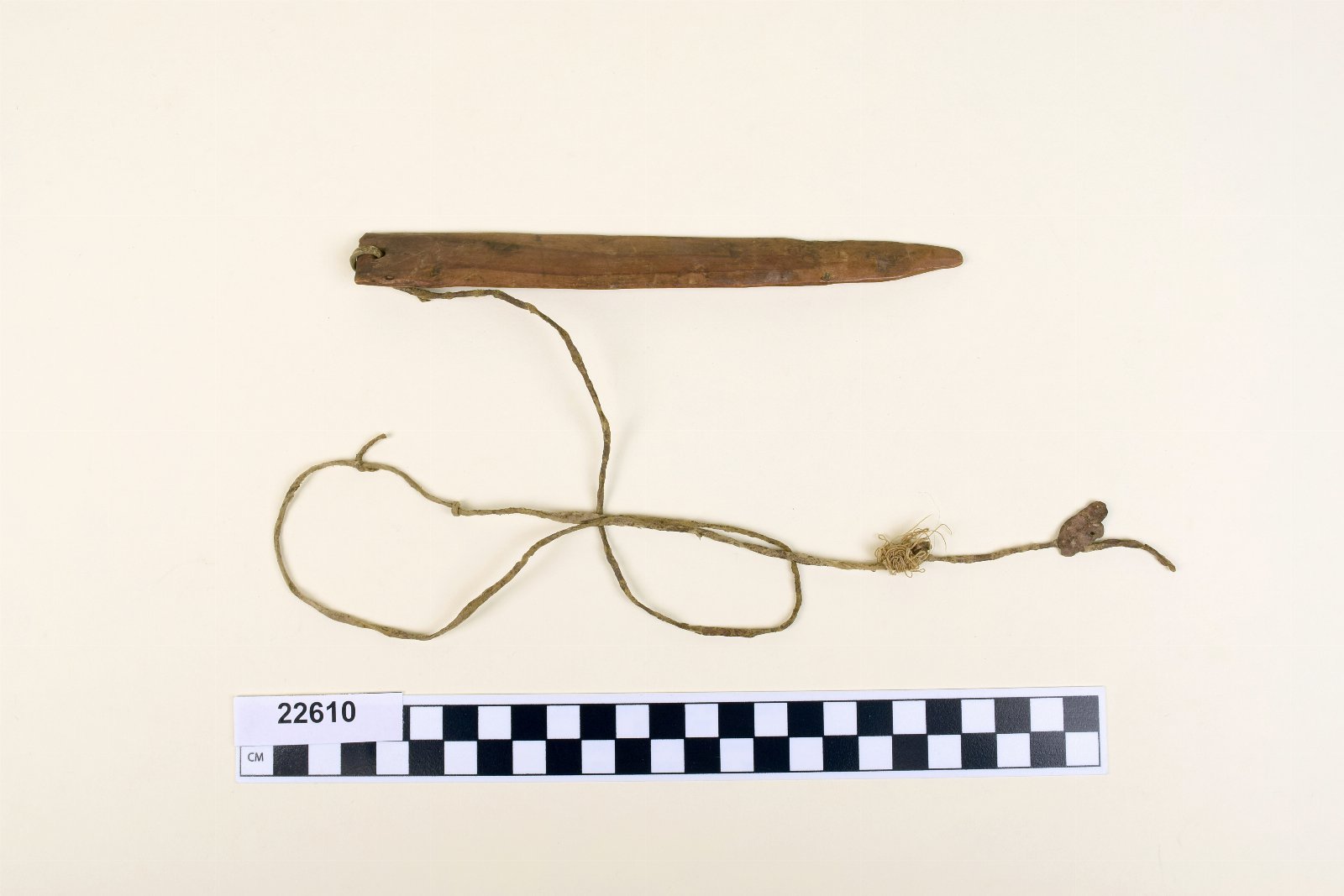
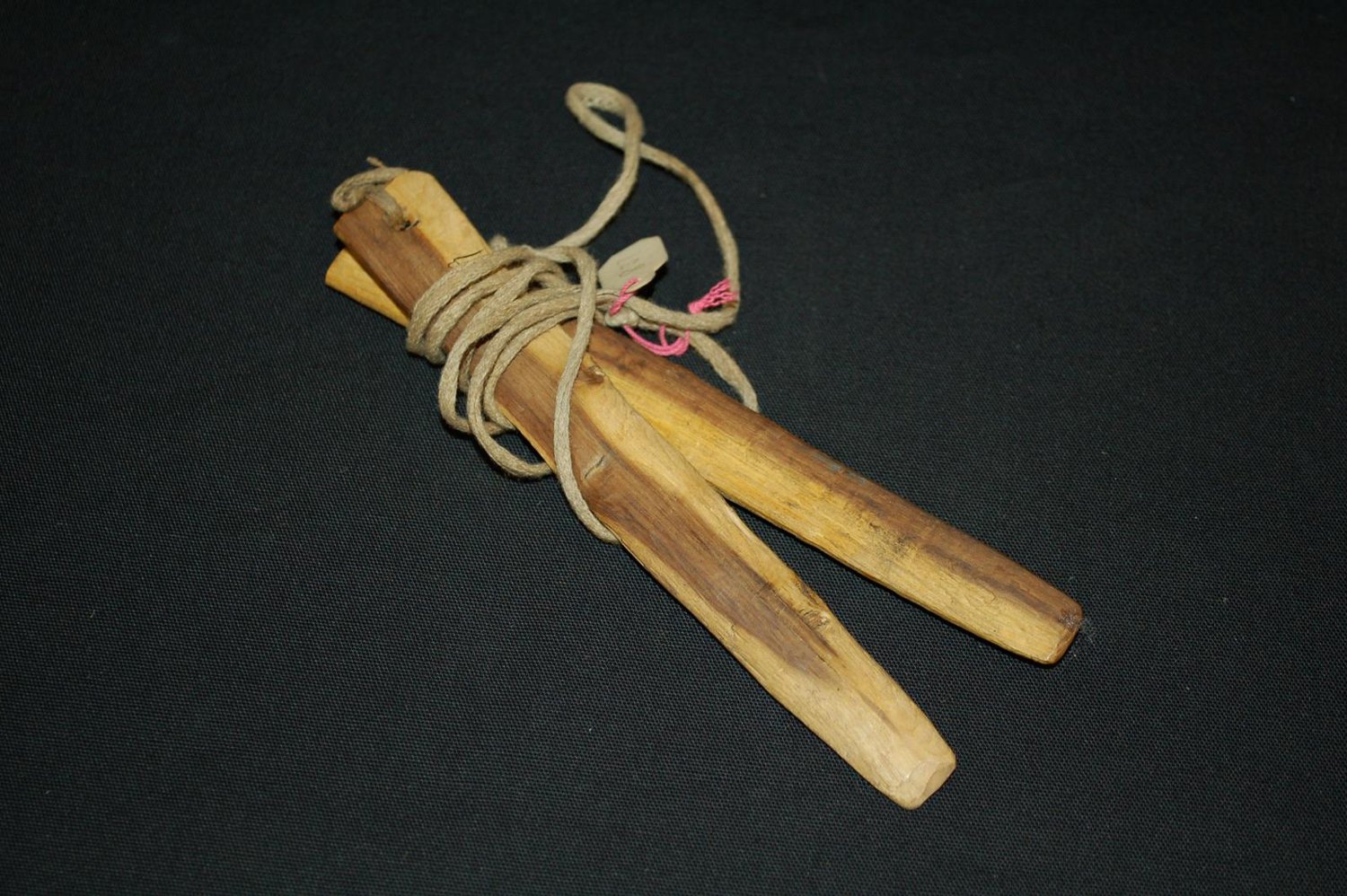
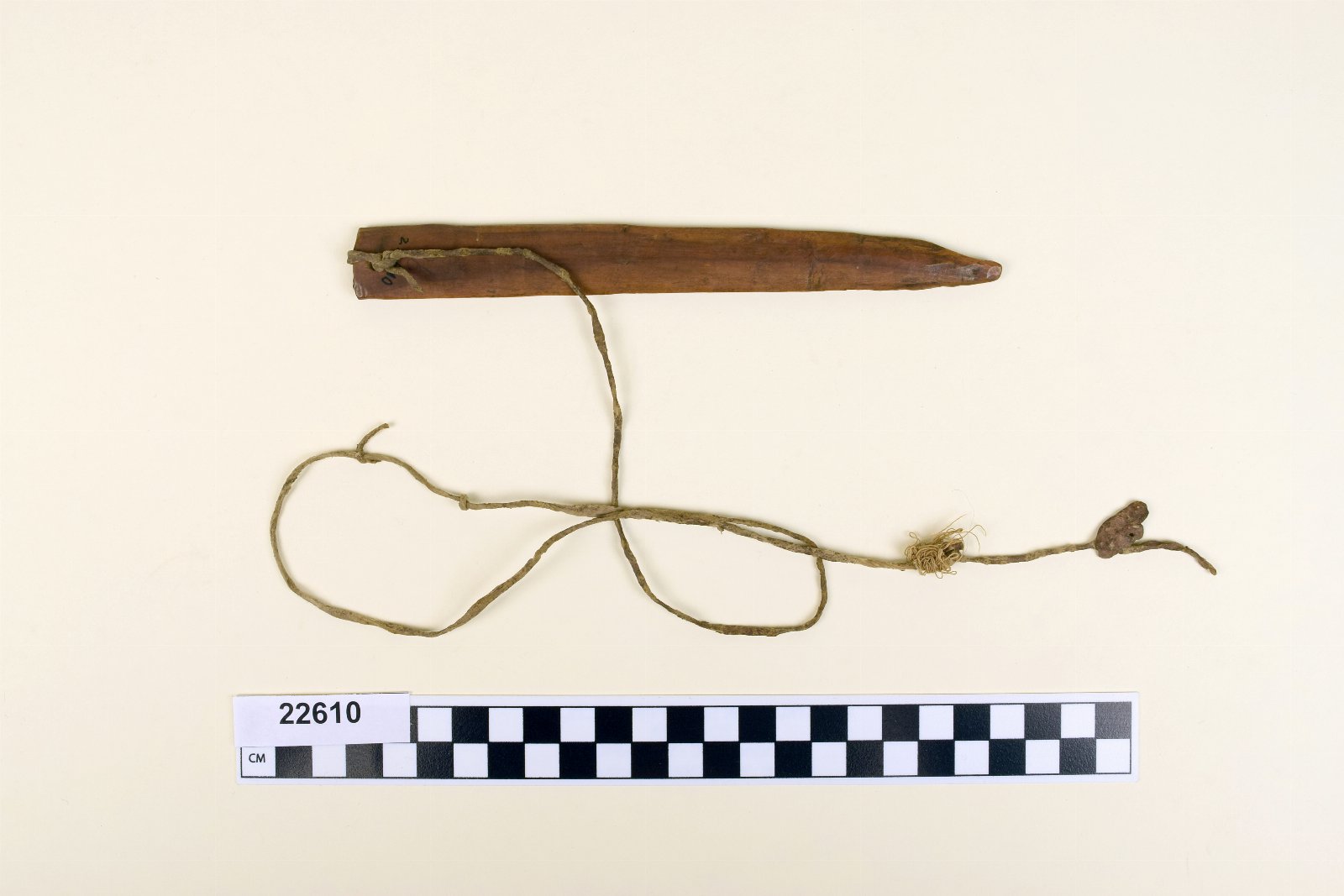
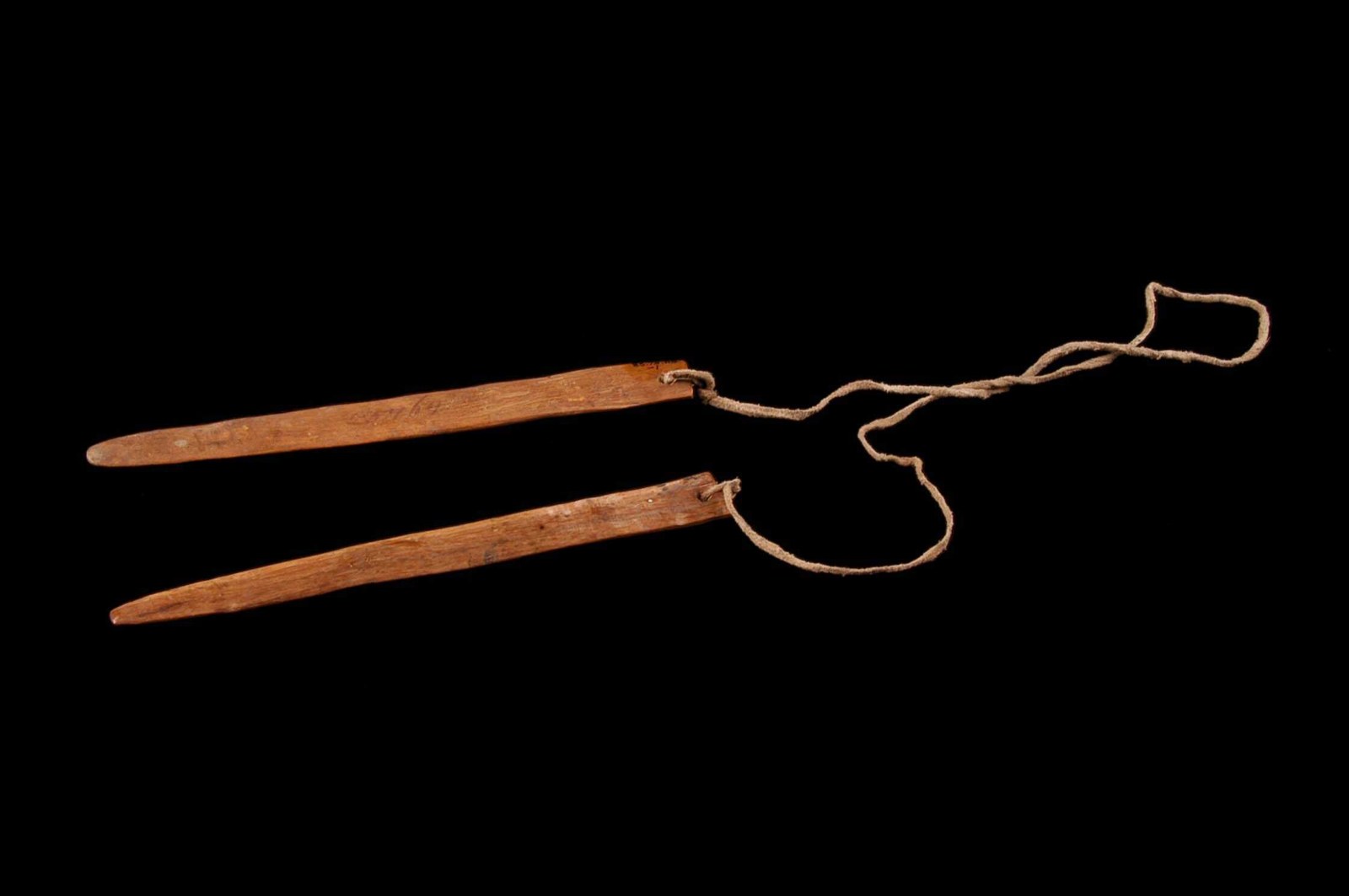
Zuni ritual-warning bullroarer
United States · Pueblo · Southwest · North America
Sacred / spirit
Nu'nu Nan'ne / thlem-tum-a-nv-nai / Towokpi
Source term: rhombus / sounding slat
One morning in the early 1880s Frank Cushing heard a deep whirring noise and ran out to find three Bow priests in plumed helmets carrying a ferocious war-god idol down the street, one man twirling a sounding slat behind them, while hundreds of Zuni climbed to the rooftops to bow their heads and scatter prayer-meal. What Cushing was not told, Matilda Coxe Stevenson later set down: the rhombus is whirled 'to create enthusiasm among the u'wannami' — the rain-makers, who pour water through the cloud masks, the clouds themselves being the breath of the gods. The whirler is nearly always a warrior. Bow priests sound it while the War Gods are honored to intercede for rain; a fraternity warrior whirls it before the altar 'calling the clouds to gather quickly'; in the Great Fire Fraternity the warrior speaks in whispers to his rhombus and keeps it by his head when he lies down. When Ko'loowisi, the Plumed Serpent of the western waters, came for the children's initiation, even his roar was a great shell blown out of sight. Later, in the plaza, women of rank watched from houses and galleries, others from the rooftops, as the warrior of the Ko'yemshi whirled the rhombus to call the rain-makers.
The use of the rhombus and flute at this time is to bring snows and rains quickly. … should one cough, the flutist plays and the warrior whirls his rhombus, and every one must immediately rise and stand until the music ceases…
Stevenson 1904, The Zuñi Indians, 23rd ARBAE, p. 516 n.
Particulars
- Object
- Penn Museum 22610 is a Zuni wooden blade, 18.26 × 1.75 × 0.48 cm, with buckskin and cotton string through a terminal hole. Pitt Rivers holds three more Zuni wooden blades — 1903.129.4.1 (159 x 13 mm, squared at one end and rounded at the other, with its whirling string still coiled), 1917.53.465 (167 mm, string surviving) and 1923.21.5 (150 x 23 mm). Cambridge MAA 1924.125 is a two-piece stick-and-blade rig 'made by a well known Indian, Zuni Dick', the one Zuni bullroarer in any register with a named maker. Harvard Peabody 84-45-10/33576, collected at Zuni by Frank Hamilton Cushing in 1883, is a carved wooden blade 11.6 × 1.7 × 0.6 cm with a red zigzag down one side and a leather cord, catalogued as a whizzer used in the rain dance to call the rain and perhaps by a Bow Priest.
- Function
- Whirled by Bow priests and fraternity warriors to summon the u'wannami rain-makers and gather the clouds; sounded in War-God processions, Sha'lako water-fetching, and fraternity rain retreats; also sounded in the plaza ceremonies accompanying voluntary initiation into the Ko’tikili.
Sources
- Matilda Coxe Stevenson, The Zuñi Indians, 23rd Annual Report of the Bureau of American Ethnology (1904), pp. 94–95, 102, 104, 106, 115–116, 128, 492, 516–517 View
- Frank Hamilton Cushing, 'My Adventures in Zuñi', part III, Century Magazine (May 1883) View
- Theodore A. Seder, 'Old World Overtones in the New World', University Museum Bulletin 16(4) (1952), pp. 51–54 View · archived