No. REICHEL1971-001
Desana nurá-mee bullroarer, Vaupés
Colombia · Vaupés · upper Rio Negro cultural region · South America · Northwest Amazonia
Sacred / spirit
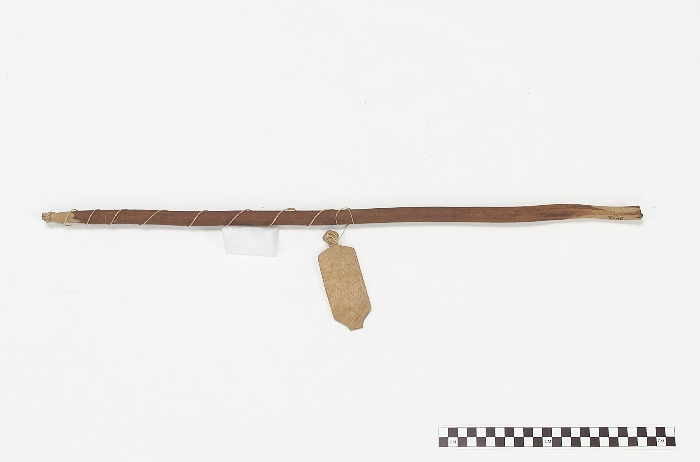
nurá-mee
Source term: bull-roarer / horsefly
nurá-mee = horsefly, from nurirí 'to bite / to insert the penis' + -mee 'the power to produce something' (Reichel-Dolmatoff 1971, p. 59).
In Desana cosmology the Sun Father committed the first sin: incest with his own daughter, at Wainambí Rapids — and women menstruate to this day, the myth says, so the crime is never forgotten. Repenting, the Creator made its prohibition his principal law, and the bullroarer is his voice still enforcing it. The Desana named the whirled slat nurá-mee, 'horsefly,' from a verb meaning both to bite and to insert the penis: the buzzing, stinging insect stands for the man who takes any woman, and in the chaos after Creation the beings who wrecked the first society 'had a language like the buzz of an insect.' When the men killed the horseflies, the norms began to rule. So the nurá-mee's threatening drone — with the yuruparí flutes and the stick-rattle, 'the voices' that warn of the dangers of incest — is the repentant Sun exhorting his children to marry out. By Reichel-Dolmatoff's day it was falling silent.
This wooden slat, suspended from a string, is swung rapidly in a circle to make a distinctive noise. It has religious significance as 'the voice of the power of the Sun' through which the Creator exhorts society to observe the rules of exogamy.
Gerardo Reichel-Dolmatoff, Amazonian Cosmos (1971), p. 59.
Particulars
- Object
- Wooden slat on a string.
- Function
- Sacred sound treated as 'the voice of the power of the Sun' exhorting the rules of exogamy — the law the Sun Father instituted in repentance for his own primordial incest; grouped with the yuruparí flutes and stick-rattle as 'the voices' that warn of the dangers of incest; already falling into disuse at the time of fieldwork.
Source
Gerardo Reichel-Dolmatoff, Amazonian Cosmos: The Sexual and Religious Symbolism of the Tukano Indians (1971), p. 59